

WinKeyFinder
About WinKeyFinder
WinKeyFinder reads the product key the operating system was installed with and shows it to you. That key lives in the registry in a scrambled form. On machines that came with the system preinstalled a second copy sits in the firmware, and the program reads both. It does the same for an installed copy of Office where the installation left a key behind, and it reads the saved passwords of wireless networks the machine has joined. Copy, save, print or encrypt what it finds, and it is done.
The job comes up at one moment. A machine is about to be wiped, sold or rebuilt, and the sticker with the key is long gone. ProduKey does the same job with a longer list of products and a plainer table.
WinKeyFinder does it with a single window, a couple of extras that suit the moment of reinstalling, and a file format for keeping the result somewhere safe.
Reading the key from the registry and the firmware
Run WinKeyFinder and the key appears in the main box, decoded from the registry value where the installer stored it. On a machine bought with the system already on it, a key is also written into the firmware so that a clean reinstall activates on its own.
A separate button reads that one. The two are often different, and the firmware key is the one that matters for a reinstall on that hardware. Product ID and edition are shown beside it, with the owner and organisation names, which can be edited from the same screen.
Below the key sits a summary of the processor, memory and installed build, handy when the reinstall media has to match. An activation status check reports whether the current installation is activated.
Office and Wi-Fi
Click the Office button and WinKeyFinder looks for an installed suite and decodes its key from the registry. That works for older releases that stored a full key. Newer releases store only the last five characters, or nothing at all when the suite was activated through an account.
The program reports what it finds, which may be a partial key or a message that none is stored. It also shows one Office key when several suites are installed, so a machine with two versions needs a second tool.
The wireless password retriever lists the networks the machine has saved and the password for each, useful the day before a rebuild. Clear them from the saved file afterwards.
Saving the result, and the Change Key button
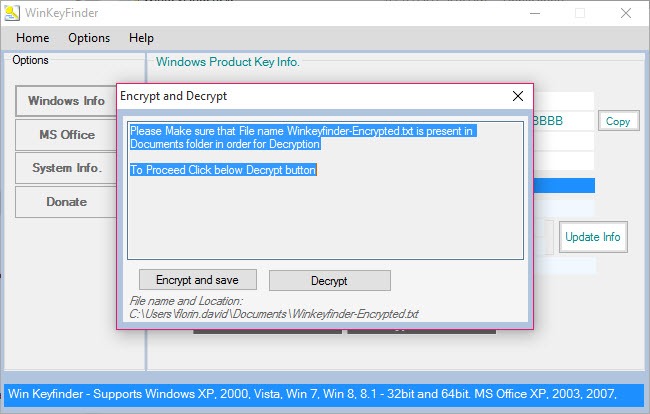
Save writes the key and the machine details to a text file, and Print sends the same to a printer for the drawer where the sticker used to be. Encrypt saves the file with a password so that a copy left on a shared drive is not readable to anyone who opens it, and a matching decrypt option reads it back.
Change Key exists for the case where a different key has to be entered on a system that is not yet activated. It is greyed out on activated installations, where the system’s own activation settings are the route.
The limits, and the false alarm
WinKeyFinder reads what is stored, and nothing more. An installation activated by a digital licence tied to the hardware or an account may show a generic key that will not activate another machine. An Office suite activated online often has no key to find. Neither is a fault in the program. Both are how the products work, and a key reader that also reads an offline drive has the same limits.
Programs that read keys look, to an antivirus, like programs that steal them, and heuristic scanners sometimes flag this one on launch. Run it, note the key, and close it.
Conclusion
WinKeyFinder is for the person about to reinstall, sell or hand down a computer who needs the key written down first. The Wi-Fi passwords and the machine’s details land on the same sheet. For that afternoon it does everything required in one window.
Anyone auditing many machines or many products will want a tool with a longer product list and a table. This one is for the one machine in front of you, and it is quick and quiet at that.
Pros & Cons
- Reads the installed key from the registry and the preinstalled key from the firmware
- Office key retrieval where the installation stored one
- Wireless network passwords listed for a rebuild
- Save or print the result, or encrypt it with a matching decrypt
- Runs from a single file with nothing to install
- Only one Office key shown when several suites are installed
- Newer Office and account-based activations yield partial keys or none
- Change Key works only on unactivated installations
- Heuristic antivirus warnings on launch
Frequently asked questions
The registry holds the key the installer used, which on preinstalled machines is often a generic one. The firmware key, read with its own button, is the one tied to the hardware and the one to keep for a reinstall.
Recent Office releases store only the last five characters in the registry, and account-activated installations store none. The program shows what is there. Sign into the account that owns the suite to reinstall it instead.
Only on an installation that is not yet activated. On an activated system the button is disabled and the key is changed through the system's own activation settings.


