

Tux Paint
About Tux Paint
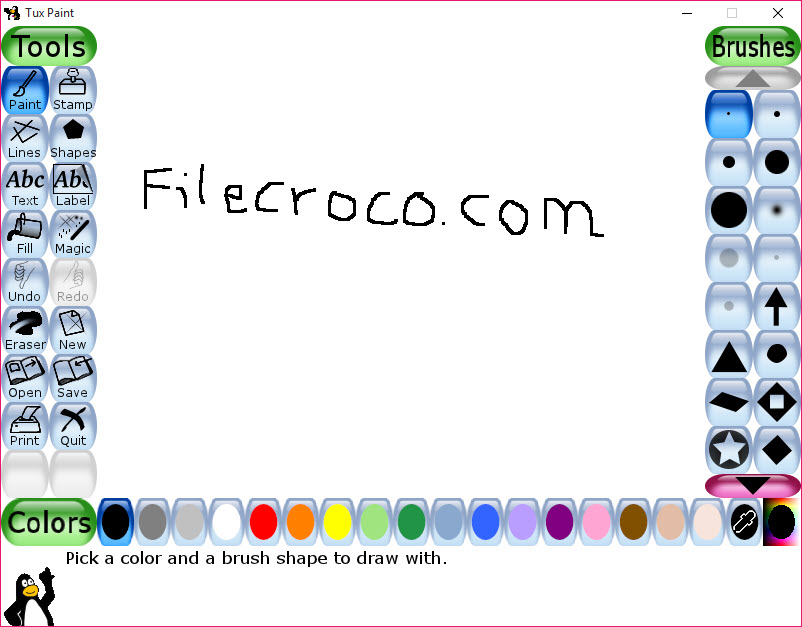
Tux Paint is a drawing program for children roughly three to twelve, and every decision in it follows from that. The tools are large buttons with pictures and names. The canvas is a fixed size that fits the screen. Saving asks no questions, and opening a picture shows thumbnails rather than filenames. Every action makes a sound, a penguin in the corner explains what each tool does in a sentence, and there is a very large Undo.
Behind the friendly face sit a paint brush with dozens of shapes and a stamp collection with hundreds of images. A Magic menu of effects ranges from rainbows to a working kaleidoscope, and a configuration tool serves the adult who sets the machine up.
That last piece is what separates it from a toy. A parent or a teacher can lock the program into full screen, remove the Quit and Print buttons, choose which stamps and effects appear, and hand the computer over. The child never sees a file dialog, never lands on the desktop by accident and never finds a menu with a setting to break.
Krita and the adult painting programs wait at the other end of childhood. Tux Paint is where a great many people first drew on a screen, and it has kept its shape because the shape was right.
The tools a child sees
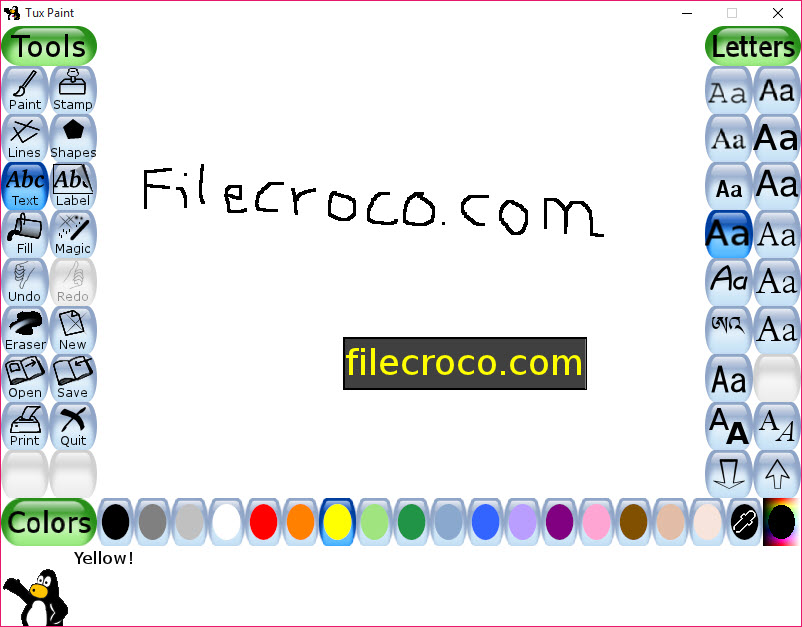
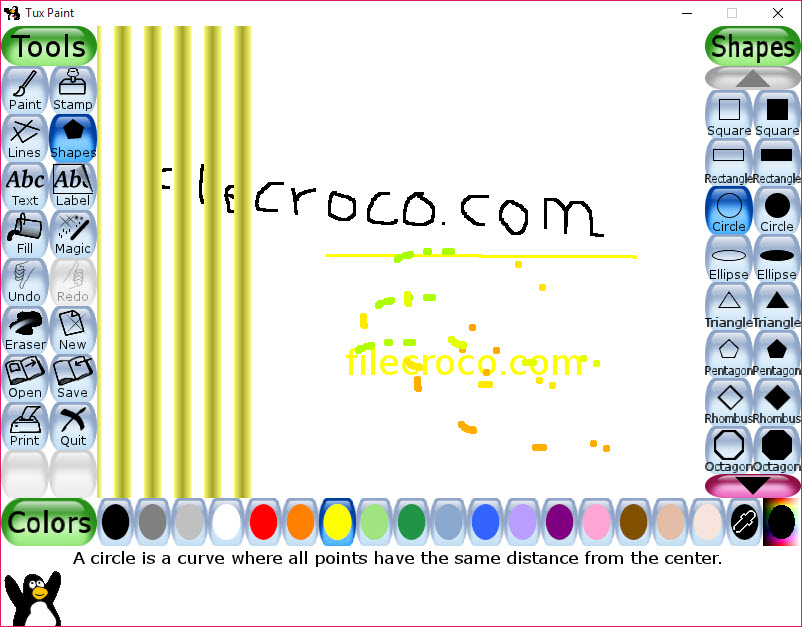
Paint in Tux Paint offers brushes from a plain round dot through calligraphy shapes and sprays to animated brushes that cycle through frames as you drag. Each takes any colour from a palette or a picker. Lines draws straight lines, and Shapes lays down filled or outlined circles and squares, triangles and stars, rotated before they are set. Text and Label type words onto the picture in a range of child-friendly fonts, with Label leaving the text editable afterwards.
Fill floods an area, with modes that fill by shape, by brush or with a gradient. Eraser and Undo speak for themselves, and Undo goes back a long way.
Stamps are rubber stamps, hundreds of them, animals and vehicles, food and letters and seasonal pictures, many with a sound when placed and a spoken word in the chosen language. They flip and resize before stamping, so one picture of a cat becomes a dozen cats of different sizes facing different ways.
It is the tool younger children spend the most time on, and the one adults find most surprising in scope.
The Magic menu
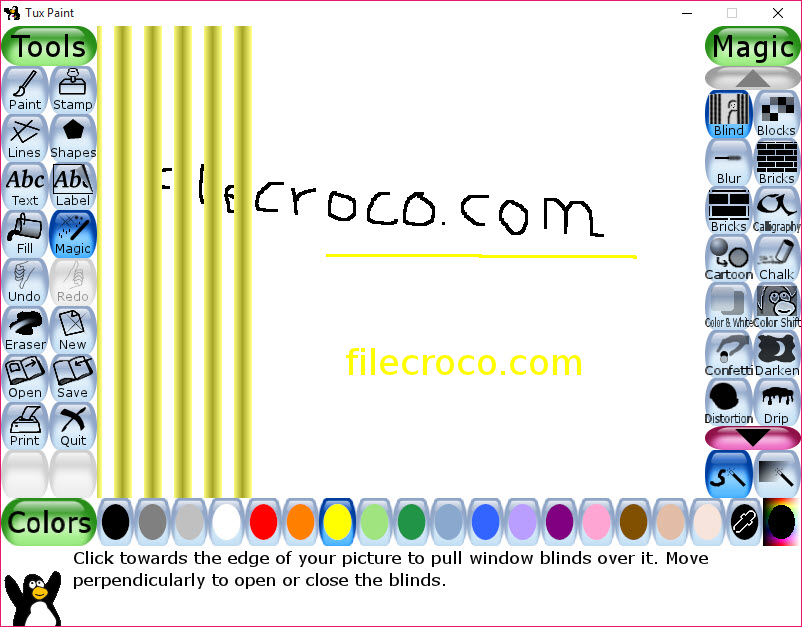
Magic is where Tux Paint stops being a colouring book. Rainbow paints in shifting colours. Blur, Sharpen, Emboss and Cartoon rework what is already drawn. Kaleidoscope draws in four mirrored places at once. Bricks, Grass, Waves and Puzzle add textures and distortions. Fill with a pattern, tint a region, shift the whole image, draw with light or with chalk or with foam. There are more than a hundred, each a small program in its own right, and the list grows with the project.
Some are painting tools that apply as you drag, and some transform the whole picture with one click, and the distinction is marked on each button. A child who has exhausted the stamps discovers Magic and stays for a year.
An adult who thought this was a simple program discovers Magic and goes quiet for a while too, before going back to a painting program with pressure-sensitive brushes.
Saving and opening without dialogs
Save in Tux Paint has no dialog. Press it and the picture is stored, with a thumbnail. Press it again on a picture that was opened from a save and the program asks, with pictures rather than words, whether to replace the old one or keep both.
Open shows a grid of thumbnails of everything saved, and a slideshow plays a chosen set with a speed control, which is how a classroom shows the afternoon’s work on the projector. Erase in the Open screen removes a saved picture after a confirmation.
Starters and Templates give a child something to begin with, an outline to colour in or a background scene to draw over, and a set comes with the program with more available as packs. Pictures export to a folder as ordinary PNG files when an adult wants them elsewhere, and a simple image editor can crop or resize them afterwards.
Print sends them to a printer, where an adult has left that button visible.
The configuration tool for grown-ups
A separate program, installed alongside Tux Paint, sets everything the child should not touch. Full screen with no way out, or a window. Disable Quit, so the program runs until an adult closes it. Disable Print, or allow it only every few minutes. Enable or disable sound, stamps, the Magic tools individually, the Label tool and the mouse wheel.
Choose the language, the canvas size, and whether simple shapes and a simplified interface should replace the full set for the youngest users. Save locations can be redirected to a shared folder for a classroom.
Accessibility settings cover keyboard-only and joystick operation, a larger cursor, and an on-screen keyboard for the Text tool. Once configured, the program starts into its locked state every time, and the child’s computer becomes an appliance that draws. That is the feature schools install it for.
Where it stops
There are no layers, no selection tool, no copy and paste within a picture and no zoom. The canvas is one size, set by the adult, and pictures cannot be cropped or resized inside the program. The stamps and starters are fixed pictures, not editable clip art.
None of these are missing so much as deliberately absent, since each is a way for a young child to get lost. A child who needs them has outgrown the program and is ready for something with a menu bar, such as Paint.NET. Tux Paint does not try to be that program, and the two coexist happily on one machine for a few years.
Conclusion
Tux Paint is for parents and teachers of young children who want a drawing program that a five-year-old can run alone without landing anywhere they should not be. A ten-year-old still opens it for the Magic menu. The configuration tool is what makes it trustworthy on a shared machine, and the stamps and effects are what make it loved.
Children who ask for layers, selections or a zoom have graduated, and the program makes no attempt to keep them. For the years before that it remains the best first canvas there is.
Pros & Cons
- Large picture buttons, spoken help and sounds suited to young children
- Hundreds of stamps with sounds, flipping, resizing
- More than a hundred Magic effects from rainbows to kaleidoscope
- Save and Open with thumbnails and no file dialogs
- Configuration tool locks the program into a safe full-screen state
- Starter pictures and templates to colour or draw over
- No layers, selection, zoom or copy and paste
- Fixed canvas size with no cropping or resizing
- Stamps and starters cannot be edited
- Adult settings live in a separate program rather than a menu
Frequently asked questions
Open the configuration tool, enable full screen and disable the Quit button. The program then runs until an adult closes it with the keyboard shortcut or from the configuration tool.
In a folder inside the child's profile, as PNG files with thumbnails. The configuration tool can redirect saving to any folder, including a shared one for a classroom, and the Open screen shows everything saved there.
Yes. Stamp packs install alongside the program and appear in the Stamps tool, and any PNG image dropped into the stamps folder becomes a stamp.
Yes, with the simplified interface enabled in the configuration tool, which reduces the tool set to the basics and enlarges the buttons. Older children can use the full set.


