

Trust.Zone VPN
About Trust.Zone VPN
Trust.Zone VPN is a privacy-first VPN client that leads with anonymity rather than a wall of features, routing your traffic through encrypted servers in dozens of countries while making a point of keeping no activity logs.
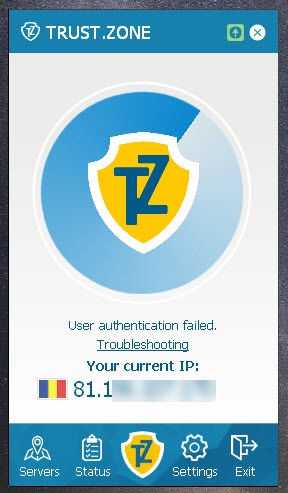
The client itself is deliberately plain, a location list, a connect button, a status readout, and the pitch underneath is that what you do while connected leaves no record on the provider’s side. For people whose main reason to run a VPN is not being tracked, that no-logs stance is the headline, and it shapes everything about how the service presents itself.
The framing worth having up front is that this is a lean, focused service rather than a maximalist one. It covers the fundamentals competently, encryption, a decent spread of server locations, the OpenVPN protocol underneath, without stacking on the extras that heavier providers advertise.
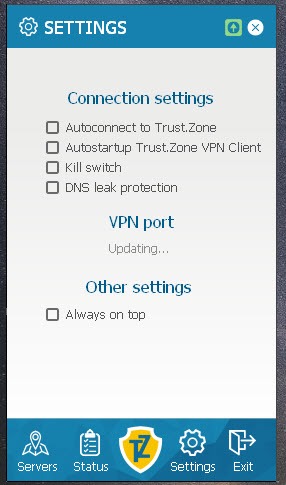
That makes it approachable and quick to use, and it means power users hunting for a specific advanced tool will sometimes find it thin. Whether that balance suits you comes down to how much you value simplicity and the privacy posture over breadth.
The no-logs posture and where the servers sit
The claim the whole service rests on is that it doesn’t keep logs of what you do while connected, no browsing history, no record of the sites you reach, so there’s nothing to hand over even if someone asks. The provider’s jurisdiction, outside the reach of the major data-sharing alliances, is part of that pitch, since where a VPN provider is legally based affects what it can be compelled to retain and disclose. Privacy-conscious users weigh jurisdiction as heavily as any feature, and this service leans on that as a selling point.
The server network spans a solid range of countries, enough to appear in most regions a user would want and to pick a nearby server for speed. It’s not the sprawling several-thousand-server network the largest providers tout, but for the everyday jobs of encrypting a connection and shifting apparent location, the coverage is adequate.
A privacy-focused rival like hide.me VPN plays in the same no-logs territory with its own audited stance, and comparing their jurisdictions and policies is a reasonable part of choosing.
Connecting and the everyday use
In daily use Trust.Zone VPN stays out of the way. Pick a country, connect, and the encrypted tunnel comes up with a clear indicator, which covers the two things most users actually want, protection on untrusted networks and a change of apparent location. Public Wi-Fi at a café or airport becomes far less exposed with the tunnel up, since the encryption shields the traffic an open network would otherwise leave readable.
The protocol foundation is the standard, trusted OpenVPN, so the encryption under the plain interface is the real thing rather than something proprietary and unexamined.
For region-shifting, the service handles the general case of appearing elsewhere, though the specific fight to unblock every streaming catalog is an arms race that even dedicated services win only some of the time, and expecting flawless streaming access from any single provider is optimistic.
Where the leanness shows
The honest limits of Trust.Zone VPN track its focused design. The client offers fewer of the power-user controls, the elaborate split tunneling, the deep protocol tuning, the extensive server-load dashboards, that a feature-dense service builds its reputation on. Some protections that privacy-serious users treat as essential are present in basic form rather than the exhaustive implementations found elsewhere, and anyone building a hardened setup should check exactly what’s included before committing.
The comparison across the field frames it fairly. A maximalist service like NordVPN offers the sprawling network, the specialty servers, and the security extras that this leaner client omits, at the cost of a busier experience.
A simpler rival such as Ivacy competes on a similar simple footing with its own feature mix. This service’s distinctive angle is the anonymity emphasis, and if that resonates more than a long feature checklist, it earns its place.
Conclusion
Trust.Zone VPN suits the user whose first priority is not being logged or tracked, and who prefers a clean, no-fuss client over a dashboard full of switches. The no-logs posture, the privacy-minded jurisdiction, and the trusted OpenVPN foundation make it a sensible pick for straightforward, privacy-focused protection on everyday and untrusted connections.
Power users wanting the deepest feature sets and the largest server networks will find it too lean and have richer options built for them. As a privacy-led, uncomplicated VPN that knows its priorities, though, it holds a clear and defensible spot in a crowded field.
Pros & Cons
- No-logs posture with a privacy-friendly jurisdiction as the core selling point
- Built on the mature, trusted OpenVPN protocol
- Plain, quick client that connects with minimal fuss
- Adequate spread of server countries for everyday region-shifting
- Effective at encrypting untrusted public Wi-Fi connections
- Leaner on advanced power-user controls than feature-dense rivals
- Smaller server network than the largest providers
- Streaming-unblocking is inconsistent, as with most VPNs
- Some protections are present in basic rather than exhaustive form
Frequently asked questions
That's the central claim, that it retains no record of your activity while connected. Its jurisdiction outside the major data-sharing alliances supports the stance, and privacy-focused users treat that combination as its main draw.
It's built on OpenVPN, the mature open standard trusted across the security industry, so the encryption beneath the simple interface is sound and well understood.
It handles general region-shifting, but reliably unblocking specific streaming catalogs is an ongoing battle that no VPN wins every time. Treat streaming access as a bonus rather than a guarantee.
It's leaner, trading the sprawling networks and advanced feature sets of the largest providers for simplicity and a strong privacy posture. The right choice depends on whether you value anonymity and ease over a long feature list.
Yes, encrypting untrusted networks is one of its clearest uses. With the tunnel active, the traffic an open hotspot would otherwise expose is shielded.


