

Timer Resolution

 (1,029 votes, average: 3.98 out of 5)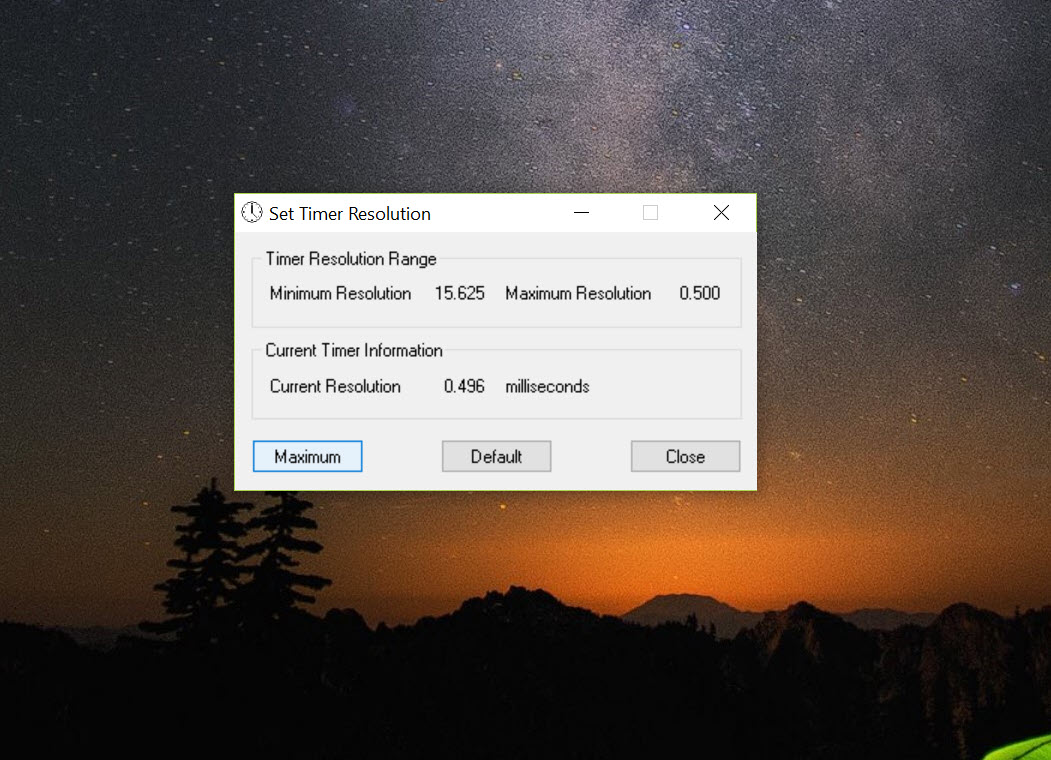
About Timer Resolution
If you’ve ever fallen down the rabbit hole of optimizing your PC for competitive gaming, chances are you’ve come across the term “timer resolution” thrown around in Reddit threads, BlurBusters forums, and YouTube tutorials promising lower input lag in Fortnite, Valorant, or whatever shooter you’re trying to climb in. Timer Resolution, the small Windows utility developed by Lucas Hale, sits right at the heart of those discussions.
The premise is simple enough: Windows by default uses a timer interval of 15.625 milliseconds, which controls how often the system checks on running tasks. Lower that number and, in theory, your applications get more frequent attention from the CPU, which can translate to smoother frame pacing, reduced input latency, and a more responsive feel overall. Whether the difference is dramatic or placebo depends on who you ask, but the tool itself takes seconds to use and costs nothing.
What timer resolution actually does
Without getting too deep into Windows internals, every operating system has what’s called a system timer, which determines the smallest unit of time the OS can schedule tasks against. On Windows the default is roughly 15.625ms, although individual applications can request a lower interval when they need higher precision.
Timer Resolution lets you force a custom timer interval globally, typically pushing it down to 0.5ms or 1ms. The result is that time-sensitive operations, things like game input handling, audio buffering, and frame timing, get checked more frequently by the kernel. For gaming specifically, this can make mouse movement feel snappier and reduce the kind of micro-stutter that drives competitive players up the wall.
In practice, the noticeable difference depends heavily on your hardware, your game, your monitor’s refresh rate, and frankly, your own sensitivity. Some players swear by it. Others don’t feel a thing. But because the tool is free and lightweight, trying it for yourself is the easiest way to know.
A tiny utility with one job
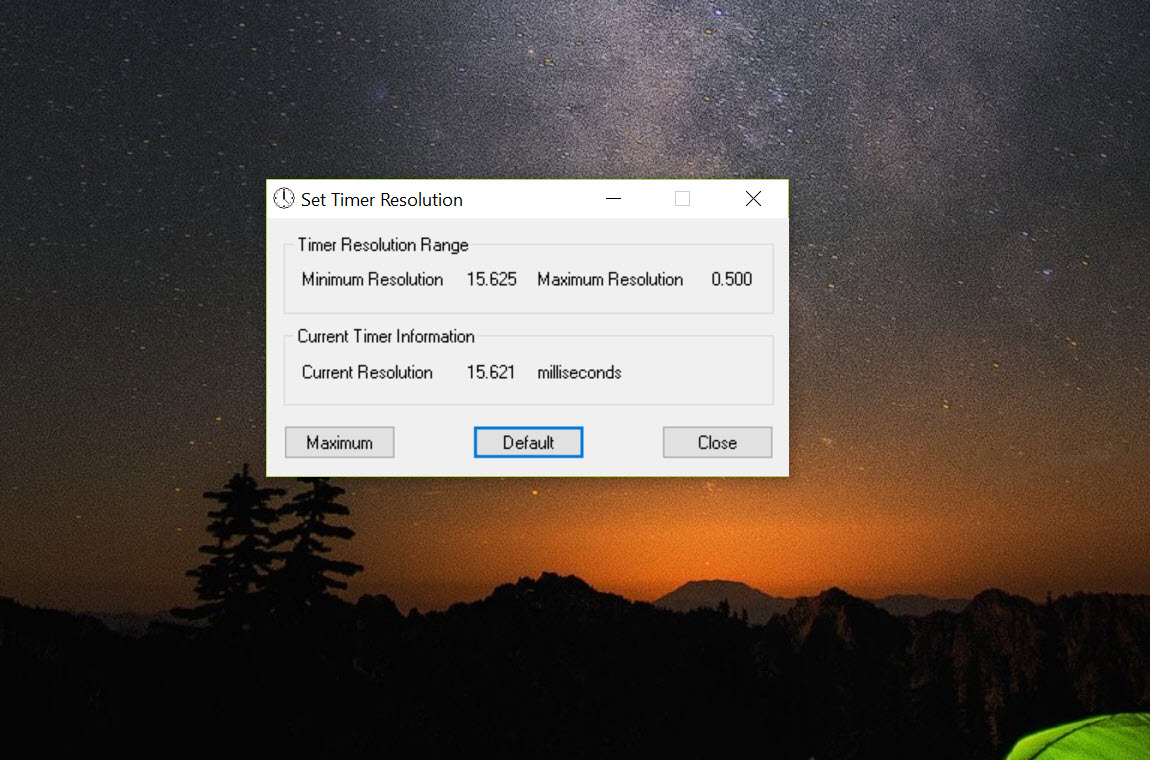
The interface of Timer Resolution is, to put it generously, minimal. You get a small window showing the current timer resolution, the maximum and minimum supported values for your system, and a single button to apply a custom interval. That’s it. No settings page, no configuration wizard, no premium tier nagging you to upgrade.
You launch the app, the system reports your current timer values, and you click to set the resolution to whichever value you want, usually the minimum your hardware allows. The change takes effect immediately and stays active as long as the application is running.
If you want it to apply automatically every time you boot, the typical approach is to add Timer Resolution to your Windows startup folder so it launches with the system and applies your preferred timer interval right away.
The Windows 10 rule change that complicated everything
If you’ve been reading about timer resolution online, you’ve probably noticed that some advice contradicts itself. That’s because Microsoft made a significant change in Windows 10 (specifically build 2004 and onward) that fundamentally altered how timer resolution requests are handled.
In short, before the change, a single application requesting a low timer resolution would lower it for the entire system. After the change, low timer resolution applies only to the application that requested it. This means a tool like Timer Resolution doesn’t affect global system behavior the way it used to, although it still works for the process making the request and for certain inherited contexts.
Bryan Dawson’s well-known blog post on the subject (titled “Windows Timer Resolution: The Great Rule Change”) goes into the technical details, and it’s worth reading if you want to understand exactly what’s happening under the hood. For most users, the practical takeaway is that Timer Resolution still has a measurable effect, but the “magic” of the tool lowering timer resolution system-wide is no longer guaranteed on modern Windows builds.
Why gamers in particular care about this
A quick scroll through Reddit’s competitive gaming subreddits reveals that Timer Resolution has a devoted following among Fortnite, Apex Legends, and CS2 players who chase every last millisecond of advantage. The reasoning is straightforward: in games where reaction time matters, even a tiny reduction in input latency can theoretically make a difference between landing a shot or missing it.
Whether placebo plays a role is a fair question, and most experienced players will admit it might. But the tool also has a measurable, non-placebo effect on certain audio production scenarios, where lower timer resolution can reduce buffer-related glitches in real-time audio applications. So even outside gaming, there’s a legitimate case for using it.
Lightweight, portable, and trustworthy
One of the genuine strengths of this software is how unobtrusive it is. The download is tiny, the executable runs without installation, and there’s no telemetry, no ads, and no bundled extras. Lucas Hale has maintained the tool for years, and the small but stable user base around it has plenty of independent verification that it does exactly what it claims.
For users who are cautious about running unknown utilities (and you should be), the source code situation around tools in this space has improved with community projects like the one on GitHub from valleyofdoom, which offer open-source alternatives. But the original Timer Resolution remains the most widely recognized version, and downloading it from the official site keeps things safe.
Conclusion
Timer Resolution isn’t a magic bullet for input lag, and anyone selling it as one is overstating its capabilities, especially given the Windows 10 changes that limit its global effect. But for what it is, a tiny, free utility that takes about ten seconds to use, it’s worth having in the toolkit of any competitive gamer or audio enthusiast who wants to squeeze every drop of performance out of their setup.
Whether you’ll feel a meaningful difference depends on too many variables to predict, but the cost of finding out is essentially zero. And in a category full of paid “gaming booster” tools that mostly do nothing useful, Timer Resolution stands out for being honest about its scope, free of marketing fluff, and focused on doing one specific thing as cleanly as possible.
Pros & Cons
- Tiny portable executable runs without installation
- Forces a lower timer interval for reduced latency in games and audio applications
- Free with no ads, telemetry, or bundled extras
- Easy to add to startup so the change applies automatically on boot
- Works on all modern Windows versions including Windows 11
- Useful for gaming, audio production, and any latency-sensitive task
- Backed by years of community discussion and verification
- Effect is significantly reduced on Windows 10 build 2004 and later due to Microsoft's rule change
- Real-world impact varies dramatically depending on hardware and use case
- Interface is barebones with almost no documentation built in
- No automatic startup configuration; users must manually add it to the startup folder
- Not a true "fix" for input lag in itself, just one piece of a larger optimization puzzle
Frequently asked questions
Yes, this software is widely used and has been around for years without any reports of harmful behavior. It's a tiny portable utility that simply requests a lower timer interval from Windows, which is a legitimate API call that any application can make. Sticking to the official download from timerresolution.com keeps you safe from modified versions.
Maybe, but the effect varies. On older Windows versions the impact was more noticeable, while on Windows 10 build 2004 and later, Microsoft changed how timer requests work, which limits the global effect. For some users the difference is real, for others it's minimal or placebo.
The default Windows timer resolution is approximately 15.625 milliseconds, although individual applications can request lower values when they need higher precision. This software typically lets you set it as low as 0.5ms, depending on your hardware.
The change made by Timer Resolution only persists while the application is running. To apply the change automatically on boot, the simplest approach is to add the executable to your Windows startup folder so it launches with the system.
Yes, this tool runs on Windows 11 just like on earlier versions. The same caveats about the Windows 10 build 2004 rule change still apply, since Windows 11 inherits that behavior, but the application itself works without compatibility issues.
Beyond gaming, this tool can be useful for low-latency audio production, certain video applications, and any workload that benefits from more frequent task scheduling. Some users also notice slightly smoother general responsiveness, although the effect outside latency-sensitive scenarios is modest.
A lower timer resolution can slightly increase CPU activity, which on laptops may translate to marginally higher power draw. The effect is usually minor, but if battery life is critical, you may want to disable the tool when running on battery power.
Yes, this software doesn't conflict with most other optimization utilities. Many users run it alongside tools that adjust GPU settings, network priority, or process affinity, since each tool addresses a different aspect of system performance.
The application itself displays the current timer resolution in its main window. For independent verification, command-line tools like "powercfg /energy" or specialized utilities like ClockRes from Sysinternals can show the active timer interval at any given moment.


This is good!