

SUPERAntiSpyware
About SUPERAntiSpyware
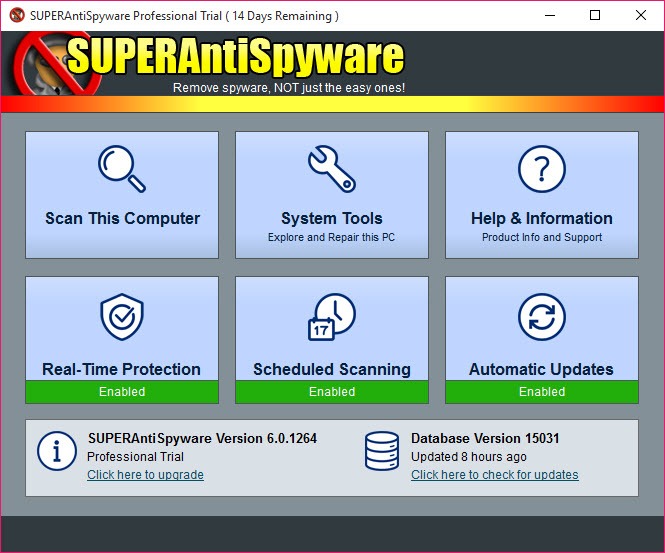
SUPERAntiSpyware is a second-opinion scanner. It runs alongside whatever antivirus a machine already has and hunts for the things that category tends to wave through. Spyware and adware, browser hijackers, tracking cookies, rogue security programs and the unwanted extras that arrive with a download.
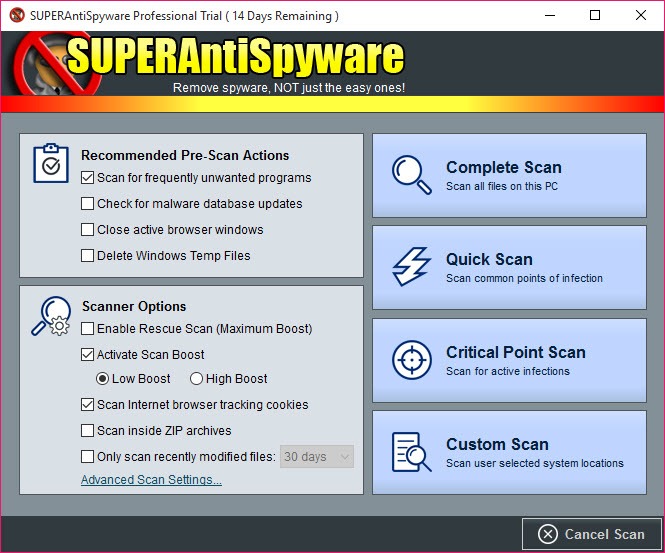
Four scan types cover a two-minute check of the usual hiding places through to a full sweep of every drive, and quarantine holds what it finds. A Repair menu puts back the settings that an infection broke, from a desktop wallpaper that will not change to a network connection that stopped working.
The standard edition scans and removes on demand and updates its definitions when you ask. The paid edition adds real-time blocking, scheduled scans, automatic updates and email reports. That split places SUPERAntiSpyware in the same drawer as Malwarebytes, where the usual advice holds.
Run it after a suspicious afternoon or when a browser starts behaving oddly, let the resident antivirus do the daily work, and keep two opinions rather than one.
Four scans and when to use each
Quick Scan in SUPERAntiSpyware checks the places infections settle first, the user profile, the startup locations, the running processes and the browser folders. It finishes in a minute or two. Critical Point Scan is shorter still, a check of the fifty-odd system locations that malware modifies. It is the one to run for a fast indication rather than a verdict. Complete Scan reads every file on the drives you select and is the one for a first cleanup or a machine that is plainly infected. Custom Scan picks the folders, drives or removable disks by hand.
A Scan Boost option uses more of the processor to finish sooner, at the expense of anything else you were doing. On a large drive the Complete Scan takes long enough to start at bedtime. The results list marks each detection with its type and location and lets you untick anything before removal.
Tracking cookies dominate the count on most machines, and the settings can exclude them so the real detections stand out.
What it detects and how
The SUPERAntiSpyware engine combines signature definitions with a behavioural pass the maker calls multi-dimensional scanning. It looks at what a file does and how it is built rather than only at a pattern in its code.
Process interrogation inspects running programs directly, which catches something that has hidden its file on disk but cannot hide the fact that it is executing. Rootkits and keyloggers, worms and the hijackers that redirect a browser’s home page are all in scope. So are the adware and bundled extras that other scanners classify as optional and leave.
Detection here leans towards the nuisance end of the spectrum, which is where the program earns its keep. An antivirus that missed a browser toolbar or a search redirect is not broken. It was looking for something else.
SUPERAntiSpyware was built to look for exactly that, and its results on a machine with an unwanted extension or a changed home page reflect it.
Quarantine, and the repair menu
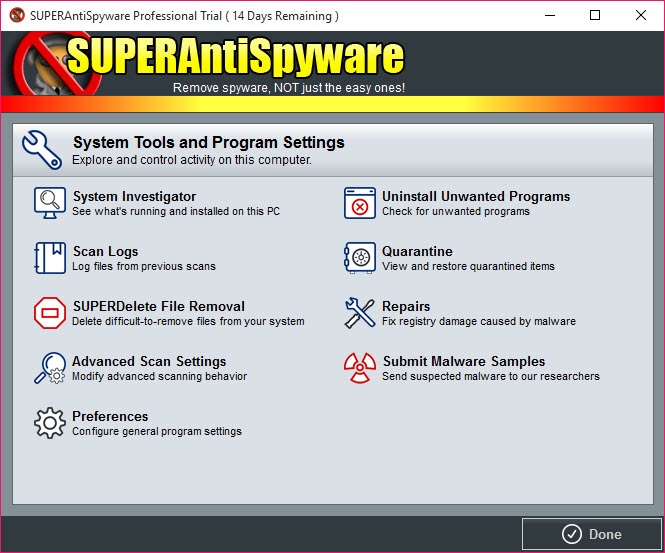
Detections go to quarantine rather than straight to deletion. A quarantined item is moved out of place and made inert. The Quarantine screen lets you restore it if a detection turns out to be a program you wanted, or remove it permanently once you are sure. Nothing is destroyed on the first click, which is the right design for a scanner whose adware detections occasionally include a legitimate program’s updater.
The Repair menu is the feature that separates this from a plain scanner. Infections change settings to protect themselves, and a clean machine often keeps the damage. The menu fixes a broken internet connection and restores a desktop background and the ability to change it.
It re-enables registry editing and the task manager when malware turned them off, resets the browser address prefixes and the clock display, and repairs a handful of other things a hijacker breaks. Each is a one-click fix with a description. For a browser whose extensions and search settings are the problem, a dedicated adware and toolbar remover finishes what the repair menu starts.
System Investigator and the rescue stick
System Investigator lists what is running and what is installed, with a mark against anything the definitions recognise as suspicious. A machine can be inspected before a scan is committed. It is a lighter version of a process viewer with the scanner’s knowledge attached, and it is where a technician looks first on a machine they have not met. Startup alerts, in the paid edition, warn when a new program registers itself to run at sign-in, which is how most unwanted software takes hold.
For a machine too infected to install anything, a portable scanner runs from a stick without installing, and the definitions can be downloaded on a clean machine and carried across. That is the workflow for the computer that will not reach the internet any more, and it pairs with a portable scanner with two engines for offline cleanup for a second look.
What the paid edition adds, and what neither does
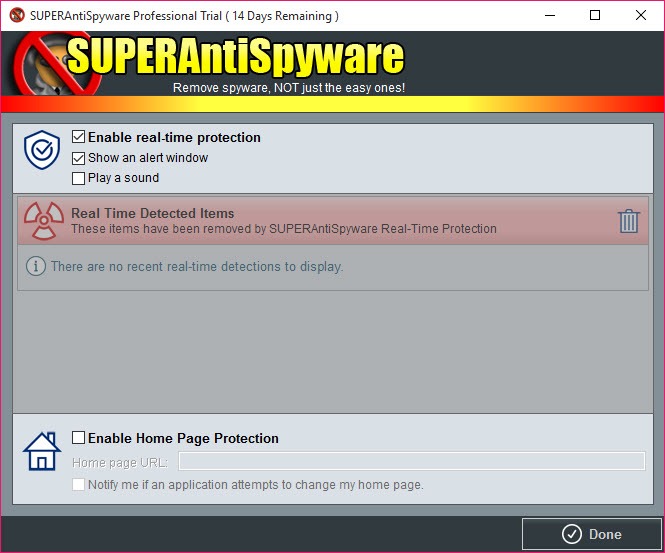
Real-time blocking stops a detected file from running the moment it appears. Scheduled scans run daily or weekly, definitions update on their own, and email notifications carry the results to whoever looks after the machine. Those four are the paid edition. Without them the standard edition of SUPERAntiSpyware depends on you remembering to open it and press Check for Updates before a scan.
Neither edition is a replacement for an antivirus. There is no web filtering, no email scanning and no firewall, and the maker says so. For rootkits buried below where this scanner looks, a rootkit and hidden malware hunter is the deeper second opinion.
The program is a specialist for the class of unwanted software that sits between a virus and a nuisance, and used as a second opinion it is a sound one. Used as the only protection on a machine, it leaves the front door open.
Conclusion
SUPERAntiSpyware is for the person whose browser has grown a toolbar it never asked for, or whose search results go somewhere strange. It is also for anyone whose antivirus keeps saying the machine is clean while it plainly is not. As a second scanner run when something feels wrong, it finds the class of nuisance the first one was not looking for. The repair menu undoes what that nuisance broke.
It is not the only protection a machine should have, and the standard edition needs you to remember it exists. Keep it beside a real antivirus, run it when the browser misbehaves, and it does the job it was built for.
Pros & Cons
- Four scan depths with a results list you can edit before removal
- Detects the adware and hijackers and bundled extras many antivirus products ignore
- Repair menu restores connections and desktops and disabled system tools after an infection
- Quarantine with restore, so a false detection is reversible
- System Investigator marks suspicious running and installed items
- Portable scanner and manual definitions for infected machines
- Standard edition has no real-time protection or automatic updates
- Complete scans are slow on large drives
- Tracking cookies pad the results until excluded
- Not a substitute for an antivirus, with no web or email protection
Frequently asked questions
Yes, and that is how it is meant to be used. It scans on demand for spyware and hijackers while the antivirus handles real-time protection. Only the paid edition adds its own real-time blocking, which some antivirus products object to.
A Complete Scan on a machine that is plainly infected or has never been scanned. Quick Scan for a routine check, and Critical Point Scan for a fast indication before deciding whether a full scan is needed.
Open the Repair menu after the scan and choose the item that matches the damage, such as a broken internet connection or a locked desktop wallpaper. Each repair applies in one click.
Yes. Use the portable scanner and download the definitions on a clean machine, then carry both across on a stick and run a Complete Scan.


