

Speakonia
About Speakonia
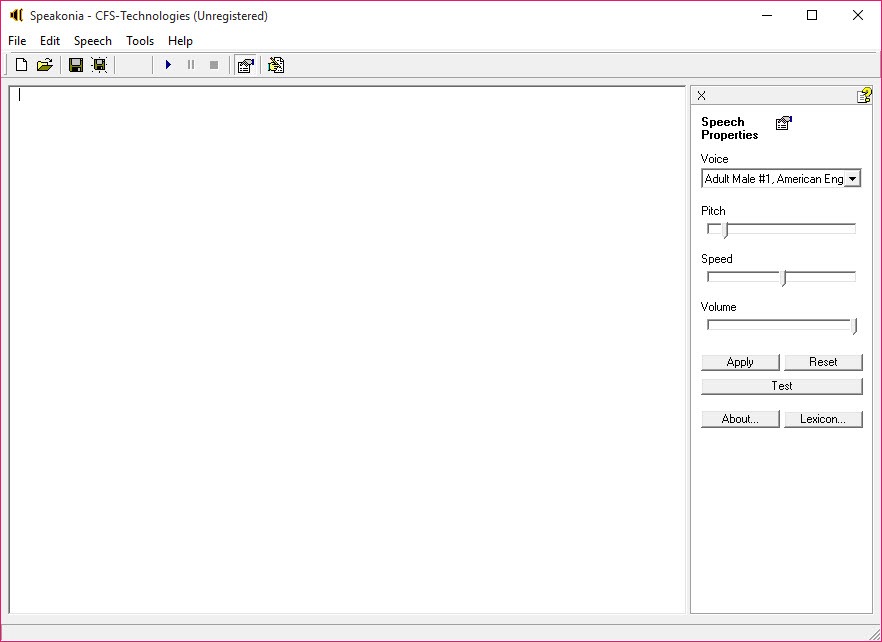
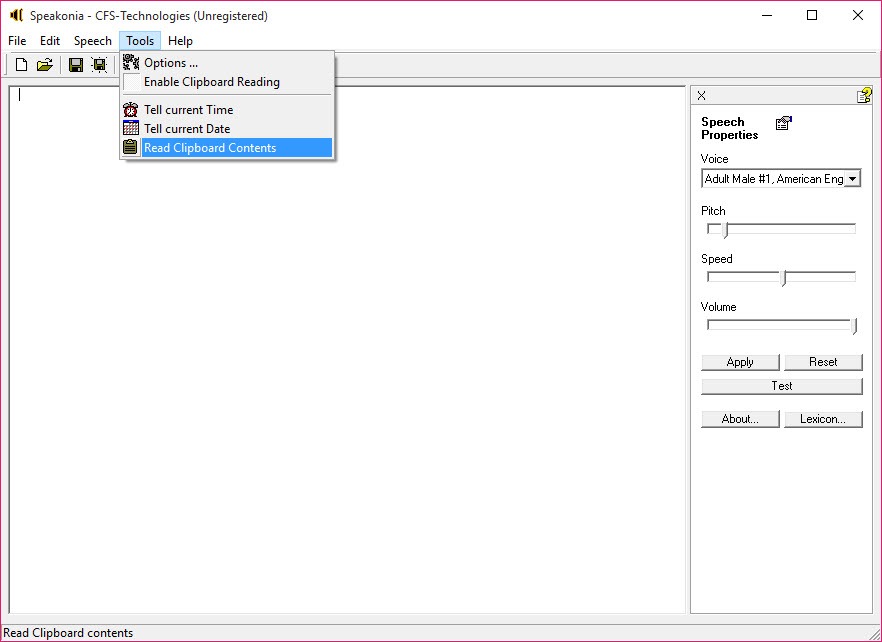
Speakonia reads text aloud through the system’s speech engines, and it is the program behind a particular robotic voice that a generation of internet videos made famous. Paste or type into the box, pick a voice, press play or F5, and the text is spoken with pitch, speed and volume set by three sliders. It also reads whatever lands on the clipboard, announces the time and date, and keeps a lexicon where you can respell a word the engine keeps mangling.
That is the whole program, and it was never meant to be more. Its appeal today splits into two camps. People who want the old synthetic voices, the flat American narrator and the eleven others it ships with, for videos and nostalgia. And people who want a text reader with no account, no cloud and nothing to configure, who will find it works and also find that Balabolka does the same job with far more voices and formats.
Speakonia has not been updated in a long time, and parts of it have stopped working as a result, which this article covers rather than hides.
The voices, and where the famous one comes from
The program installs with a set of adult voices adapted from an older synthesis engine, named by number and gender, with one of them, the first male voice, being the narrator people recognise from a thousand reaction clips. The voice everyone asks about by name is not in the box.
It belongs to a separate speech package, and once that package is installed, Speakonia lists it alongside robot and whisper variants that came with it. The British voices the program once offered are gone, since their packages are no longer obtainable.
Every voice gets the same treatment from the sliders. Pitch shifts the fundamental up or down, speed stretches or compresses, volume is volume, and a test button speaks a fixed phrase so you hear the result before committing. The sliders have no numbers on them, so matching a setting across two sessions is done by ear.
Reading and the clipboard
The main box takes text of any length, and play, pause and stop behave as expected, with the current position kept while paused. Clipboard reading is the quieter convenience. Switch it on, and anything copied in any program is spoken immediately, which turns the tool into a crude screen reader for a web page or a document without pasting a thing. Copy a paragraph, hear it, copy the next.
Two quirks come with that. Running another speech program at the same time can take the clipboard function away, since both want the same hook. And the lexicon, which fixes the pronunciation of a stubborn word or a name, only saves its changes when the program runs as administrator on current systems, which nobody tells you until the change fails to stick.
Saving audio, and why you may need a recorder
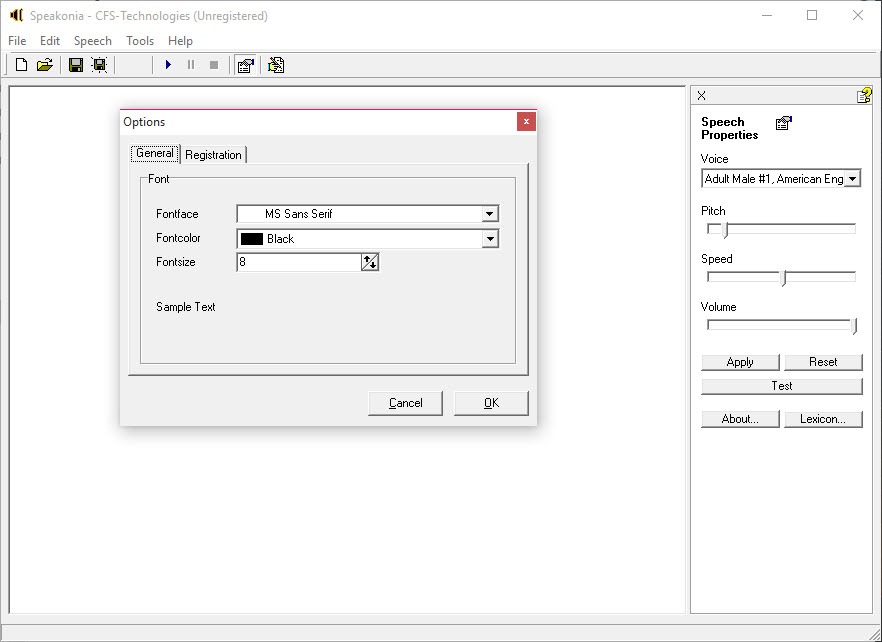
Text saves to a TXT file and speech saves to a WAV file, in theory. In practice the WAV export sits behind a registration step that can no longer be completed, so on a fresh install the save-as-audio button is a locked door. That is the single biggest change, and it matters because saving the voice was the reason most people installed it.
The workaround is to record the output. Audacity set to capture the system’s playback picks up the speech as it plays, and the result is the same WAV you would have exported, with the small bonus of being trimmable on the spot.
Anyone making videos was going to open an editor anyway.
Where it stands now
Speakonia does one thing in a window that has not changed, and the thing it does still works. Voices speak, sliders slide, the clipboard reads. What has decayed is everything around the edges, the export, the extra voice packs, the lexicon on a non-elevated account. For listening to text, it is a working tool with a small vocabulary of voices. For producing audio files, it is a reader with a recorder sitting beside it.
Anyone who wants more voices, more formats and a program that is still maintained has a clear alternative in the same category, and the honest advice is to take it unless the specific voices here are the point. Often they are.
Conclusion
Speakonia is for people who want a particular set of old synthetic voices, whether for a video, a joke or a reader that sounds the way computers used to, and who are willing to record the output rather than export it. For them nothing newer sounds right, and this still does.
Everyone else, meaning anyone who just wants text read aloud well, should take a current reader and never look back. This one is kept alive by its voices, not by its features.
Pros & Cons
- Reads typed, pasted or clipboard text with pitch, speed and volume sliders
- Supports the older synthetic voices that newer readers no longer offer
- Lexicon corrects the pronunciation of specific words
- Announces time and date on request
- WAV export is locked behind a registration that no longer works
- Extra voice packs are hard or impossible to obtain
- Sliders show no values, so settings cannot be reproduced exactly
- Lexicon changes require running as administrator
Frequently asked questions
Not in the box. That voice comes from a separate speech package, and once that is installed the program lists it with the other voices. The narrator voice it does ship with is the one heard in many older videos.
The WAV export exists but is locked on a fresh install, since the registration it needs is no longer available. Record the playback with an audio editor instead.
Usually because another speech program is running and has taken the clipboard hook. Close the other program and the function returns.


