

Rufus
About Rufus
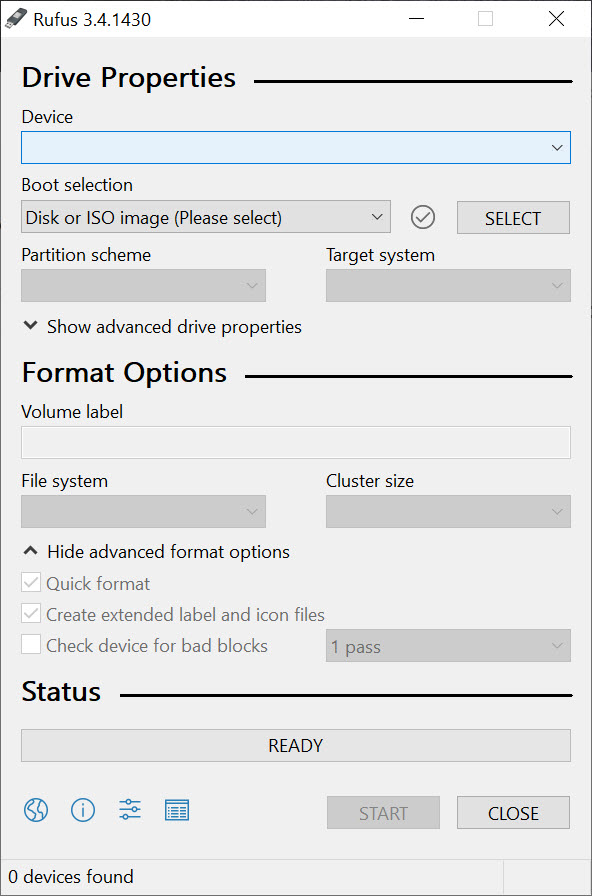
Rufus writes ISO images to USB flash drives and turns them into bootable media, which sounds simple until you’ve tried doing it with a dozen other utilities that choke halfway through or quietly produce a stick your machine refuses to recognize. What sets it apart is speed and control.
The tool finishes most writes in a fraction of the time bigger suites take, and it hands you the kind of low-level options (partition scheme, target system, file system, cluster size) that usually live three menus deep in something far clunkier.
The whole thing fits in a single executable that needs no installation. You point it at a drive, point it at an image, pick a couple of settings, and hit start. For something this small, the amount it can do is faintly absurd. It writes installer media, builds Linux live drives, flashes raw disk images, and can even fetch and prep certain installation files for you on the fly.
And it does all of this while staying out of your way. There’s no telemetry begging for attention, no nag screen, no bundled extras. Just a compact window with everything visible at once, which is increasingly rare in a category where tools love to hide their good features behind tabs.
Bootable drives without the guesswork
The core job is creating bootable USB drives, and Rufus handles the part most people get wrong: matching the drive’s partition scheme to how the target machine actually boots. You choose between MBR and GPT, and between BIOS or UEFI targets, right from the main window.
Get it wrong with another tool and you end up with a stick that formats fine but never appears in the boot menu. Here the dropdowns are labeled in plain language, and the application picks sensible defaults the moment you load an image, so you can ignore them entirely if you don’t care.
It detects the image type automatically too. Load a standard installer ISO and it sets itself up one way. Load a Linux distribution and it offers to write in ISO mode or DD mode, the latter being important for certain images that refuse to boot any other way. That little prompt has saved a lot of people a confusing afternoon.
Why is it so much faster?
Speed is the thing people notice first. Writing a 4 GB installer image to a decent USB 3.0 stick takes a few minutes, and benchmarks consistently put Rufus ahead of the bulkier alternatives doing the same job. Part of that is how lean the program is. It isn’t running a heavy interface or background services while it works, so nearly all the throughput goes to the drive itself.
You also get a live log if you want one. Click into it and you can watch each step (clearing the MBR, creating the partition, copying files, writing the boot record) as it happens. Most people never open it. But when a write fails, that log tells you exactly where, which beats the silent “something went wrong” you get elsewhere.
If you regularly prep boot media, a quicker option for raw image writing is ImageUSB, though it trades away the granular control that makes this utility worth keeping around.
Verification and bad-block checks
One feature that gets overlooked: the application can check your drive for bad blocks before it writes anything. Run the scan and it passes test patterns across the whole stick, flagging sectors that don’t read back correctly. Cheap or counterfeit drives often report a size they can’t actually store, and this catches them before you trust one with installation media that’ll silently corrupt.
It also computes hash values (MD5, SHA-1, SHA-256) for whatever image you load, with a single click. So if you’ve downloaded an ISO and want to confirm it matches the checksum the source published, you don’t need a separate utility for it.
Small touch, genuinely useful, and the kind of thing that signals the tool was built by someone who actually creates boot drives rather than just shipping a feature list.
Persistent storage and advanced options
For live Linux drives, Rufus can set up a persistent partition, meaning your files and settings survive a reboot instead of vanishing every time. You drag a slider to choose how much space to reserve. It’s not flawless across every distribution (some handle persistence better than others), and the tool is upfront about which combinations it supports rather than pretending it all just works.
Dig into the hidden advanced section and there’s more: options to add fixes for older machines, to use Rufus MBR with a custom BIOS ID, to set the cluster size manually, or to create extended labels. None of it is necessary for everyday use.
But if you’re reviving an ancient laptop or working around a stubborn firmware quirk, the escape hatches are there. For full disk wiping rather than imaging, something like DBAN is the more direct route, and for managing partitions outside the boot context there’s DiskGenius.
How it compares to bigger boot tools
Plenty of utilities create bootable drives. Where this one wins is the ratio of capability to weight. It does roughly what a sprawling burning suite does for boot media, minus the install footprint and the clutter. The trade-off is scope. If you want to keep dozens of ISOs on one drive and pick at boot time, a multi-boot approach like Ventoy or a builder such as Easy2Boot fits better, since this tool writes one image per drive at a time.
For the single, common task of “I have an image and an empty stick, make it boot,” though, almost nothing matches it for speed and simplicity. That focus is the whole point.
Conclusion
If your work involves spinning up installer sticks, live drives, or recovery media with any regularity, Rufus earns a permanent spot on the desk. It’s fast, it’s honest about what it does and doesn’t support, and it gives experienced users real control without forcing that complexity on anyone who just wants a drive that boots. The single-image-per-drive limit is its one real boundary, and the layout asks a little patience up front.
But for the everyday task of turning an image into bootable media, this is about as good as a small utility gets. Casual users get safe defaults, tinkerers get the deep options, and both walk away with a drive that actually works on the first try.
Pros & Cons
- Writes bootable USB drives noticeably faster than most competing tools
- Single portable executable with no installation and no bundled extras
- Plain-language partition and target options with smart automatic defaults
- Built-in bad-block scanning catches faulty or counterfeit drives
- Computes MD5, SHA-1, and SHA-256 hashes without a separate utility
- Persistent partitions supported for live Linux drives
- Writes one image per drive, so it isn't built for multi-boot collections
- Persistence support varies depending on the distribution you use
- The dense single-window layout can intimidate first-timers
- Advanced options are powerful but offer little guidance on when to use them
Frequently asked questions
ISO mode copies files onto a formatted partition and works for most standard installers, letting you read the drive afterward. DD mode writes the image bit for bit, which some images require to boot but leaves the stick showing only the image's own contents.
It almost always comes down to the partition scheme. If your machine boots in UEFI mode but the drive was written as MBR for BIOS, the firmware won't see it. Rewrite with the matching target system selected and it should show up.
Yes. Turn on the bad-block check and it runs test patterns across the entire drive, reporting any sectors that fail. This is the quickest way to expose fake-capacity sticks before they ruin your install media.
No. Persistence depends on how the specific distribution implements it, and Rufus only enables the slider for images it knows support it. Some distributions handle saved data cleanly while others ignore the partition entirely.
It calculates the image's hash with one click, covering MD5, SHA-1, and SHA-256. You compare that value against the checksum published with the image, and a match confirms the file downloaded intact.


