

RivaTuner
About RivaTuner
Graphics card tuning today means a slider for the core clock, a slider for the memory and a fan curve. RivaTuner came from a period when it meant considerably more than that, and its reach into the hardware and the driver is the reason its name still appears attached to software that has nothing to do with it.
Two entirely different kinds of access sat inside RivaTuner. One worked through the driver, changing how it handled rendering. The other went past the driver to the chip itself.
Understanding that split explains both what made the software remarkable and why almost none of it applies to a machine you would buy now.
Driver level and low level are not the same thing
The RivaTuner distinction matters because the two halves carried different risks and different capabilities.
Driver-level tweaking meant reaching into the settings the graphics driver exposes and the many more it does not. Filtering quality, rendering behaviour, compatibility options and the way particular interfaces were handled were all adjustable, with the changes applying per application through a profile system.
Low-level access meant talking to the chip directly, bypassing the driver’s opinion entirely. Clock frequencies, voltages and the configuration of the hardware itself were reachable there, which is where overclocking actually happened.
Most tools of the era did one or the other. Having both in one place meant a novice could adjust image quality safely while somebody who knew what they were doing could reconfigure the hardware, and the interface hid the dangerous half on cards where it did not apply.
The driver-level half survives in maintained form, and NVIDIA Profile Inspector exposes that same per-application settings database for current cards.
The pipeline unlocking, which is the famous part
Here is the capability that gave RivaTuner its reputation, and it belongs to a moment in hardware history that has closed.
Manufacturers built one chip and sold it as several products. Parts of the chip were disabled to create the cheaper models, meaning rendering pipelines and vertex units switched off in the firmware rather than physically absent.
A bundled driver component could re-enable those disabled units. Somebody who bought the cheaper card sometimes ended up with the expensive one, at no cost beyond the risk.
The risk was real and worth stating plainly. Units were disabled for two different reasons, one being market segmentation and the other being that they failed testing. Re-enabling a unit that was switched off deliberately worked. Re-enabling one that was faulty produced visual corruption, crashes, or a card that behaved correctly until something specific stressed the broken part.
There was no way to know which case you had except by trying and testing. That lottery is exactly why the feature was celebrated and why manufacturers eventually closed it, moving from firmware switches to physically cutting the connections.
What replaced that kind of tuning is far tamer, and EVGA Precision X1 edits the voltage and frequency curve on current cards rather than reconfiguring the chip.
The patch script engine
The most unusual RivaTuner component deserves explaining, because nothing comparable exists in current tools.
Scripts could patch the driver files themselves, rewriting the code the driver ran so it behaved in ways no setting exposed.
That is a remarkable thing to ship in a consumer utility. It meant capabilities could be unlocked, protections removed and behaviour altered without waiting for the manufacturer to expose an option, and the scripts were maintained against specific driver versions because a patch that matched one release would corrupt another.
The approach is unthinkable now. Driver files are signed, the system verifies them, and modifying one produces a driver that refuses to load rather than a driver that behaves differently.
The monitoring half became something else
The RivaTuner monitoring module tracked temperatures, clocks, fan speeds and load, plotting them over time and displaying them while a game ran.
That display was the seed of something considerably more successful. The component handling it started as a bundled extra, gained the ability to inject its display into running applications, and eventually separated into a program in its own right.
Anybody who has watched a frame rate counter in the corner of a game has used its descendant. That statistics server is still maintained, still injecting its display into running applications, and still bundled with the tuning software most people install.
The processor side of the same question needs its own reader, and a monitor reporting per-core temperature and throttling behaviour covers what a graphics tool does not.
Profiles, and a keyboard nobody remembers
RivaTuner applied everything per application through profiles, so a demanding game received one configuration and a desktop application another, switching automatically.
That idea is now standard and it was not then. Manufacturer software of the period applied one setting to everything, so having a game reconfigure the card on launch and release it on exit was a real departure.
Among the smaller features was support for a small screen built into a particular gaming keyboard of the era, which displayed the monitoring readouts. It is a good marker of how thoroughly the software chased every corner of enthusiast hardware.
Where it all went
RivaTuner stopped being developed and did not disappear, which is an unusual ending. Manufacturers recognised the engine underneath was better than anything they had, and licensed it. The overclocking utilities distributed with graphics cards from several brands run on that core rather than on code those brands wrote.
So the program is dead and the code is everywhere. MSI Afterburner is the best known descendant, built directly on that engine.
That afterlife is the honest reason to know about this. Nobody should install it, and almost everybody tuning a graphics card is using its offspring.
Why it will not work for you
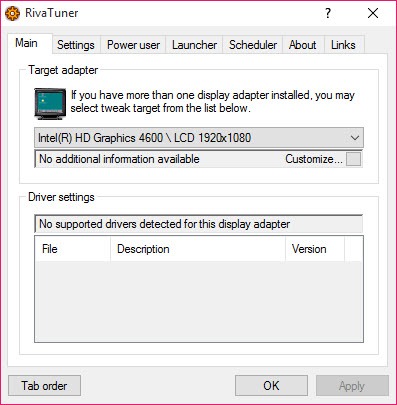
Being direct about the practical RivaTuner position, since the historical interest is the only interest. The supported hardware ends at a generation of cards that stopped being sold a very long time ago. The driver families it understands ended at the same point. A current card is not recognised, and a current driver has nothing it can reach.
The mechanisms it relied on have also been closed. Driver files are signed, low-level hardware access is mediated differently, and the firmware switches it exploited were replaced by physical changes to the silicon.
For actually reading what a current card is and what it is doing, GPU-Z reports the chip, the clocks and the sensors accurately.
Conclusion
RivaTuner belonged to a period when a graphics card was a more open piece of hardware and a determined utility could reach every part of it. Driver settings that were never exposed, chip sections that were disabled rather than absent, and driver code that could be rewritten by a script are all things that no longer describe the hardware people buy.
Its ending is the interesting part. The program stopped and its engine was adopted by the manufacturers themselves, which means the software most people use to tune a graphics card today is its direct descendant. Read about it for that reason, and use the descendants for anything you actually intend to do.
Pros & Cons
- Combined driver-level tweaking and low-level hardware access in one program
- Per-application profiles, which was novel rather than standard at the time
- Monitoring with historical graphs and an in-game display
- Could re-enable disabled sections of certain chips
- Patch scripts modified driver behaviour beyond any exposed setting
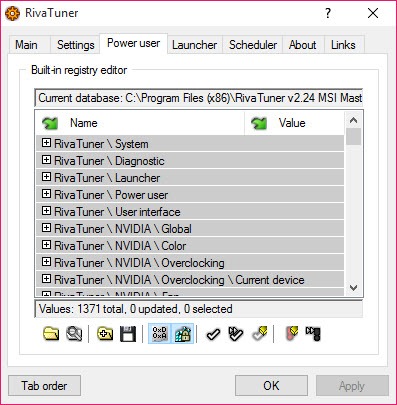
- Built-in registry editor and diagnostic reporting for the hardware
- Its engine still powers the overclocking utilities several manufacturers ship
- Supports a generation of cards and drivers that ended long ago
- Pipeline unlocking was a gamble, since disabled units were sometimes faulty
- Driver patching cannot work now, because driver files are verified
- No development for a very long time
- Almost everything useful in it exists in maintained descendants
Frequently asked questions
Driver-level tweaking changed how the graphics driver handled rendering, applied per application. Low-level access went past the driver to the chip itself, which is where clocks and hardware configuration lived. Few tools offered both.
Manufacturers built one chip and disabled parts of it to create cheaper models. The software could re-enable those parts, sometimes turning an inexpensive card into an expensive one, and sometimes enabling units that had been switched off because they failed testing.
It was a gamble with no way to know beforehand. Units disabled for market reasons worked perfectly, and units disabled for defects produced corruption or crashes, occasionally only under specific conditions that took weeks to appear.
No. It supports hardware and driver families that ended long ago, and the mechanisms it relied on have since been closed, including signed driver files that cannot be patched.
Because manufacturers licensed its engine. Several of the overclocking utilities distributed with graphics cards today run on that core, and the monitoring component became a separate program that is still maintained.


