

OpenToonz
About OpenToonz
OpenToonz is a 2D animation studio in one program. It draws in vector or raster, times drawings on an exposure sheet, colours them from indexed palettes, composites them through a node-based effects graph and renders the result to video or image sequences.
The pipeline it models is the one broadcast animation used for decades. Rough drawings are scanned or drawn, cleaned into crisp lines, painted and sheeted, then photographed by a virtual camera stand that moves over them.
That makes it different in kind from Krita or Pencil2D, which animate by flipping drawings in a timeline. OpenToonz wants a production. It rewards people willing to learn the terms an animation studio uses and punishes people who expected a drawing app with a play button.
Which of those you are decides everything about how the next hour goes.
Rooms, and the three kinds of drawing
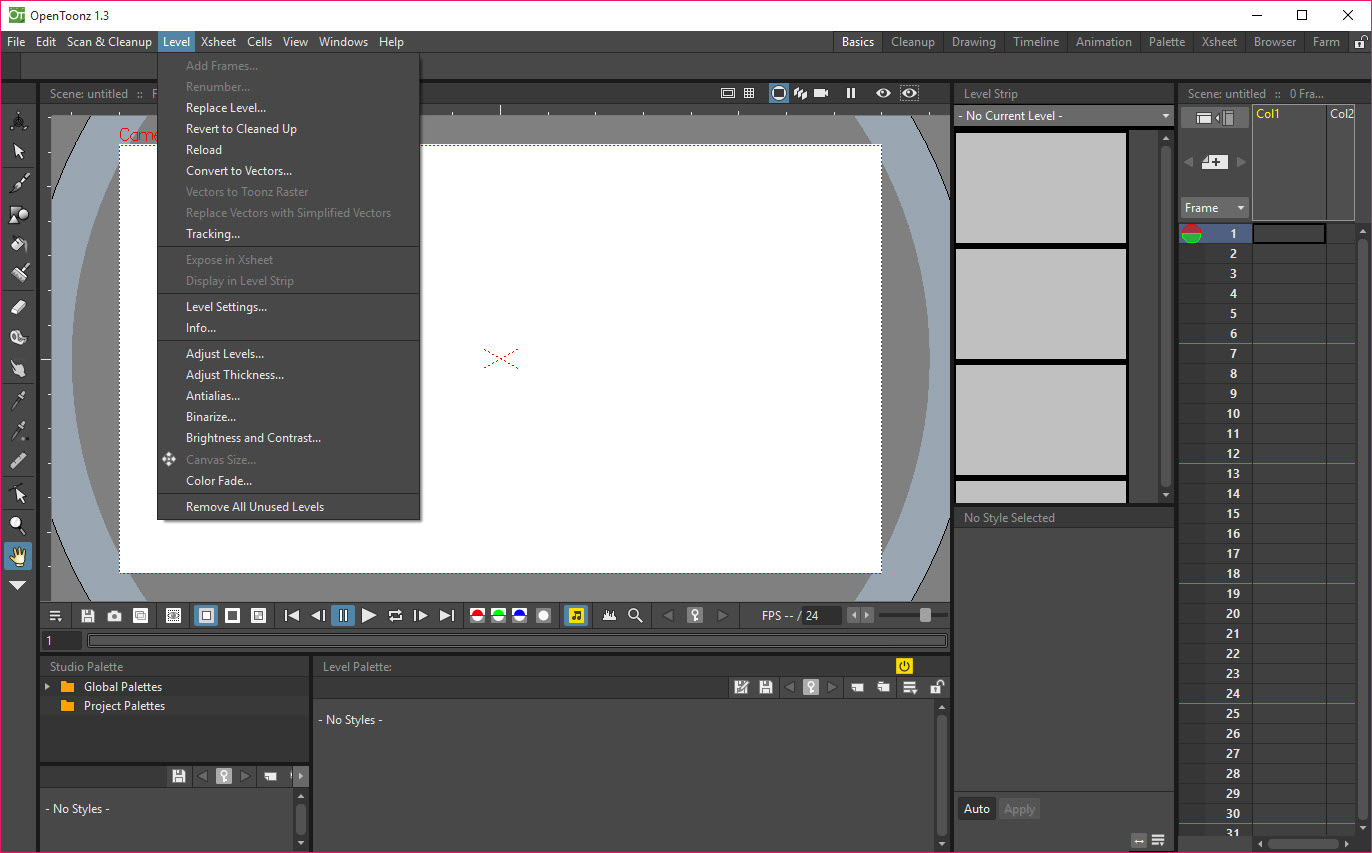
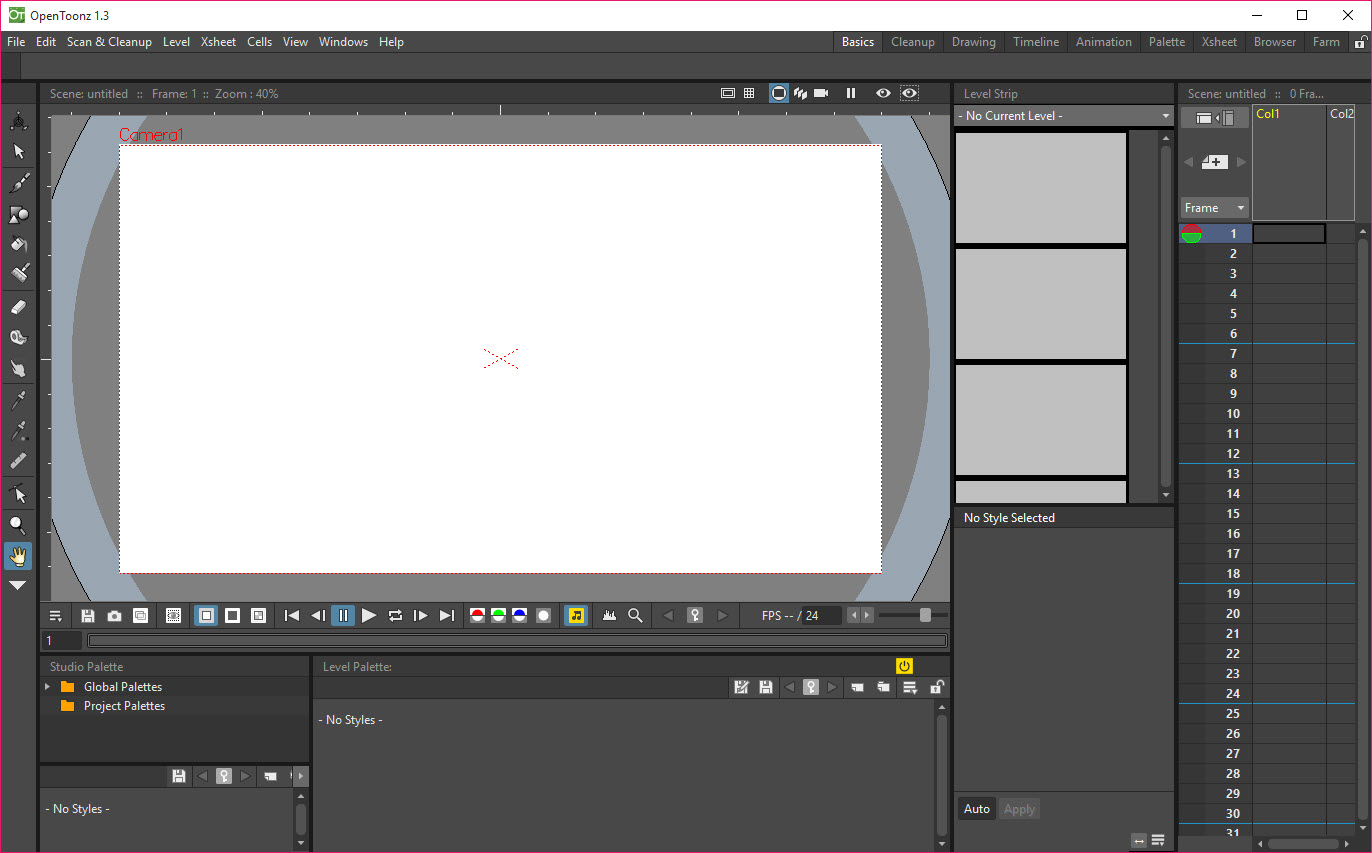
The interface is arranged into rooms, tabs along the top that each hold a layout of panels for one stage of work. Basics, Cleanup, Drawing, Animation, Xsheet, Palette, Timeline and Browser are the defaults, and any of them can be rearranged or replaced. Beginners tend to live in Basics and Drawing, and to discover the rest only when a tutorial sends them there.
Every drawing lives in a level, and there are three level types. Toonz Vector levels are strokes with editable points and fills, small on disk and infinitely scalable. Toonz Raster levels are bitmap lines with a palette attached, which is what scanned and cleaned drawings become.
Plain Raster levels are ordinary full-colour bitmaps for painted backgrounds. The Xsheet colours each type differently (yellow for vector, green for Toonz raster, blue for raster), and picking the wrong type for a job is the first mistake most people make.
Line work you intend to paint wants Toonz Raster. Anything you will scale or rig wants Vector.
Cleanup, or how paper drawings get in
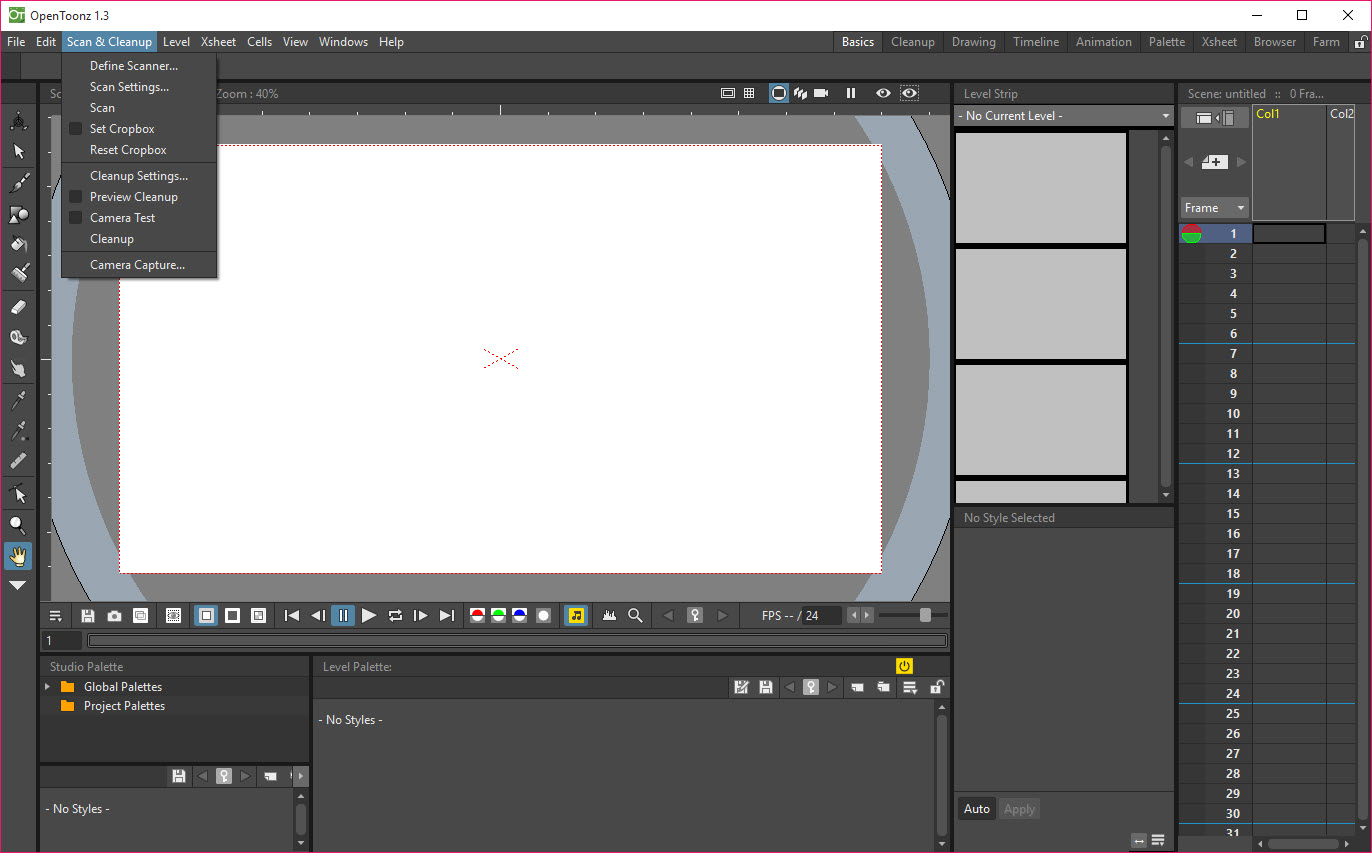
The Cleanup room exists for drawings made on paper. Scan a stack of pencil sheets through TWAIN and the cleanup process finds the registration marks or the page centre. It straightens each sheet, then reduces the pencil line to a single-colour line on a transparent field. A brightness and contrast pair controls how much of the light construction lines survive, and a colour model lets you cleanup drawings inked in more than one colour into separate palette styles.
It also accepts photographed drawings and can run without line processing, so a phone photo of a sketchbook page can be centred and rotated without being thresholded. For anyone who still thinks on paper, this room is why OpenToonz exists. Everyone else can skip it.
Palettes and the fill tool
Colouring in OpenToonz is not painting. Each Toonz level carries a palette of numbered styles, and the Fill tool pours a style into an enclosed area of the line drawing. Change a style’s colour and every frame using it updates, which is how a shirt changes shade across two hundred drawings in one click. A studio palette stores palettes for reuse across scenes, and styles can animate, so a sky darkens over a shot by keying its colour.
Fill fails where lines do not meet. A one-pixel gap lets paint flood the whole frame, and the answers are the Autoclose setting, which bridges small gaps invisibly, and the Tape tool for joining ends by hand. New users spend a bad afternoon on this before they find either.
Fill also works in raster levels through the Paint Brush tool, but the palette logic is what makes cel painting fast, and it only fully applies to Toonz levels.
The Xsheet, the timeline and tweening
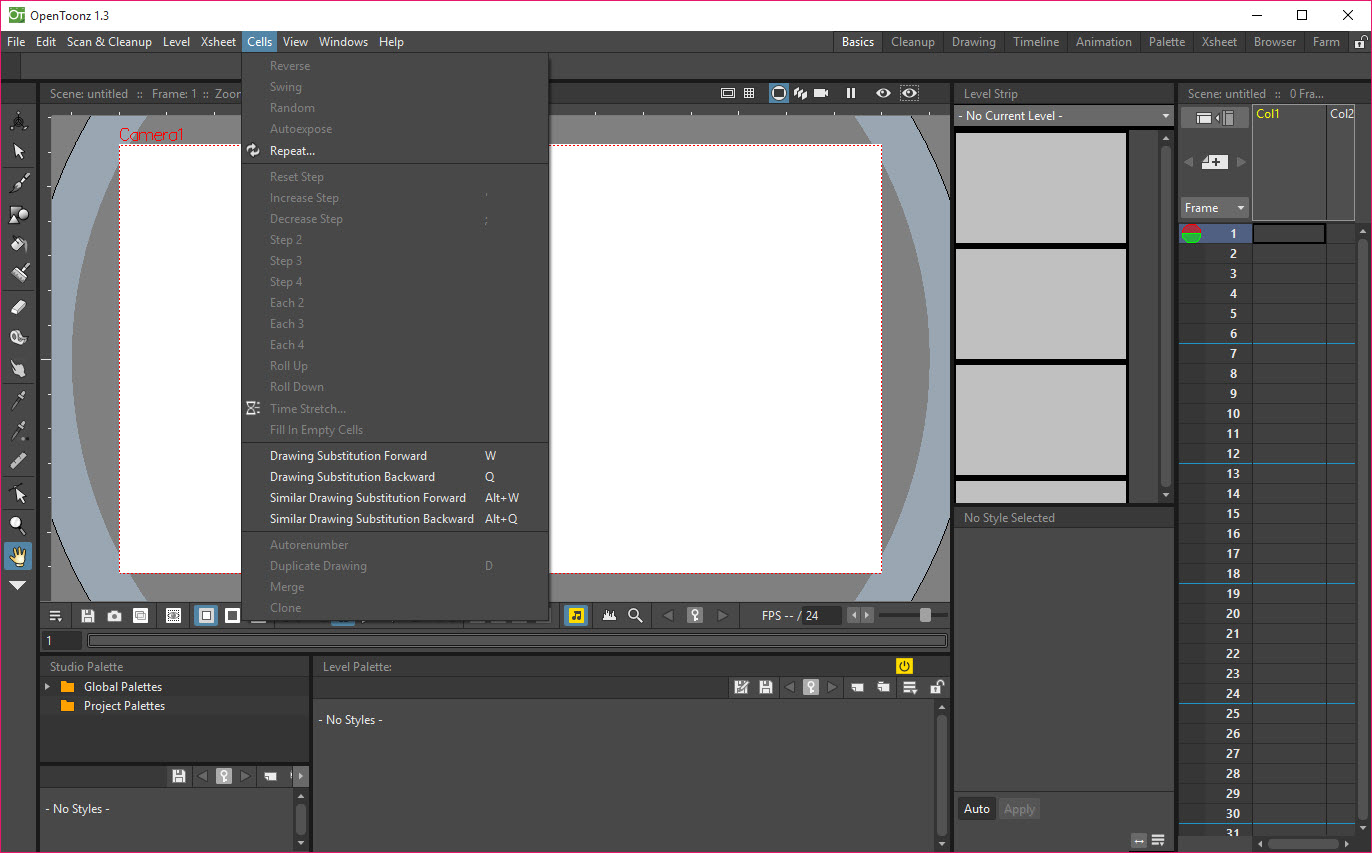
The OpenToonz Xsheet is a spreadsheet of time. Columns hold levels, rows are frames, and a cell names which drawing of a level shows on that frame. Holding a drawing for four frames means four cells with the same number, and the shift and trace tools, cell marks and sub-xsheets all exist to manage that grid. The Timeline room shows the same data sideways as layers, for people who arrive from video editors, and the two views stay in sync.
Movement comes from two places. Drawing new frames is one. The other is animating the column itself. Every column has position, rotation, scale plus shear, all keyable over time with an interpolation curve, and columns can be parented to pegbars and to a camera.
A pan across a painted background is a camera key, not a redrawn background. Ease-in and ease-out are edited on a function curve panel that will feel familiar to anyone who has used a 3D package.
The FX schematic and the plastic tool
Effects in OpenToonz are a node graph. Each column appears as a node, effects are dropped between the columns and the output, and wiring decides the order. Blur, glow, colour correction, particles, distortion, lighting, layer blending and a few hundred more are available, many of them running on the GPU, and any chain can be saved as a macro. It is compositing inside the animation program, which saves a round trip to a separate compositor for most short work.
The Plastic tool is the other advanced piece. Draw a mesh over a level, place bones and pins, and the drawing bends as you move them, with skeleton animation keyed on the Xsheet. It turns one drawing into a rig, which is how cut-out and puppet animation gets done here, and it is the part of the program most likely to make you wish for a step-by-step guide.
The documentation has one. Read it before touching the mesh.
Drawing tools and tablets
The Brush tool responds to pressure and tilt, has smoothing, and keeps separate settings for vector and raster levels, and stroke replication for drawing symmetrical shapes. Geometric, Type, Eraser, Tape, Pinch, Pump and Finger tools round out the set, plus an Assistant tool for perspective guides.
Pen tablets work, and touch drawing works on touch-equipped laptops. It is a competent set for clean-up and inking. For expressive painting with texture and thick brushes, a dedicated painting program is simply a better place to draw, and many people draw there and animate here.
Onion skin shows previous and following frames tinted, with adjustable counts in each direction, and the flipbook viewer plays a level or a scene at speed with frame stepping. Both are where you spend most of an animation session.
Rendering, and the MP4 that is not there
In OpenToonz, Output Settings picks resolution and frame range, then a format and a destination. Image sequences in PNG, TIFF, TGA and OpenEXR work out of the box. Video formats are a different story. MP4, WebM and GIF depend on FFmpeg and the program does not ship it.
Until you point Preferences at an FFmpeg folder, the video formats are missing from the list, and this single fact accounts for a startling share of forum questions. Set it once and the formats appear.
Scenes can also export to a PDF of the Xsheet for paper timing, and to a TVPaint project. A separate lip-sync integration reads a voice track and places mouth shapes on the sheet automatically. The renderer can run multiple FFmpeg threads, which matters once effects are involved.
Conclusion
OpenToonz is for students, small studios and serious hobbyists who want to learn animation the way it is taught in production, with an exposure sheet, a camera stand and a palette, and who will trade a hard first month for a tool that scales to a real short. The cleanup pipeline for paper drawings and the palette-based painting have no equal at this level.
Casual animators who want to sketch a loop this evening should start in a simpler program, or in the Tahoma2D fork, and come back when the loop turns into a film.
Pros & Cons
- Full production pipeline from scan and cleanup through painting, sheeting and compositing
- Palette-based colouring updates every frame when a style changes
- Node-based FX graph with GPU effects and reusable macros
- Plastic mesh and bone rigging for cut-out animation
- Xsheet and Timeline views of the same scene, kept in sync
- Vector, Toonz Raster and Raster levels for different jobs
- Steep learning curve built on studio terminology
- Video export is absent until FFmpeg is configured by hand
- Fill floods through tiny line gaps until Autoclose or Tape is learned
- Drawing tools trail dedicated painting programs
- Occasional crashes, so save early and often
Frequently asked questions
The video formats need FFmpeg, which is not included. Download it separately, then open Preferences, find the FFmpeg path setting and point it at the folder containing the executable. MP4, WebM and GIF appear in Output Settings afterwards.
Toonz Vector for anything you will scale, rig with Plastic or keep small. Toonz Raster for line drawings you intend to paint with the Fill tool, including scanned cleanup. Raster for painted backgrounds and imported images.
The line has a gap somewhere. Turn on Autoclose in the Fill tool options to bridge small gaps, or use the Tape tool to join the ends, then fill again.
Enable onion skin from the viewer's frame ruler by dragging the markers, or from the right-click menu. Previous frames appear tinted red and following frames green, with the count adjustable on each side.
Tahoma2D is a fork built from the same code with a simplified interface and some features that flow back and forth between the two. Scenes are largely compatible, and both use the same level types and Xsheet model.


Can I get some help? Or where can I get some help?
Opentoonz crashes when I created a mesh and after I skeleton added skeleton to my character, when I press “animate” it crashes.