

Open-Shell
About Open-Shell
Open-Shell replaces the Start menu with one that opens instantly, lists programs in a tree, searches as you type and shows nothing you did not put there. No recommendations, no tiles, no web results, no promoted apps.
It picks up where Classic Shell stopped, carrying the same three menu styles, the same skins and the same settings pages with a few hundred options between them, and it runs on everything from Windows 7 to Windows 11, with one awkwardness on the newest one that this article will get to.
The pitch is simple enough that it barely needs stating. If you press the Start button to launch a program, find a file or shut down, and the built-in menu makes that slower than it used to be, this puts it back. What makes it more than nostalgia is the configurability underneath, which lets the menu be anything from a strict two-column list to a near-copy of the Windows 7 menu with a search box that finds settings and documents as well as programs.
Three styles, and the one most people pick
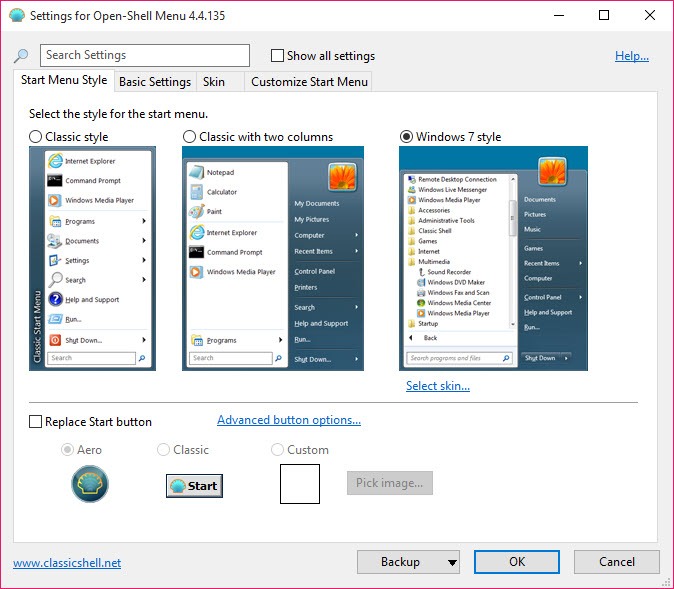
The first Open-Shell settings page offers Classic, Classic with two columns, and Windows 7 style. Classic is the single-column cascading tree where Programs opens a submenu that opens further submenus, fast once you know where things are and hostile until then. Two columns adds places such as Documents and Control Panel to the right. The Windows 7 style has the search box, a pinned and recent programs list on the left, and the places column on the right, and it is what most people want, because it is the menu they remember being good.
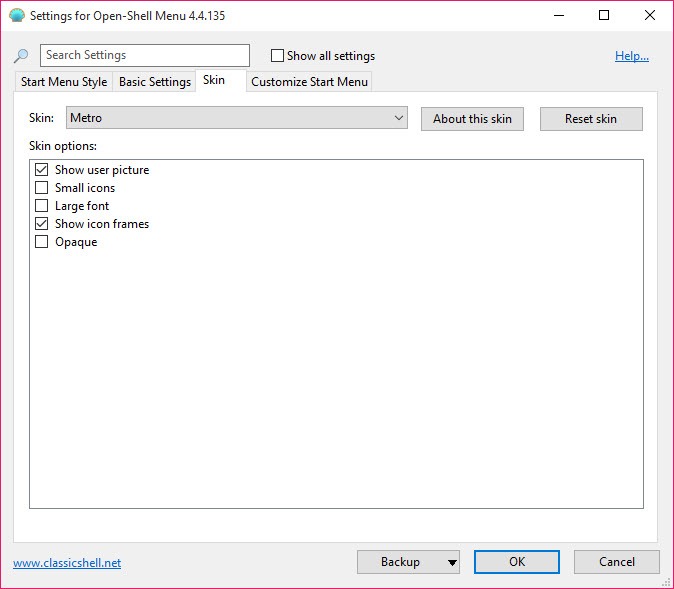
Each style takes a skin. Metro, Immersive, Smoked Glass, Windows Aero, Midnight and a few more, each with its own options for transparency, caption colour, icon size and whether user name and picture appear. Skins decide more than looks, since the Metro one uses fixed colours that clash with a dark theme and ignores the glass colour override, while Immersive follows the system accent. Trying three skins takes a minute and settles most complaints.
Settings that go as deep as you want
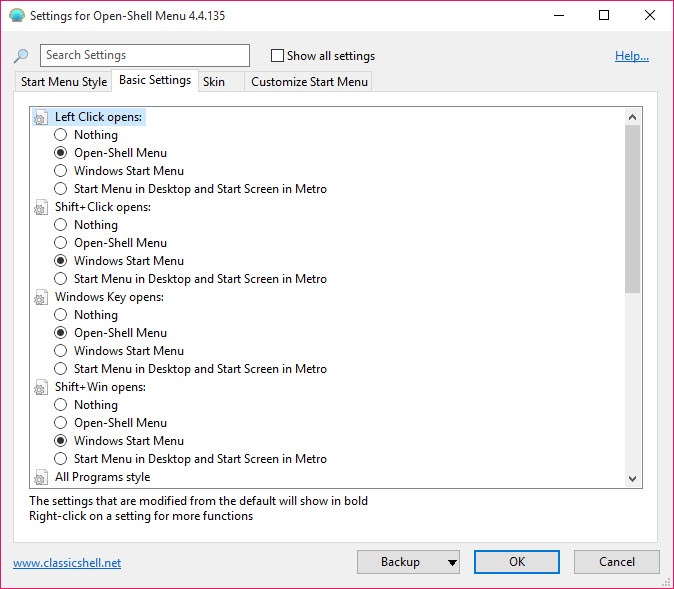
A checkbox labelled Show all settings turns the four tabs into a dozen. From there Open-Shell controls what the Windows key does (open this menu, open the stock one, or open the stock one with Shift), what each place item is (link, menu or hidden), how recent programs are counted, whether the shutdown button defaults to sleep, restart or shutdown, and how the Programs folder is sorted. The Customize Start Menu tab is a drag-and-drop list of every item the menu can show, in the order you want, with your own shortcuts added anywhere.
Menu Look holds the fix for high-resolution screens. Override system DPI takes a number, and 96 multiplied by the display scaling, so 144 for 150 percent, gives a menu sized to match the rest of the desktop.
Settings export to an XML file and import from one, which is how a tuned menu moves to the next machine in two clicks. a settings editor that lists every change you applied is the companion for the system settings this tool deliberately leaves alone.
Search that finds settings, not adverts
Type into the Open-Shell search box and results group into programs, settings, files and, if you allow it, an internet search. Programs match on any word in the name, settings search the control panel entries and the modern settings pages alike, and files use the system index, so a document indexed anywhere appears without a folder path. There is no web content unless you turn it on, and there are no sponsored results at all.
It is quicker than the built-in search in practice, partly because it does less. Arrow keys move through results, Enter launches, and the whole thing closes behind the launched program. That is the sequence the stock menu has made slower with every revision, and getting it back is the reason the search box alone converts people.
The Start button on Windows 11, and the catch
Replacing the Start button image works when the taskbar is left-aligned, which the system allows from its own taskbar settings. With the default centred layout the button stays in the middle and the replacement cannot sit on it. The second problem is subtler. The stock button underneath still has a hit area, so a click that lands on the edge of the custom image opens the stock menu instead, which looks like a bug and is a geometry problem.
The practical fixes are two. Use the Windows key, which Open-Shell captures reliably regardless of the button. Or set a custom button image large enough to cover the stock one entirely, which users have done with a near-transparent image sized to the taskbar. Neither is elegant.
Pair the menu with ExplorerPatcher and the old taskbar comes back too, which removes the geometry problem but adds a second tool to keep updated.
Classic Explorer and the rest of the package
The Open-Shell installer offers a second component that adds a toolbar to File Explorer with an Up button, cut, copy, paste and properties, a status bar that shows the size of selected files and remaining drive space, and a few behaviour tweaks. On Windows 10 it works. On Windows 11, with the redesigned Explorer, it is unreliable and best left unticked. The third component, a browser add-on for a browser that no longer ships, exists only for completeness.
Taskbar options live in the menu’s own settings, with colour, opacity and a texture image, which is how the taskbar is made to match a skin rather than the other way round. That is a small thing that the stock system has never allowed, and it is typical of the whole project. StartIsBack++ does the Windows 11 button and taskbar more cleanly, where this one asks for a workaround and nothing else.
Conclusion
Open-Shell is for anyone who wants the Start menu to launch programs and nothing else, and who is willing to spend ten minutes in a settings dialog to get it exactly right. On Windows 10 it is close to flawless. On Windows 11 the menu is as good and the button is a compromise, and the Windows key covers most of the gap.
People who want a one-click fix for the Windows 11 button, or who need the old taskbar too, should look at a dedicated replacement or pair this with a taskbar patcher. For the menu itself, nothing else is this configurable, and nothing else has stayed this fast.
Pros & Cons
- Three menu styles with skins, each with its own transparency, colour and icon options
- Search covers programs, settings and indexed files with no sponsored results
- Every menu item is configurable, reorderable and exportable to XML
- Windows key behaviour, shutdown default and DPI scaling all adjustable
- Taskbar colour and opacity can be matched to the menu
- On Windows 11 the Start button replacement needs a left-aligned taskbar and still has edge clicks that open the stock menu
- Classic Explorer is unreliable on the redesigned Explorer
- Metro skin ignores the glass colour override and clashes with dark themes
- Hundreds of settings make the first setup longer than it should be
Frequently asked questions
Yes, the menu works and the Windows key opens it reliably. The Start button replacement needs the taskbar left-aligned and may still let edge clicks through to the stock menu, so many people rely on the key.
Because the original button keeps its hit area under the custom image. Use a larger custom image that covers it, or press the Windows key instead of clicking.
Yes. The settings dialog exports everything to an XML file and imports it on the other machine, menu layout and skin included.
Set Override system DPI in Menu Look to 96 times your scaling factor, so 144 for 150 percent, and the menu matches the rest of the desktop.


