
NTLite
About NTLite
NTLite is the tool you reach for when you want a Windows installation that looks and behaves the way you want, not the way Microsoft ships it by default. The application takes a Windows installation image (the WIM or ESD file inside an ISO) and lets you strip out components you don’t need, integrate drivers and updates so they’re already present after install, configure dozens of settings before the OS ever boots, set up unattended installation for hands-off deployments, and create custom ISOs that produce exactly the Windows you specified.
The result is an OS that boots cleaner, installs without bloatware, includes your hardware drivers from the start, and skips the OOBE (Out of Box Experience) configuration steps you’d otherwise click through manually.
The current version handles Windows 7, 8, 8.1, 10, and 11 along with the corresponding Server editions, with active updates as Microsoft ships new builds. Recent versions added the ability to strip Copilot and other AI features from Windows 11 25H2 installations, which has become a popular use case for users who’d rather not have AI components running by default.
The application also operates on live Windows installations, applying many of the same modifications to a system that’s already running rather than only working on installation images. The free tier covers basic functionality, with Home, Business, Enterprise, and Developer tiers adding capabilities like image splitting, parallel processing, command-line automation, and unrestricted commercial use depending on which tier matches your situation.
Component removal and what you can take out
Component removal is the headline feature most users come for. Windows ships with hundreds of components by default, ranging from things you definitely use (the kernel, networking, audio) to things most users never touch (Hyper-V, Windows Subsystem for Linux, OneDrive client, Cortana, various accessibility tools, sample music files, Edge browser components, Microsoft Teams, the Bing search integration).
The component browser shows the complete list organized by category, with each item describable enough that you can decide whether to keep or remove it.
The granularity goes deeper than just toggling features through Settings. You can remove specific drivers for hardware you don’t have, eliminate entire language packs to recover several hundred megabytes of disk space, strip out the printing subsystem if you’ll never print from this machine, remove sample wallpapers and sounds, or take out the entire Microsoft Store along with its modern app infrastructure. The application includes warnings on items where removal might cause problems, with color-coded indicators showing which removals are safe versus which carry risks of breaking dependent functionality.
For users targeting older or constrained hardware, aggressive component removal produces a Windows installation that’s substantially lighter than stock. Storage savings of 4 to 8 GB are typical for moderate cleanup, with more aggressive configurations recovering further space.
RAM consumption at idle drops because removed components aren’t loaded as services. Boot time decreases because fewer drivers and services initialize during startup. The cumulative effect transforms an installation experience that felt sluggish on the original hardware into one that feels responsive again.
Stripping Copilot and AI features from Windows 11
The recent update that landed in May 2026 added explicit support for removing Copilot and the various AI components Microsoft has been building into Windows 11. Copilot itself, the AI Assist features, the Recall functionality (with its accompanying privacy concerns), and the various integration points where AI features inject themselves into existing applications can all be stripped during image preparation rather than fought against after installation.
The component removal includes the underlying infrastructure rather than just the user-facing toggles. Hiding Copilot in settings doesn’t actually remove the components running in the background. NTLite removes the components themselves, which means the AI features genuinely aren’t present rather than just hidden from view.
For users uncomfortable with AI components processing their data and concerned about future Microsoft updates re-enabling features they thought they’d disabled, this removal at the image level produces durable results that surface-level configuration can’t match.
The same approach handles other Windows 11 components users frequently want gone. Widgets, the Microsoft Store experience, OneDrive integration, Edge browser components, the Teams consumer integration, various telemetry components, all removable through component selection rather than requiring after-the-fact suppression scripts.
The result is a Windows 11 installation that feels closer to what users expected when they first heard about the new OS rather than what Microsoft actually shipped.
Integration of updates, drivers, and applications
Beyond removal, the integration features handle adding things to your installation image so they’re present from the moment Windows finishes installing. Update integration takes Microsoft Update files (downloaded as MSU or CAB files) and embeds them into the image. The result is a Windows installation that’s already current after install rather than requiring hours of update downloads and installation cycles before the system is usable.
For deployment scenarios, this update integration matters substantially. Deploying Windows to a fleet of computers takes orders of magnitude less time when each machine doesn’t need to download and install years of accumulated updates after first boot. The integrated image arrives current, restarts when needed during installation rather than after, and reaches usability without the post-install update cycles that fresh stock installations require.
Driver integration handles the same pattern for hardware drivers. Add the drivers for your specific hardware (network cards, RAID controllers, GPU drivers, anything else relevant) into the image, and the installation includes them from the start. For machines with hardware that isn’t in Microsoft’s default driver set, this integration is the difference between an installation that works after install versus one that requires booting to a recovery environment to add drivers manually.
Application integration adds programs to the installation image so they’re present after Windows finishes installing. Silent installers, MSI packages, and various other installer formats can be configured to run during the OOBE phase, leaving you with a Windows installation that already has your standard application set installed.
For users who reinstall Windows periodically and want their typical software set ready immediately, this saves the post-install application installation time across every deployment.
Unattended installation through autounattend.xml
The unattended installation feature creates the autounattend.xml file that automates the Windows setup process. Specify your computer name, user account credentials, time zone, regional settings, network configuration, partition layout, product key, and various other details that the standard Windows installer asks about. The configured XML file pairs with your custom image to produce an installation that runs from start to finish without manual intervention.
For deploying Windows to multiple machines, this automation eliminates the per-machine click-through that takes 15 to 30 minutes per deployment. Drop the prepared USB into a target machine, boot from it, and walk away. The installation completes including setup, account creation, and post-install configuration without anyone watching the screen. Multiply across dozens or hundreds of machines, and the time savings become substantial.
The unattended configuration extends beyond basic setup to include first-run customizations. Set wallpaper, configure default browser, apply registry tweaks, run scripts during specific phases of installation, all configurable through the autounattend.xml the application generates. For users building a fully-customized deployment image, the unattended file is where you specify the post-install behaviors that complete the customization.
Live installation editing for already-running systems
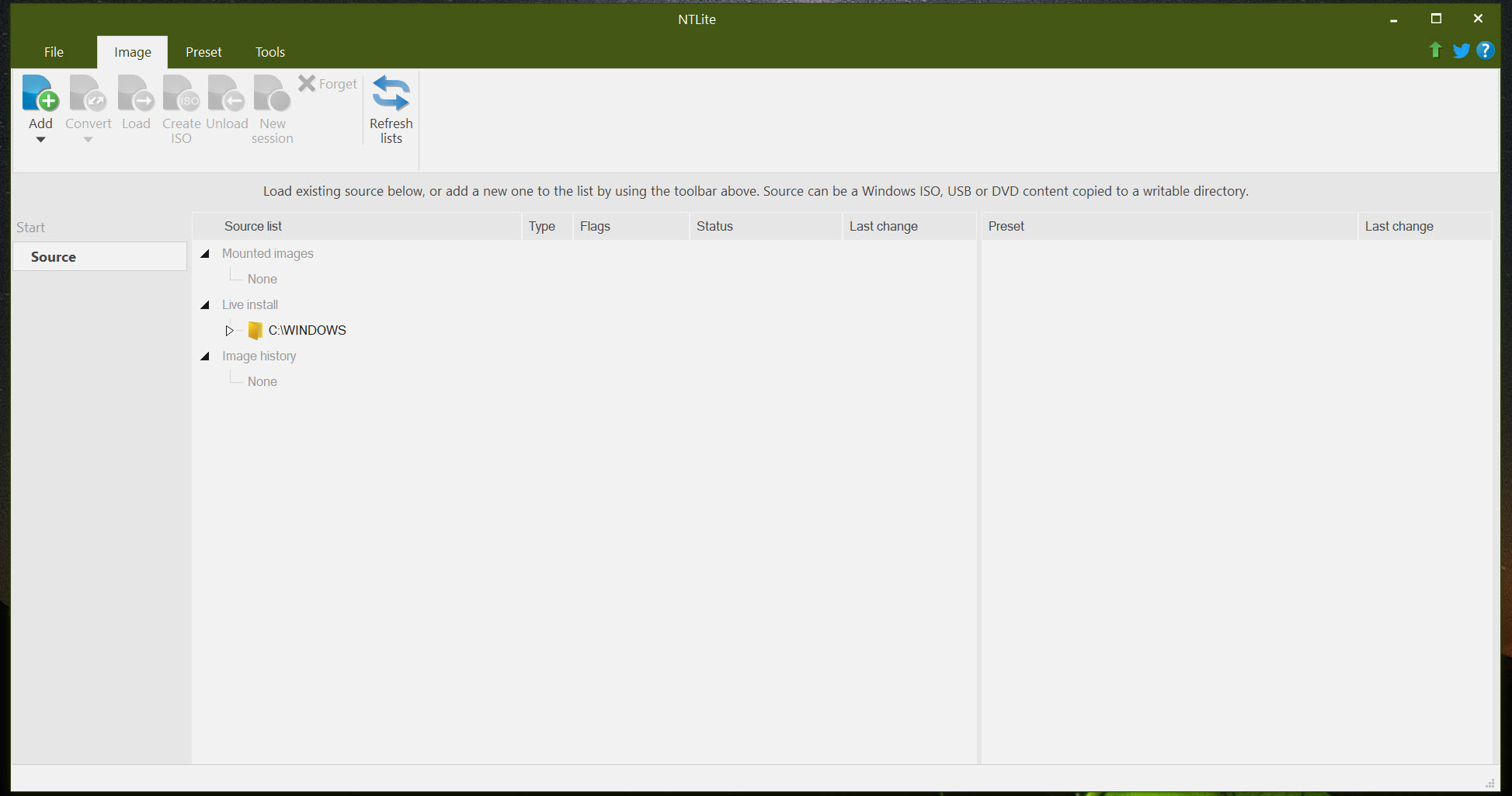
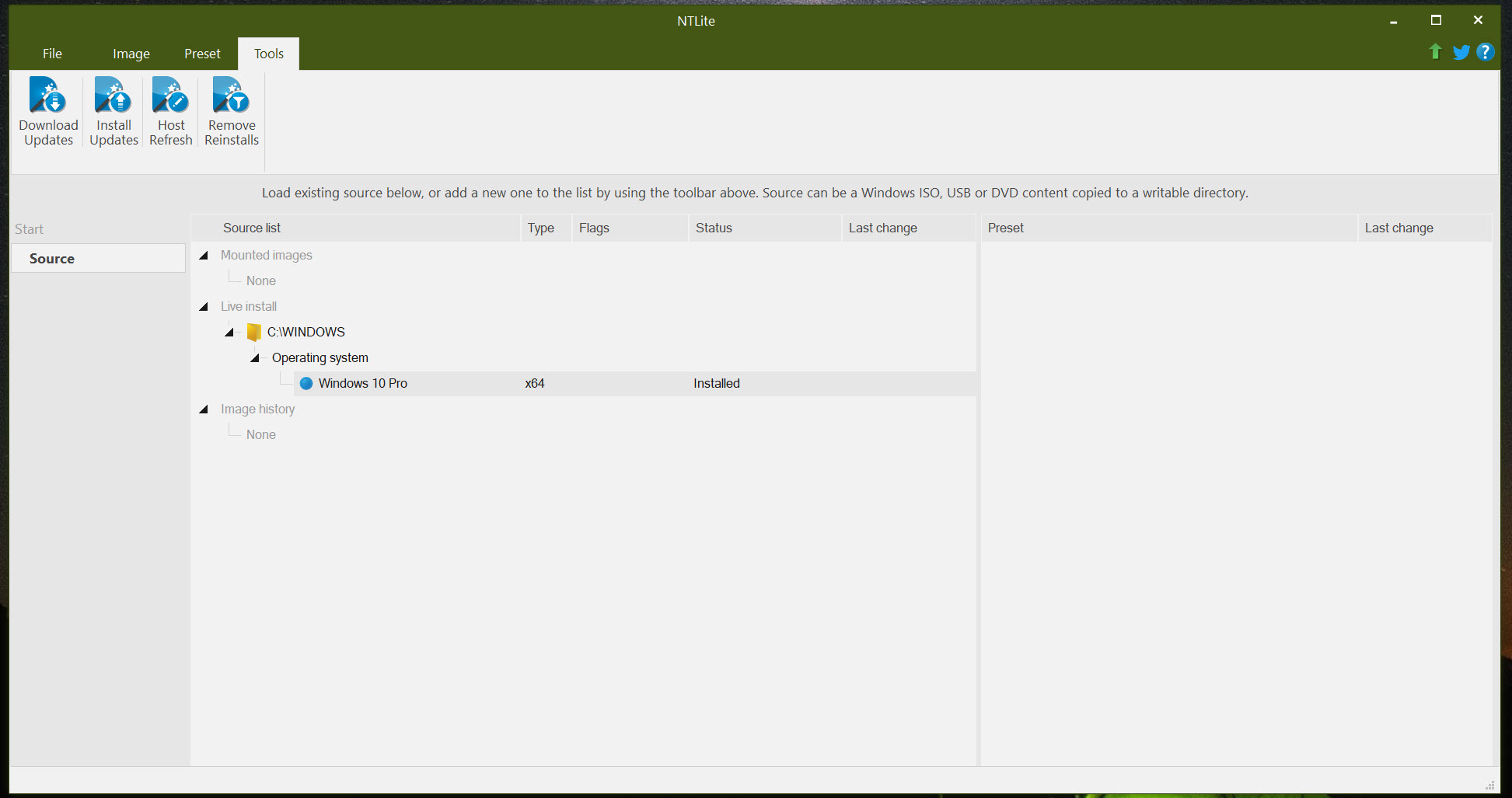
The live install feature applies modifications to a Windows installation that’s already running rather than only working on installation images. Connect to the running system through the application’s interface, and you can remove components, apply tweaks, integrate drivers and updates, and perform various other operations on the live OS.
This capability matters for users who want to slim down an existing installation without the work of building a custom image and reinstalling. The component removal works similarly to the image-based version, with the same warnings about dependent functionality and the same color coding for risk levels. The changes take effect immediately, with reboot prompts when components require restart to apply changes.
The live mode is useful for incremental cleanup of installations users already have set up the way they want them. Rather than committing to a complete reinstall, you can experiment with removing specific components and reverting if something breaks.
For users uncertain whether a particular removal will cause problems, this incremental approach produces less risk than image-level changes that only manifest after deployment.
Tweaks and configuration before installation
The Tweaks section exposes hundreds of Windows settings that you can configure before the installation runs. Privacy settings, telemetry options, default browser behaviors, file association preferences, taskbar and Start menu configurations, system services to disable, performance options, security settings, and various other categories cover the configuration scope that would otherwise require manual setup after installation.
For users who consistently configure new Windows installations the same way, having all those configurations applied during install rather than manually afterward saves the cumulative time. The applied tweaks also persist correctly across the installation, where some manual after-install changes get reset by Microsoft’s defaults during update cycles or feature updates.
The tweak categories handle the changes most users actually want without requiring registry expertise. Disable telemetry. Turn off Cortana. Set Windows Update to manual mode. Disable advertising IDs. Stop Windows from automatically reopening applications after restart. Configure File Explorer to show file extensions and hidden files by default.
Enable the classic right-click context menu in Windows 11. The list goes on across multiple categories of typical user preferences.
ISO creation and bootable media preparation
After all your modifications are applied, the application produces a bootable ISO file ready to be burned to DVD, written to USB, or used directly with virtualization software. The ISO creation handles the technical details (proper boot sector configuration, file structure, hash verification) that would otherwise require knowledge of disk imaging tools.
For USB deployment, third-party tools like Rufus or the Windows Media Creation Tool handle writing the ISO to USB sticks. The application doesn’t include direct USB writing functionality, but the produced ISOs work with any standard USB writing tool. Once written to USB, the prepared installation runs from any computer that supports USB boot, with the customizations applied automatically during install.
The ISO format also works for virtual machine installations through VirtualBox, VMware, Hyper-V, and other virtualization platforms. For testing your customizations before deploying to real hardware, virtual machine installation provides a fast feedback loop. Build an image, test in a VM, identify problems, rebuild with corrections, repeat until the image produces the result you want before committing to physical deployment.
Image splitting and ESD/WIM conversion
For installations larger than the 4 GB FAT32 file size limit (which affects USB drives that need FAT32 for UEFI compatibility), the image splitting feature splits the install.wim file into smaller SWM segments that fit within the size limit. Without this splitting, large customized images can fail to boot from FAT32 USB media even when they otherwise work correctly.
The ESD/WIM conversion handles the format differences between Microsoft’s compressed ESD format used in Windows update delivery and the WIM format that supports easier modification. Convert ESD to WIM for editing, make your modifications, and optionally convert back to ESD for tighter compression in the final ISO. The conversions happen through the application’s interface rather than requiring command-line DISM operations.
For users dealing with the various Windows image formats Microsoft uses across different distribution channels (retail ISOs, Volume Licensing media, Update Catalog distributions, MSDN/VLSC downloads), having the format conversion capabilities built in eliminates dependency on external tools. The application handles the format complexity so you can focus on the actual customization work.
Tier differences and feature limitations
The free tier provides core functionality with some limits. Component removal works but with restrictions on which components can be removed. Update and driver integration is available but with some limitations on advanced scenarios. The unattended installation feature has reduced configuration options. Various other capabilities are partially available rather than fully present.
The Home tier adds full unattended setup, removes the component removal restrictions, and includes various other capabilities the free tier doesn’t provide. For typical home users wanting comprehensive customization without commercial use, this tier provides full functionality at modest cost.
The Business and Pro tiers add commercial use rights, parallel image processing for users working with multiple images simultaneously, and various advanced features. The Enterprise tier includes the full feature set including command-line automation that lets the application be integrated into automated deployment pipelines. The Developer tier targets users who want to support development and includes the full feature set along with priority support.
For users uncertain which tier fits their needs, the free version is sufficient to evaluate the application’s basic capabilities. The paid tiers become appropriate when specific advanced features become limiting in the free version, with the upgrade path available without losing your existing configuration work.
Comparison with the alternatives
The competitive context for image customization is small but worth understanding. MSMG ToolKit is a free batch-script-based tool covering similar capabilities through a command-line interface. The capability set is comparable in some ways but the user experience requires comfort with batch scripts and configuration files. Users wanting maximum control with command-line workflows sometimes prefer it. Users wanting GUI-driven customization find this software more accessible.
Win Toolkit (formerly Win 7 Toolkit) targets earlier Windows versions specifically. For users still working with Windows 7 deployments, Win Toolkit covers some scenarios this software doesn’t focus on as heavily anymore. For Windows 10 and 11 work, this software provides current support that older alternatives don’t match.
DISM (the Microsoft-provided Deployment Image Service and Management tool) handles many of the same operations through command-line invocation. For users comfortable with PowerShell scripting and DISM syntax, the built-in tool covers most basic image manipulation without third-party software. The trade-off is that DISM requires substantial expertise and produces no visual feedback, while this software wraps the same operations in an interface that doesn’t require learning the command syntax.
For the specific use case of Copilot and AI removal that’s brought new attention to image customization recently, this software is the most accessible option. ExplorerPatcher and similar runtime modification tools can hide some AI features but don’t actually remove the underlying components. Group Policy and registry modifications can disable features but don’t reduce the installed footprint. NTLite‘s component removal at image level produces genuinely cleaner results than runtime modification approaches.
Considerations and limitations
Aggressive component removal can produce installations that fail to update properly through standard Windows Update channels. Some Microsoft updates assume specific components are present and fail when they encounter customized installations missing those components. Users planning to keep their custom installations updated long-term should be conservative about which components they remove, especially around the servicing infrastructure itself.
The application requires understanding what components actually do before removing them. The included warnings help, but ultimate responsibility for removal decisions falls on the user. Removing components you depend on (even unknowingly) produces broken installations, and recovering from a broken custom image typically means rebuilding from scratch rather than fixing in place. Building experimentally in a virtual machine before committing to production deployment matches the risk reasonably.
Some specific Windows features have evolved to make removal harder across recent versions. Microsoft has gradually integrated certain components more tightly with the OS core, which means clean removal is less feasible than it was in earlier Windows versions. The application updates respond to these changes, but specific features remain harder to fully remove than others. Users with very specific removal goals should verify current support before assuming everything they want to remove is removable.
The unattended installation features work but require careful XML configuration testing. Mistakes in the autounattend.xml produce installations that hang at specific phases, fail to create user accounts correctly, or skip steps that need manual configuration. Testing the unattended setup in a virtual machine before deploying to real hardware catches these issues without producing broken physical installations.
The free tier’s limitations push users toward paid tiers more aggressively than some users prefer. The paid tiers are reasonably priced for their capabilities, but users committed to free software for philosophical reasons may find some functionality genuinely unavailable in the free version.
Conclusion
For users who want their Windows installations to look and behave the way they want rather than the way Microsoft ships them, NTLite delivers serious customization capability through an interface that doesn’t require deep system administration expertise. The combination of component removal, update integration, driver integration, unattended installation, and the recent additions for stripping Copilot and AI features covers the practical scenarios that motivate users to customize Windows in the first place.
The reasons to consider alternatives are mostly about specific preferences. Users committed to fully free software with command-line workflows find MSMG ToolKit fitting their philosophy better.
Users with sophisticated PowerShell skills can accomplish much of the same work through DISM directly. Users wanting only minor cleanup of installed Windows may find runtime tools sufficient without committing to image-level customization work.
But for the broader category of users who want clean Windows installations with their preferred customizations baked in, this software remains one of the most capable options available, with active development that’s responding directly to current concerns about what Microsoft is putting into modern Windows.
Pros & Cons
- Component-level removal of Windows features including Copilot, AI features, OneDrive, and many others
- Update integration eliminates post-install update cycles for deployed images
- Driver integration includes hardware support directly in the installation image
- Unattended installation through autounattend.xml automates deployment for multiple machines
- Live install editing applies modifications to running Windows systems
- Hundreds of tweaks and settings configurable before installation runs
- ISO creation produces bootable media ready for USB or virtual machine deployment
- Image splitting handles large customized installs that exceed FAT32 size limits
- Active development with updates following Microsoft's Windows release cadence
- Free tier covers basic functionality for users evaluating the application
- Aggressive component removal can break Windows Update functionality
- Free tier has feature limitations that push users toward paid tiers
- Removal decisions require understanding which components are actually safe to remove
- Some Windows features have become harder to remove across recent versions
- Unattended configuration requires careful XML testing to avoid broken installations
- Less appropriate for users uncomfortable with system-level modification work
Frequently asked questions
This software is a Windows configuration tool that modifies Windows installation images and live installations to remove unwanted components, integrate drivers and updates, configure unattended installation, apply hundreds of system tweaks, and produce custom installation ISOs. It supports Windows 7, 8, 8.1, 10, 11, and Server editions, with recent updates adding the ability to strip Copilot and AI features from Windows 11 25H2 installations.
The application targets users who want customized Windows installations rather than what Microsoft ships by default. Common use cases include creating slim Windows installations for older hardware, preparing custom enterprise deployment images, integrating drivers and updates so they're present after install, automating Windows deployment through unattended installation, removing components users don't want (Copilot, OneDrive, Edge, Teams, Cortana, telemetry features), and producing bootable USB media with all customizations baked in.
Yes, the application supports Windows 11 including the recent 25H2 release. Recent updates added explicit support for removing Copilot and other AI features from Windows 11 installations, with component removal at the image level producing genuinely cleaner results than runtime suppression. The Windows 11 support extends to all the standard customization features (component removal, update integration, driver integration, unattended installation) that work on earlier Windows versions.
The Home tier provides full feature access for non-commercial use, while the Pro tier (and Business, Enterprise, Developer tiers above it) adds commercial use rights and various advanced capabilities. Pro includes parallel image processing for users working with multiple images simultaneously. Enterprise adds command-line automation for integration into automated deployment pipelines. Developer includes priority support and additional features. The free tier covers basic functionality with some feature limitations that the paid tiers remove.
The application produces an ISO file containing your customized Windows installation. To write that ISO to USB, use a third-party tool like Rufus or the Windows Media Creation Tool, which handle the actual USB writing process. The application doesn't include direct USB writing functionality. Once the ISO is written to USB, the prepared installation runs from any computer that supports USB boot, applying all customizations automatically during install.
Both tools handle similar customization scenarios, but with different user experiences. MSMG ToolKit is free and operates through batch scripts and configuration files, requiring comfort with command-line workflows. NTLite wraps the same general capabilities in a graphical interface that's more accessible to users without command-line experience. For users wanting maximum control through scripting, MSMG ToolKit may fit better. For users wanting GUI-driven customization, this software is generally easier to use.
Yes, the recent update added explicit support for removing Copilot and other AI features from Windows 11 25H2 installations. The removal happens at the component level, which means the AI features are genuinely not present in the resulting installation rather than just hidden through configuration. This produces durable results that don't get re-enabled by future Windows updates the way settings-level disabling sometimes does.
The application includes update integration features that embed Microsoft Update files (downloaded as MSU or CAB files) into your installation image. The result is a Windows installation that's already current after install rather than requiring update downloads and installation cycles afterward. To use it, download the updates you want to integrate from the Microsoft Update Catalog, add them to the image through the Updates section in the interface, and proceed with normal image creation.


