

Move Mouse
About Move Mouse
A machine left alone locks the screen, dims the display and reports you as away. Move Mouse prevents all three by producing small amounts of activity on a timer, whether that is moving the pointer, clicking, sending a keystroke, or running something you wrote yourself.
Move Mouse installs nothing and needs no administrative rights, so it runs from a folder and leaves when you delete it.
The design is considerably more thoughtful than the category suggests, and the reason people install it is worth addressing honestly rather than pretending otherwise.
It gets out of your way when you are working
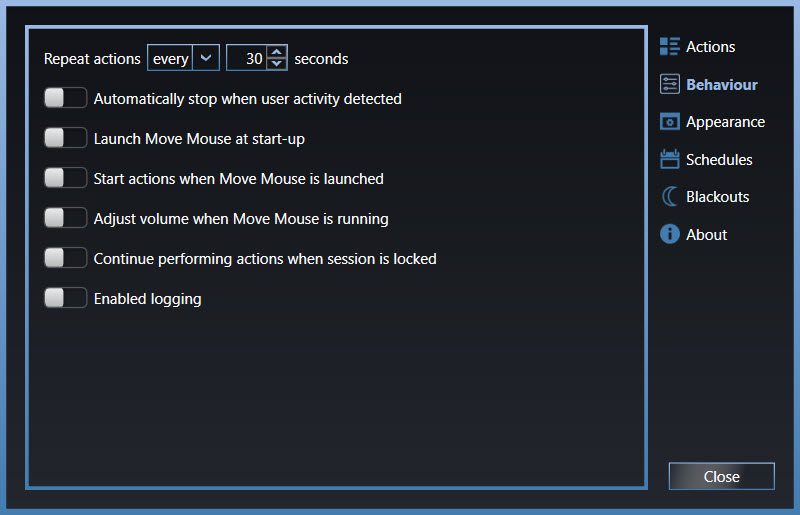
The Move Mouse behaviour that separates a well-made tool from a crude one. Detected user activity pauses it automatically and it resumes once you go idle again. So it is not fighting you for the pointer while you are trying to use the machine, which is the complaint people have about the simpler alternatives.
Running on battery pauses it too, if you enable that, since draining a laptop to keep a session alive while unplugged is rarely the intention.
A coloured ring shows which state it is in at a glance, meaning idle, counting down, executing, paused for your activity, paused on battery, or asleep during a scheduled quiet period.
For the crudest version of the same idea, with a timer and nothing else to configure, Mouse Jiggler does one thing and stops.
Schedules, and blackout windows
Move Mouse scheduling goes beyond starting and stopping, which is what makes it usable as something permanent. Start and stop times can be set, so it runs during the hours you want and not otherwise.
Blackout windows do the reverse, defining periods where it deliberately sleeps despite otherwise being active. That covers the case of wanting it running generally but definitely not at particular times.
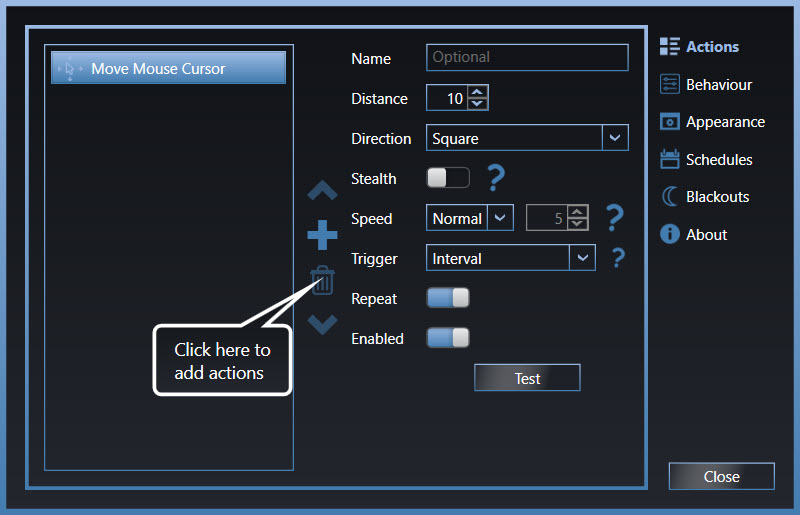
Each action carries its own trigger, meaning perform on start, at each interval, or on stop, which allows a sequence rather than a single repeated twitch.
The interval can be random
A small Move Mouse option with a specific purpose, and it deserves stating plainly.
Rather than a fixed interval, a lower and upper bound can be set so the timing varies between them. Activity then arrives irregularly rather than precisely every thirty seconds.
The reason that matters follows from why people install this, which is the next section.
Why most people install it, and what that risks
Being direct about Move Mouse, because the dominant use is obvious and the useful information is practical rather than moral.
The common reason is keeping a status indicator green and a session counted as active while stepping away. The maker’s own description mentions remote sessions and long-running processes, and everybody understands the other reading.
Here is the part that decides it. Software detecting simulated activity exists, is described as increasingly common, and works by analysing whether input has the characteristics of a person rather than a program. Some of it inspects at a level below ordinary applications.
More telling is a first-hand account from somebody who used a hardware device rather than software, not plugged into the computer at all, and was still detected and disciplined despite good work and no complaints about availability.
So the practical summary is that this is not reliably invisible, the hardware route is not safer, and whether it is permitted is a question about your employment rather than about the software. The tool makes no claims either way.
The uses that are not that
Being equally clear that the legitimate Move Mouse cases are real rather than a fig leaf. A long process that must not be interrupted by sleep, meaning a render, a transfer, a backup or an installation, is the original reason tools like this exist.
A display showing a dashboard, a monitoring screen or an information board needs to stay awake indefinitely with nobody touching it.
A presentation running unattended is the third, where the screen going dark mid-demonstration is the failure everybody has witnessed.
For those cases the system’s own power settings cover most of it without any software, which is worth trying first. This becomes useful when the settings are locked by policy, or when the requirement is a session staying active rather than a screen staying lit.
For the opposite requirement of turning the display off deliberately while the machine keeps working, BlackTop does that with a hotkey.
Scripts, for anything else
The Move Mouse extension point most people never touch, and it changes what the software is. Custom scripts can be triggered by the same schedule and interval machinery, so the thing being performed at each interval does not have to be a mouse movement at all.
That makes it a small scheduler with pause-on-activity behaviour attached, which is a more interesting description than a jiggler. Anybody wanting something run every few minutes only while they are away has the parts here.
For general scripting and hotkeys across the desktop rather than on a timer, a scripting language built for automating the desktop covers that ground properly.
Conclusion
Move Mouse is better built than its category deserves. Pausing when you actually use the machine, pausing on battery, scheduling, blackout windows and random intervals are all signs of somebody thinking about the problem rather than shipping a timer that twitches the pointer.
Be realistic about the main reason people install it. Simulated activity is detectable, detection is becoming more common, and a documented case exists of somebody being caught using hardware that was never connected to the machine. For keeping a render alive overnight or a dashboard lit, none of that applies and the tool is excellent.
Pros & Cons
- Pauses automatically when you use the machine and resumes when idle
- Pauses on battery power if you want it to
- Schedules and blackout windows, so it runs only when intended
- Random intervals rather than fixed timing
- Actions triggered on start, at intervals or on stop, so sequences are possible
- Custom scripts can replace the movement entirely
- Runs without installation or administrative rights
- Simulated activity is detectable, and detection software is increasingly common
- Hardware alternatives are not safer, with documented cases of those being caught
- Whether it is permitted depends on your workplace rather than on the software
- The system's own power settings cover the legitimate cases without any software
- More configuration than somebody wanting a simple timer expects
Frequently asked questions
Yes. Software that identifies simulated activity exists and is increasingly common, analysing whether input behaves like a person or a program. There is also a documented case of a hardware device, not even connected to the computer, being detected.
No, if you enable the behaviour that pauses on detected activity. It stops when you start using the machine and resumes once you go idle, which is what separates it from cruder tools.
Yes, through start and stop schedules, and blackout windows that make it sleep during defined periods even when it would otherwise be active.
No. It runs without installation and without administrative rights, so it can be kept in a folder and removed by deleting it.


