

KeyTweak
About KeyTweak
KeyTweak changes what a key on the keyboard does, permanently and for the whole system. Click a key on the picture of a keyboard, choose which key it should behave as, or choose to disable it, and press Apply.
After the next sign-in the physical key sends the new code everywhere, in every program, at the login screen and in games that read the keyboard directly. Caps Lock becomes a second Control. A broken letter is moved to a key you never use. The key that opens a search panel is switched off for good.
It does this by writing a scancode map into the registry, the same mechanism SharpKeys uses, which means the operating system itself performs the remap and nothing has to run in the background.
KeyTweak adds a picture and a teach mode on top of that mechanism, and it stops exactly where the mechanism stops. Understanding that boundary is the whole review.
Clicking a key and choosing another
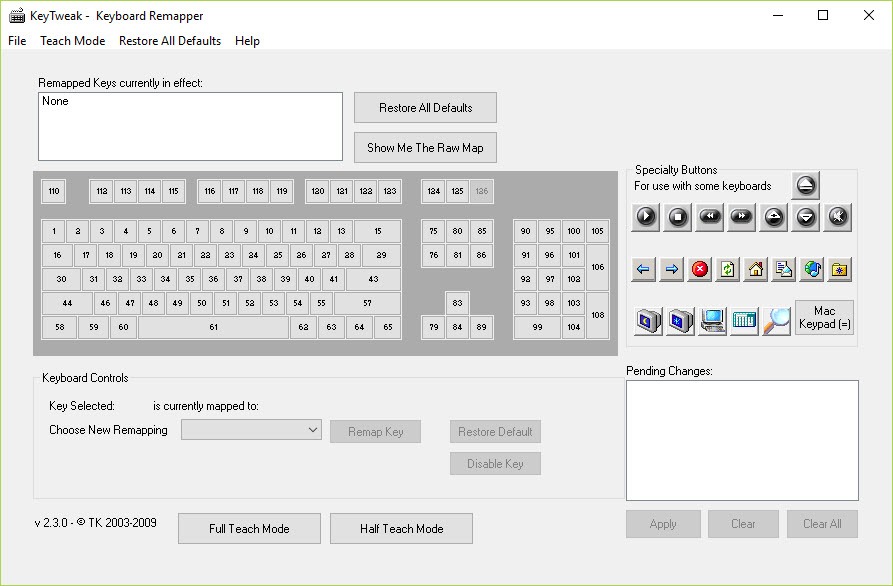
The KeyTweak window is a drawing of a full keyboard with each key numbered. Click a key and its name appears below, with a dropdown listing every key it can be turned into and a Remap Key button. Disable Key removes it entirely.
The pending changes accumulate in a list at the bottom, so several remaps can be queued and applied together. Restore All Defaults wipes every mapping the program has made in one click, which is the button to remember if a remap goes wrong.
The multimedia and browser keys found on many keyboards have their own list, so a Mail key can become Play or a Calculator key can become Mute. Apply writes the map and asks to restart.
Signing out and back in is enough on most systems, but a full restart is the dependable route, and nothing changes until one or the other happens.
Teach mode for keys the picture does not show
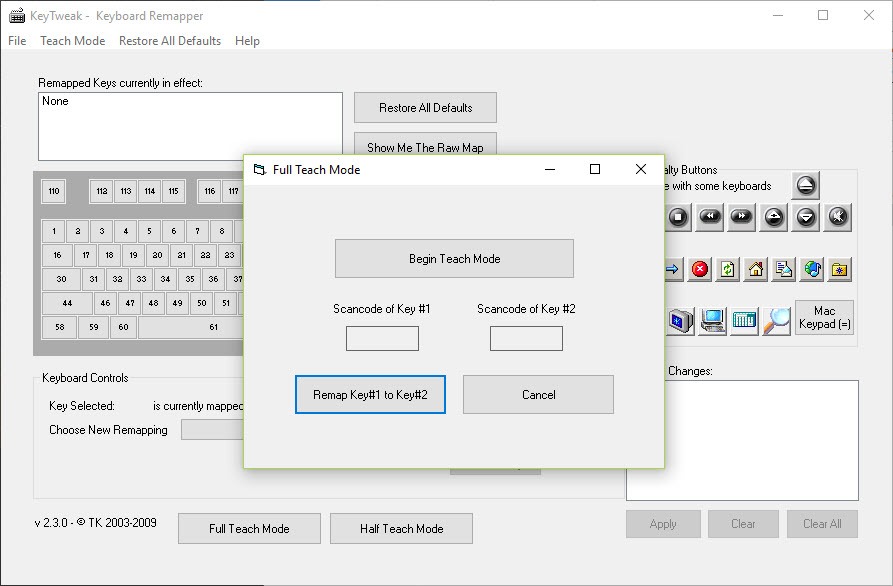
Laptops and compact keyboards carry keys the drawing does not have. Full Teach Mode handles them. Press the button, press the physical key you want to change, then press the key whose behaviour it should adopt, and the program records both scancodes and adds the mapping.
Half Teach Mode records only the source key by pressing it, then lets you pick the destination from the dropdown. That suits the case where the target is on the picture but the source is not.
Teach mode also reveals what a mystery key on an unusual keyboard actually sends, since the program displays the scancode it receives.
What a scancode map can and cannot do
Because the operating system applies the map before any program sees the key, a remap made with KeyTweak works everywhere, including places where software remappers fail. Games with anti-cheat, remote desktop sessions, the login screen and full-screen applications all see the new key. Nothing runs, so nothing crashes, and there is no process to be killed or blocked.
The same mechanism sets the limits. One key can become one other key, and that is all. There are no combinations, so a key cannot become Ctrl plus C. There is no layering, so a key cannot do one thing normally and another with a modifier held.
There is nothing per application, so a remap that suits one program applies to every other. And the map is per machine, not per user or per keyboard, so plugging in a second keyboard inherits the same changes.
For anything conditional or combined, a scripting tool that rewrites keys on the fly is the next step, with a process that must be running.
Rough edges
The keyboard picture in KeyTweak is a standard layout, so a key that sits elsewhere on your board has to be found by its name or taught. Some keys on the dropdown, notably the Pause key and a few of the far-right cluster, do not always take a mapping cleanly. Administrator rights are needed, since the map lives in a protected part of the registry.
And because every change waits for a sign-out, testing a mapping takes a minute rather than a second, so queue what you want and apply once.
Conclusion
KeyTweak is for the person with a broken key, a Caps Lock they never wanted or a laptop key that opens something annoying, who wants it changed once and never thought about again. Because the operating system does the work, the change is total and nothing has to run.
Anyone who wants a key to mean different things in different programs, or to fire a combination, has outgrown the mechanism this program wraps and should pick a scripted remapper instead. For a plain, permanent swap it remains the quickest way.
Pros & Cons
- Remaps or disables any key for the whole system with no background process
- Works at the login screen, in games and over remote sessions
- Teach mode captures keys the picture does not show
- Restore All Defaults undoes every mapping in one click
- Multimedia and browser keys can be reassigned too
- One key to one key only, with no combinations or layers
- Applies to every program and every user on the machine
- Changes take effect only after signing out or restarting
- Interface and keyboard drawing are dated
Frequently asked questions
The scancode map is read at sign-in. Sign out and back in, or restart the machine, and the new mapping takes effect. The program does not remap live.
No. A key can only become one other single key. Combinations, macros and per-program behaviour need a software remapper that stays running.
Open the program and click Restore All Defaults, then sign out and back in. Every mapping it created is removed. Individual mappings can be cleared from the pending list before applying.


