

Hotspot Shield
About Hotspot Shield
Hotspot Shield is built around a proprietary VPN protocol called Catapult Hydra, which is the central reason to choose this software over alternatives. Where most VPNs run on open standards like OpenVPN, WireGuard, or IKEv2, Catapult Hydra is custom-built by Pango, the parent company, and optimized specifically for speed.
In independent benchmarks across the years, this software has consistently landed among the fastest VPNs available, with download speeds that frequently outperform competitors using standard protocols on the same connections.
Beyond the protocol, the service runs on more than 80 server locations spanning the global network, supports up to 10 simultaneous device connections, and includes streaming optimization for Netflix, Hulu, BBC iPlayer, Disney+, HBO Max, and various other geo-restricted services that typically detect and block VPN traffic.
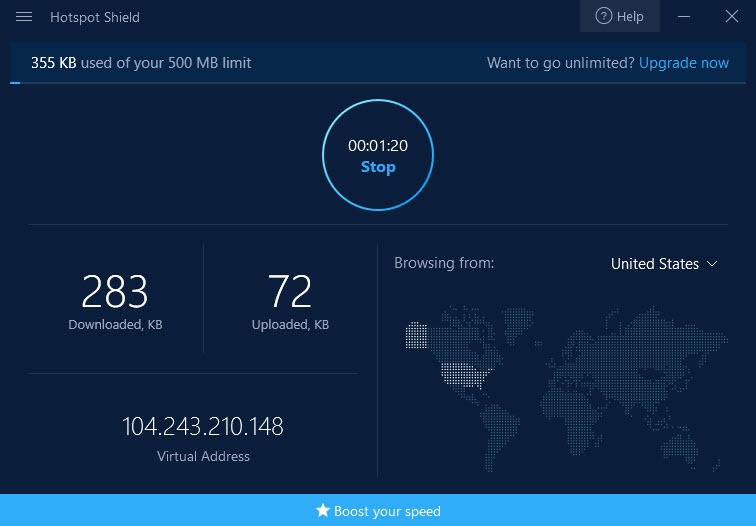
The free tier provides 500 MB of daily data on a single US location for users testing the protocol. The Premium tier removes the data cap and opens up the full server network alongside the streaming-optimized infrastructure.
Catapult Hydra and why it matters
Most VPNs route your traffic through a single encrypted tunnel using one of the standard open-source protocols. Catapult Hydra works differently. The protocol uses multiple parallel connections to the VPN server simultaneously, with traffic distributed across them and reassembled on the other side.
The mechanism is conceptually similar to how BitTorrent downloads pull pieces from multiple sources, except applied to the relationship between your device and a single VPN server.
The practical effect is genuine speed advantage in real-world conditions. Where standard protocols can lose 40 to 60 percent of available bandwidth to encryption overhead and routing inefficiencies, Catapult Hydra typically retains 80 to 90 percent. On a 500 Mbps connection, that’s the difference between a VPN that feels unusable for HD streaming and one that feels essentially transparent. Independent reviewers from PCMag, TechRadar, and Tom’s Guide have repeatedly placed this software at or near the top of speed rankings.
The trade-off is that Catapult Hydra isn’t open source. OpenVPN and WireGuard can be independently audited by anyone who wants to inspect the code; Pango’s protocol cannot. For users whose primary concern is performance, this rarely matters in practice.
For users whose primary concern is verifiable cryptographic privacy, the closed nature is a meaningful limitation that competitors using open protocols don’t share.
Streaming support that actually unblocks what it claims to unblock
The streaming arms race is brutal. Netflix, Hulu, BBC iPlayer, and Disney+ actively detect VPN traffic and block known VPN IP addresses faster than most providers can rotate them. Hotspot Shield invests substantial effort in maintaining streaming functionality, with dedicated server pools allocated specifically for these services and rotation cycles fast enough to stay ahead of detection.
In practice, this means you can connect to a US server and access US Netflix from anywhere in the world, switch to a UK server for BBC iPlayer, jump to a Japanese server for Japan-exclusive content.
The reliability isn’t perfect (no VPN’s is, given the active blocking on the streaming side), but the success rate is genuinely good compared to many alternatives that quietly fail more often than their marketing suggests.
The Free tier specifically does not include streaming optimization. The single US server available in the free version typically gets blocked by major streaming services within minutes of any unblocking attempt, and the data cap of 500 MB per day kills any meaningful video session anyway. Streaming through this software is a Premium-only proposition.
Server network and how to think about it
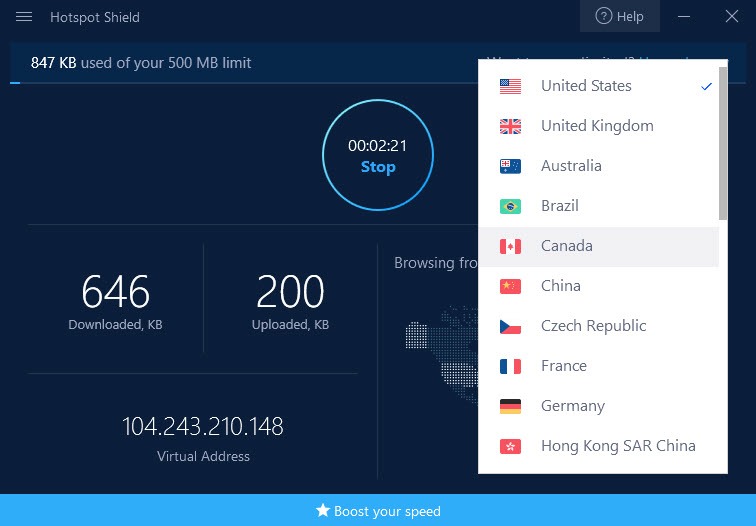
The 80+ server locations cover the major regions you’d expect from a competent VPN: every meaningful country in Western Europe, the US (with multiple cities), Canada, Australia, Japan, Singapore, Hong Kong, India, Brazil, and various others. Some regions get city-level selection (multiple US cities, multiple UK cities, multiple cities in major European countries), which matters for users wanting to optimize latency or appear from a specific metropolitan area.
The auto-connect feature picks the fastest available server based on current load and your physical location, which works well as a default for users who don’t have specific country preferences. Manual server selection takes about three clicks through the interface, and the speed test feature lets you check actual throughput before committing to a session on a specific server.
Coverage in restrictive countries is an area where the network shows its limits. Mainland China, Russia (post-2022 restrictions), and a handful of others actively block VPN traffic at the protocol level, and Catapult Hydra hasn’t been reliably bypassing the Great Firewall in the way some specialty providers manage.
Users in those regions should evaluate carefully or pair the service with additional obfuscation tools.
Performance in everyday use
The download speed advantage of Catapult Hydra holds up across most testing conditions. On a 1 Gbps fiber connection in good network conditions, this software typically delivers 800-900 Mbps through nearby servers, dropping to 400-600 Mbps for transcontinental connections (US to Europe, for example). On a more typical 100 Mbps home connection, you’ll see negligible speed loss for most use.
Latency is a different story. VPNs always add latency proportional to the physical distance between you and the server, and Catapult Hydra’s multipath approach doesn’t escape this fundamental limitation. Gaming through this software works fine for non-competitive games, but adds enough ping that competitive multiplayer becomes meaningfully harder.
For gaming-specific use, dedicated gaming VPNs or multipath gaming optimizers serve better than a general-purpose VPN.
Connection establishment is fast. Click connect, the tunnel typically establishes within 2 to 5 seconds depending on server load. Reconnection after network changes (switching from WiFi to ethernet, for example) happens automatically and quickly enough that most users won’t notice the brief gap.
Privacy practices and the company history
The privacy story here requires honest discussion. In 2017, the Center for Democracy and Technology filed a complaint with the FTC alleging that AnchorFree (now Pango) was logging user data and serving targeted ads despite marketing claims about privacy. The complaint argued the practices contradicted the company’s stated no-logs policies. The FTC didn’t pursue formal action, but the incident damaged the brand’s reputation among privacy-focused users.
Since then, Pango has updated its privacy policy multiple times and now states explicitly that the service doesn’t log browsing activity, IP addresses, or session data. Whether to trust these updated claims comes down to individual judgment about the company’s track record.
Users who prioritize verifiable privacy practices typically prefer providers like ExpressVPN, NordVPN, or Mullvad, which have had independent third-party audits of their no-logs claims.
Hotspot Shield has not had comparable independent audits, though the company points to its updated policies and ownership structure as evidence of changed practices.
For users whose primary concern is geo-unblocking, public WiFi protection, or general traffic encryption against ISPs and casual surveillance, the privacy considerations matter less. The encryption itself works (AES-256-GCM through Catapult Hydra), and traffic between your device and the VPN server is not readable to anyone in the middle.
The question is purely about what the VPN provider itself can see and what they do with that visibility.
Considerations and limitations
The proprietary protocol is the central trade-off. Speed advantages are real, but the lack of independent code audit means privacy guarantees rest on trusting Pango rather than on verifiable cryptography. Users for whom this matters should evaluate accordingly.
The free tier is genuinely limited. 500 MB per day is enough for a few hours of basic browsing, not enough for any significant download, video session, or sustained use. Treating the free version as a long-term solution rather than a trial is a setup for frustration.
Customer support has been variable across the years, with some users reporting slow response times to technical issues and others getting prompt help. The support quality seems to depend on which channel you use and which region you’re in, with English-language live chat generally working faster than email-based support.
China and similarly restrictive regions are difficult for this service. The Great Firewall has gotten progressively better at detecting and blocking Catapult Hydra traffic, and reliability in those regions varies dramatically across days and weeks. Users with critical needs in heavily censored countries should test thoroughly before committing.
Conclusion
For users whose VPN priorities are speed and streaming unblocking, Hotspot Shield is one of the few services that genuinely delivers on both. The Catapult Hydra protocol is faster than the open alternatives in real testing, the streaming unblocking actually works for the major services it claims to support, and the 80+ country network covers most geographic needs without gaps.
The reasons to look elsewhere are mostly about privacy verification. The closed-source protocol and the past controversies around logging mean the service can’t compete with audited providers like Mullvad or ExpressVPN on verifiable privacy guarantees.
If your VPN use is heavily privacy-sensitive (journalists, dissidents, users in adversarial environments), the trade-offs probably push you toward those alternatives despite their slower protocols. For everyone else, the speed and streaming advantages are real and worth weighing seriously.
Features & benefits
Pros & Cons
- Catapult Hydra protocol consistently delivers among the fastest VPN speeds in independent testing
- Streaming optimization actually unblocks Netflix, Hulu, BBC iPlayer, Disney+, and similar services
- 80+ server locations across most major countries with city-level selection in larger regions
- Up to 10 simultaneous device connections cover typical household use
- Auto-connect picks the fastest available server without manual configuration
- 45-day refund window allows extended evaluation of the Premium tier
- Browser extensions and router-level support for users wanting alternatives to system-wide clients
- Catapult Hydra is proprietary and cannot be independently audited like OpenVPN or WireGuard
- Past controversies around logging and advertising practices affect privacy reputation
- Free tier limited to 500 MB per day on a single US server, with no streaming access
- Reliability in heavily censored regions like mainland China is inconsistent
- No third-party audit of the no-logs policy comparable to what major competitors have published
- Customer support quality varies depending on channel and region
Frequently asked questions
This software is a VPN service built around the proprietary Catapult Hydra protocol, designed for high-speed encrypted connections through a global network of 80+ server locations. The service supports up to 10 simultaneous device connections, includes streaming optimization for Netflix, Hulu, BBC iPlayer, Disney+, and other geo-restricted services, and offers browser extensions, router-level setup, and various other deployment options.
This proprietary protocol uses multiple parallel connections to the VPN server simultaneously, distributing your traffic across them and reassembling it on the other side. The result is substantially less bandwidth loss compared to standard VPN protocols like OpenVPN or WireGuard, with real-world testing typically showing 80 to 90 percent of original connection speed retained versus 40 to 60 percent for the open standards. The trade-off is that the protocol is not open source and cannot be independently audited.
Reliability in mainland China has been inconsistent and trending worse as the Great Firewall improves at detecting Catapult Hydra traffic. Some users report functional connections, others report consistent blocking, with the situation varying across days and weeks. Users with critical needs in China should test thoroughly with a refundable subscription before relying on the service, or consider providers specifically designed for Chinese circumvention.
Yes, the Premium tier supports P2P traffic on most servers without throttling or bandwidth limits. Some specific server locations are optimized for torrenting workloads with better peer connectivity. The free tier's 500 MB daily cap makes it impractical for torrenting in any meaningful way regardless of policy.
This software typically beats both on raw speed thanks to Catapult Hydra, and tends to be more aggressive on streaming unblocking. ExpressVPN and NordVPN have stronger privacy reputations, with independent third-party audits of their no-logs policies that this service has not commissioned. Users prioritizing speed and streaming should consider this software seriously; users prioritizing audited privacy practices typically prefer the competitors despite their slower protocols.
Yes, the Premium subscription includes up to 10 simultaneous device connections under a single account. This covers most household scenarios including multiple family members, multiple devices per person, smart TVs running the app, and similar situations. Browser extensions and router-level installation provide additional flexibility for users wanting different deployment models.


