

goScreen
About goScreen
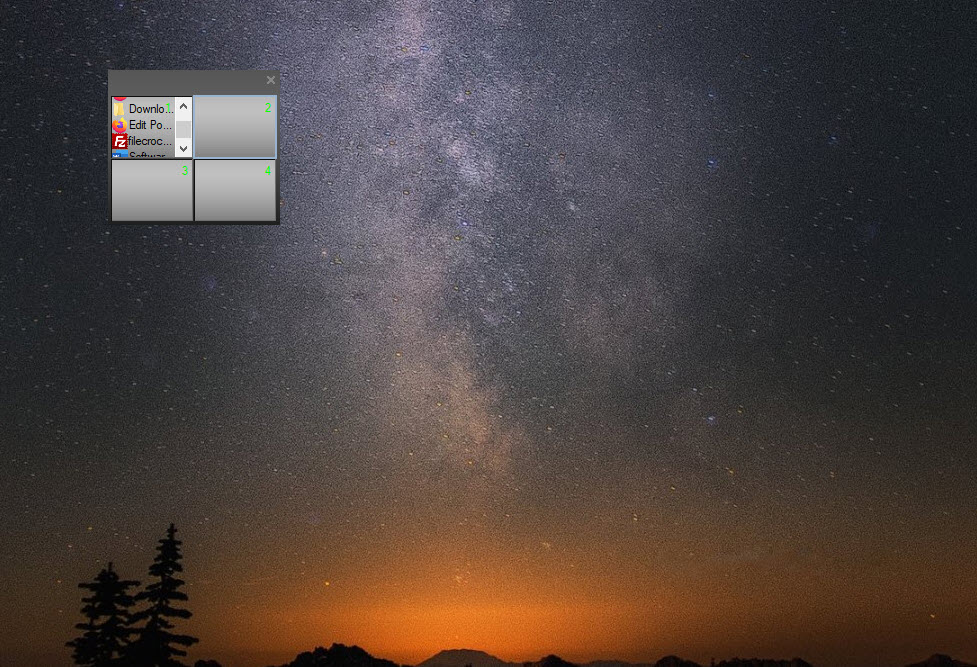
Most virtual desktop tools make your screen wider, a row of desktops you slide between. goScreen makes it deeper. It stacks up to 80 pages the exact size of your monitor on top of one another, shows one at a time, and gives each its own taskbar, its own wallpaper and colour, and its own name and icon. A program launched on page three lives on page three until you move it, and when you switch to page four its taskbar button goes with it.
The application has been doing this since long before the operating system grew a virtual desktop feature of its own, and it still does several things that feature does not. Pages can be hidden entirely, windows can be pinned to appear on every page, a hotkey restores a window to a saved position, and a rules engine decides where each new window lands.
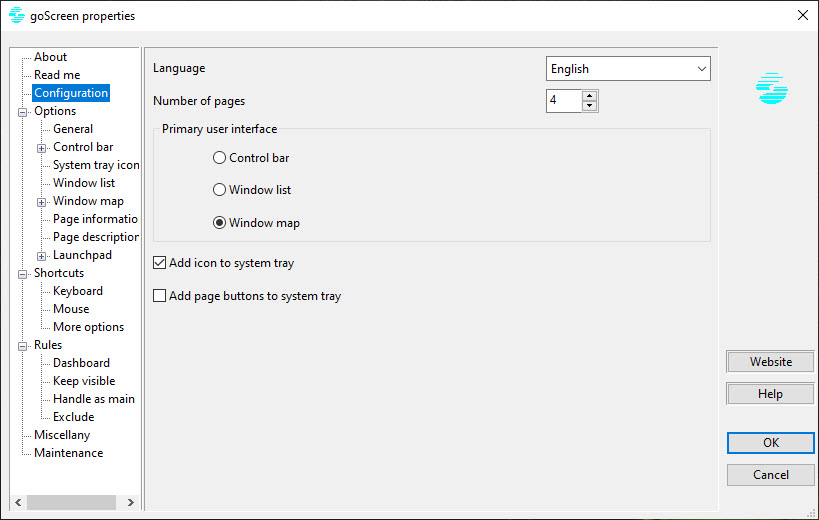
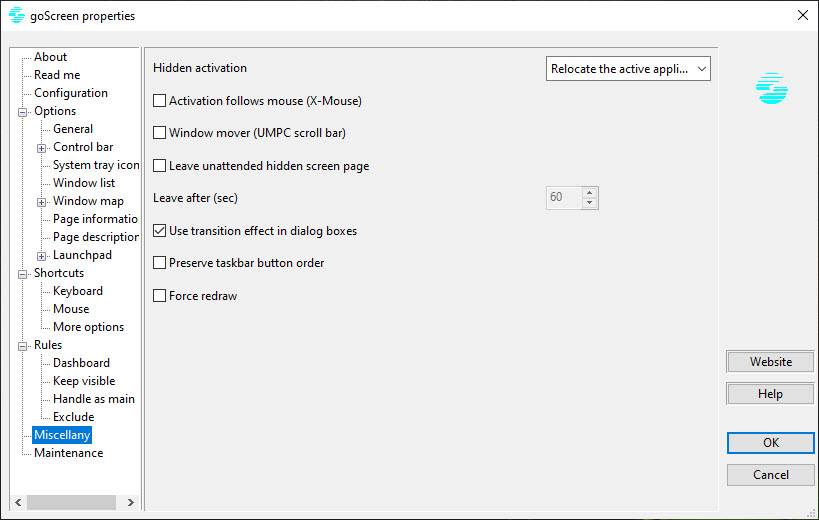
It competes with Dexpot for the title of most configurable desktop manager in its class, and configurable is the operative word. The settings dialogs are deep and dense, and they look their age.
Pages, and what you can hang on each one
Every page carries its own desktop colour and wallpaper, so a glance tells you where you are, plus a name and an icon that you can pull from an icon file or extract from any installed program. Pages sort numerically, alphabetically or in whatever order you drag them into, and a configuration can be copied from one page to another so you set up the look once.
A page information display, which the documentation compares to a TV channel number, pops up on each switch and can be styled or turned off.
Hidden pages are the odd feature here. Mark a page hidden and it drops out of every menu and shortcut list until you unhide it, which the documentation frames as a privacy measure and which in practice is a way to keep a messy project out of sight without closing it.
Nothing stops anyone who knows the hotkey, so treat it as a curtain rather than a lock.
Switching and the 3D transitions
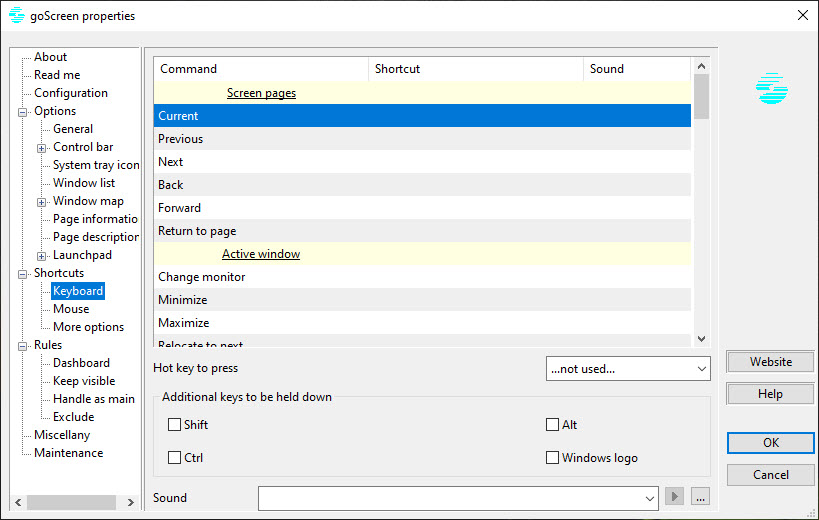
Each page gets its own hotkey, and every goScreen command, from next page to show desktop, can be bound to a keyboard or mouse shortcut of your choosing. Numeric keypad bindings only fire with NumLock on, which caused us a confused ten minutes.
The switch itself can be instant or animated. The transition effects include a rotating cube, a slide and a whirl, and on a modest laptop they stay smooth, though we switched them off after a day because a cube that spins forty times an hour stops being charming.
A Launchpad grid holds program shortcuts whose buttons can be resized and span several cells, with multi-line labels. Hover over any page entry and a tooltip lists the windows running there and the hotkeys defined, which is quicker than switching to check.
Rules decide where windows go
This is where goScreen pulls ahead of the built-in desktops. Window identification rules match on title, class or process, combine with AND, OR and NOT, and can include monitor affinity, so “any browser window whose title contains Jira, on the left monitor” is a legitimate rule. The matched window can be sent to one page, to several, or made sticky so it appears everywhere. A preferred placement (position plus size) can be recorded for a window and restored with one keystroke after a monitor unplug scrambles everything.
Page-wide commands close, minimise, maximise or restore every window on the current page at once, and Tile and Cascade arrange them. Two gaps to know about. Only windows that show a taskbar button are managed, so tool palettes and some tray applications appear on every page whether you like it or not.
And windows running with elevated rights cannot be touched at all unless the manager runs elevated too, which the documentation advises against for everyday use.
Multiple monitors and switchable profiles
A second monitor is handled one of two ways. Run a single instance and some commands extend across all monitors, with rules deciding which screen a window prefers, or run one instance per monitor and manage each independently, with its own page count and hotkeys. The second option is the more reliable one in our experience, and it pairs well with Dual Monitor Tools handling the cursor and wallpaper side.
Configuration profiles let you keep a work layout and a home layout and swap between them, and settings export to a single file for backup, which you will want before experimenting with rules. The whole thing runs from an unzipped folder without a setup step, and command-line options allow a scripted start. High DPI scaling is handled properly, which is not a given for a tool with this much history.
When it fights the system
Run goScreen alongside the operating system’s own virtual desktops and the two will confuse each other, so the documentation tells you to show only current-desktop windows in the taskbar and switch off the task view button. Full-screen games can misbehave, with the practical advice being to close the manager before playing. Application desktop toolbars placed on different pages corrupt the work area until you set them sticky.
If the interface ever vanishes, launching the program again from its shortcut brings it back, and ending the process in the task manager makes every hidden window visible again. The failure modes are documented and recoverable, which counts for more than it sounds.
Conclusion
goScreen is for the person who runs twenty windows across three projects and wants each project a hotkey away with its own wallpaper, its own taskbar and rules that file new windows automatically. The depth of configuration, the sticky windows and the saved placements go well beyond what the operating system offers.
Anyone content with two or three desktops and a swipe gesture will find the setup effort hard to justify, and the dialogs do not make a good first impression. Give it a week with the rules engine and the impression changes.
Pros & Cons
- Up to 80 pages, each with its own taskbar, wallpaper, name and icon
- Rules with AND, OR and NOT logic send windows to pages by title, class or process
- Sticky windows, hidden pages and saved window placements restored by hotkey
- Runs from an unzipped folder with settings that export to one file
- Per-monitor instances for independent page sets on each screen
- Settings dialogs are deep and look their age
- Only windows with a taskbar button are managed
- Cannot control elevated windows without running elevated itself
- Conflicts with the system's own virtual desktops unless those are tamed
- Full-screen games may need the manager closed
Frequently asked questions
Up to 80 pages, each the size of the monitor and each with its own taskbar, colour, wallpaper and hotkey. Most people settle on four to eight.
Yes. Mark it sticky, either manually or through a rule, and it stays visible no matter which page is active.
By default only windows with a taskbar button are managed, and windows running with administrator rights are off limits unless the manager runs elevated too.
End the process in the task manager and every window it had hidden reappears. Nothing is lost, only unsorted.
Not well. Pick one. If you keep this tool, set the taskbar to show current-desktop windows only and hide the task view button.


