

Gopher360
About Gopher360
Gopher360 does exactly one thing, and it does it with almost no ceremony. It turns an Xbox-style gamepad into a mouse and keyboard for your desktop, so you can drive the entire machine from the couch. Left stick moves the cursor. Face buttons click. Right stick scrolls. That’s the whole idea, delivered as a single tiny executable that runs the moment you open it, no installer, no setup wizard, no account, nothing.
The category it lives in is controller-as-input tools, and most of its rivals are heavier by design. They offer profile managers, per-game layouts, macro editors, and interfaces with a dozen tabs. Gopher360 takes the opposite bet. It assumes what you want is simply to control the desktop right now, using the pad already in your hands, and it gets you there in the time it takes to double-click a file. For a media PC plugged into a television, that’s usually the entire job.
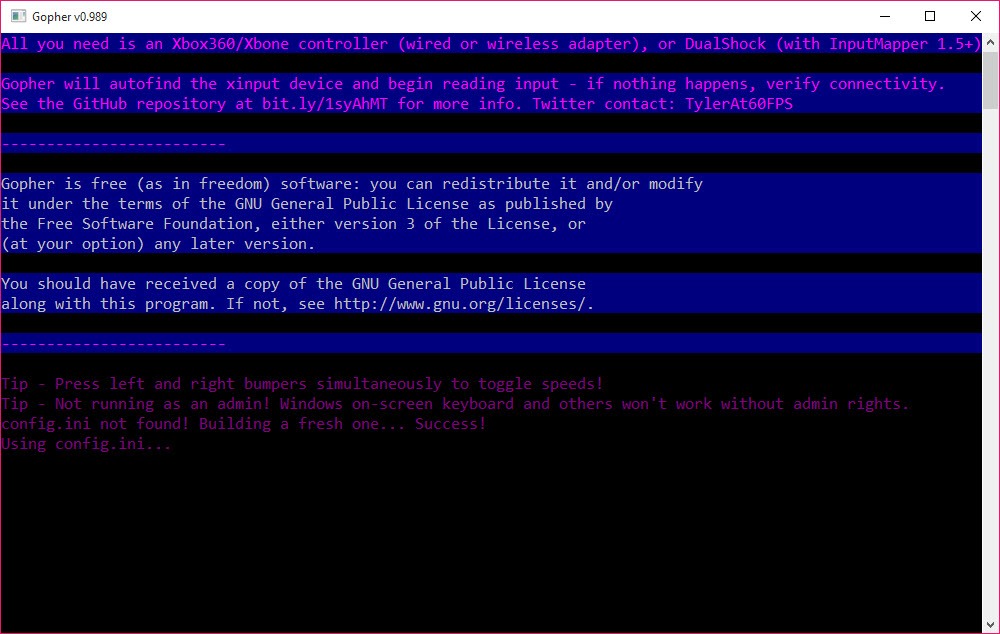
It’s a bare-bones utility and proud of it. When you launch it, what appears is a plain console window rather than a polished interface, and configuration happens in a text file rather than a settings screen. Some people will find that charmingly direct.
Others will find it crude. Both reactions are fair, and knowing which camp you’re in tells you most of what you need to know before downloading.
What the controls actually feel like
The defaults are sensible enough that most people never change them. The left stick glides the cursor around, the A button acts as a left click, X handles right click, and the right stick scrolls pages, which quickly feels natural for browsing. The D-pad stands in for arrow keys, handy for stepping through menus and lists, and there’s a button reserved for hiding the console window so it stops cluttering your view.
The detail that makes daily use pleasant is the cursor speed toggle. Click the left stick and Gopher360 cycles between speed levels, from a slow crawl for precise clicking up to a quick sweep for crossing a large screen, with a rumble pulse confirming each change so you don’t have to look at anything.
Fine pointer work with an analog stick is never going to match a real mouse, but the ability to drop to a slower speed for a fiddly checkbox takes most of the pain out of it.
The toggle that makes it livable
Here’s the problem every tool like this has to solve. If the pad is always acting as a mouse, it fights you the moment you launch an actual game, since every stick movement now does two things at once.
Gopher360 answers with a button chord that switches it off and on. Press the combination and the tool goes dormant, letting the controller behave normally in your game. Press it again when you’re back on the desktop and mouse duty resumes, with vibration confirming the switch either way.
It sounds trivial. It’s the feature that decides whether you keep the tool running all evening or close it in frustration after an hour. Because toggling takes a second and requires no window, no mouse, and no getting up, the workflow of desktop, game, desktop, game just flows. That’s the living-room use case handled in the simplest way that works.
Configuration by text file
Everything is remappable, but not through an interface. Gopher360 reads its settings from a plain configuration file where you assign functions to buttons, adjust the cursor speeds, and tune the stick dead zones.
Open it in any text editor, change a line, restart the tool, done. If a worn stick drifts and drags your cursor toward a corner, raising the dead zone value fixes it in about thirty seconds once you know where to look.
This is the point where the tool picks its audience. There’s no discovery, no tooltips, no undo. You either enjoy this kind of direct tinkering or you want a proper interface doing it for you. If it’s the latter, Keysticks covers the same controller-as-mouse ground with a friendlier face, and JoyToKey or Xpadder give you visual per-game profile management this tool never attempts.
Where it fits and where it doesn’t
The sweet spot is narrow and real. A home-theater PC where the pad is the only input device within reach. A quick session on the sofa where dragging out a wireless keyboard feels like overkill. A machine hooked to a projector across the room. In those moments, a tool that adds mouse control in two seconds with zero footprint beats every feature-rich alternative, because features aren’t the problem, distance is.
Outside that spot, its minimalism cuts the other way. It expects an Xbox-style pad, so controllers that don’t speak that standard need converting before this tool will see them. Development has gone quiet, so what exists today is the finished shape of it.
And anyone wanting macros, game-specific layouts, or combo bindings has simply picked the wrong tool, since a heavyweight like reWASD exists precisely for that depth. This one trades all of it for being small and instant.
Conclusion
Gopher360 is a specialist, and a refreshingly honest one. It exists for the person on a couch with a gamepad and a desktop across the room, and for that person it solves the whole problem in a file small enough to forget about. The toggle chord, the speed cycling, and the instant startup show that the essentials were thought through, even if the console window and text-file settings announce loudly that polish was never the goal.
If you want visual configuration, game profiles, or support beyond Xbox-style pads, the bigger mapping tools earn their extra weight. But if the entire wish is “let my controller be a mouse, right now, for free,” it’s hard to argue with the smallest tool that does exactly that.
Pros & Cons
- Single tiny executable that works seconds after downloading, no installation
- Sensible default layout with cursor, clicks, scrolling, and arrow keys covered
- Cursor speed cycling with rumble feedback makes precise pointing manageable
- Quick on/off chord lets games use the controller normally without closing anything
- Fully remappable buttons, speeds, and dead zones through a simple text file
- Configuration requires editing a text file, with no visual settings screen
- Runs as a bare console window rather than a polished interface
- Only works with Xbox-style pads, leaving other controllers out unless converted
- No profiles, macros, or per-game layouts for anyone needing depth
Frequently asked questions
Press the toggle chord on the controller and the tool goes dormant, letting the pad behave normally in your game. Press it again on the desktop and mouse control returns. A vibration pulse confirms the switch in both directions. 2 Can I change which buttons do what in Gopher360? Yes, everything is remappable, but through a text configuration file rather than a settings window. You edit the file, assign functions to buttons, adjust speeds and dead zones, then restart the tool for changes to apply.
Usually, yes. Drift almost always comes from a worn analog stick resting slightly off center, and raising the dead zone value in the configuration file tells the tool to ignore that small offset.
It's built for Xbox-style controllers and pads that present themselves the same way. Controllers using older or different standards won't be recognized until something converts them to that format first.
For browsing, media control, and general navigation it's comfortable, especially using the slower cursor speeds for small targets. For pixel-precise work like photo editing, no stick-based pointer replaces an actual mouse, and this tool doesn't pretend otherwise.


