

FlyVPN

About FlyVPN
FlyVPN is a VPN client whose server map leans east. While the big household names pile their capacity into North America and Western Europe, this service concentrates hundreds of servers in Seoul alone, backs them with clusters across Japan, Vietnam, Thailand, India, and Hong Kong, and still keeps several hundred machines in the United States.
For anyone whose online life points toward Asia (regional game servers, local streaming catalogs, family video calls that need a nearby exit point), that geography is the entire pitch.
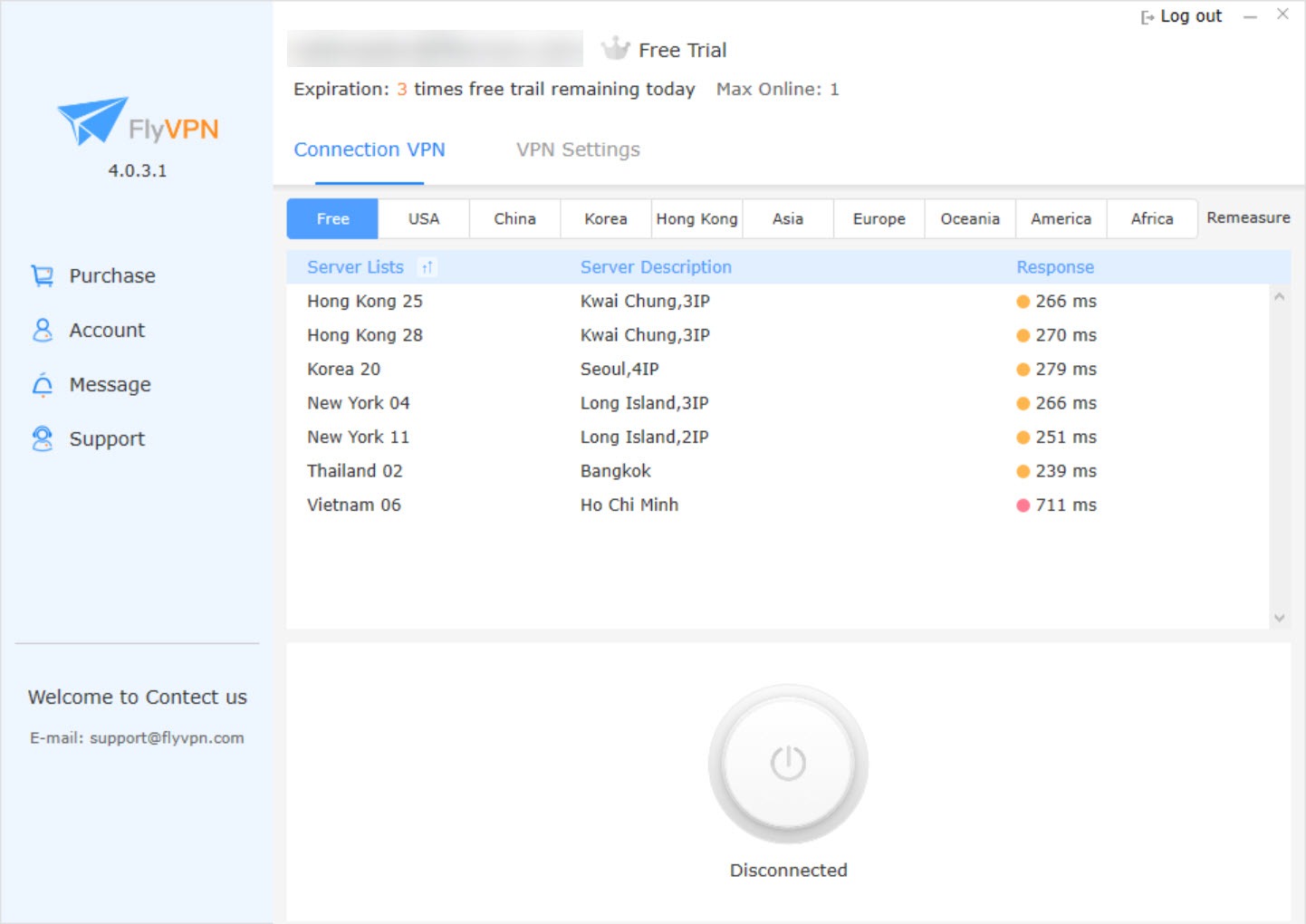
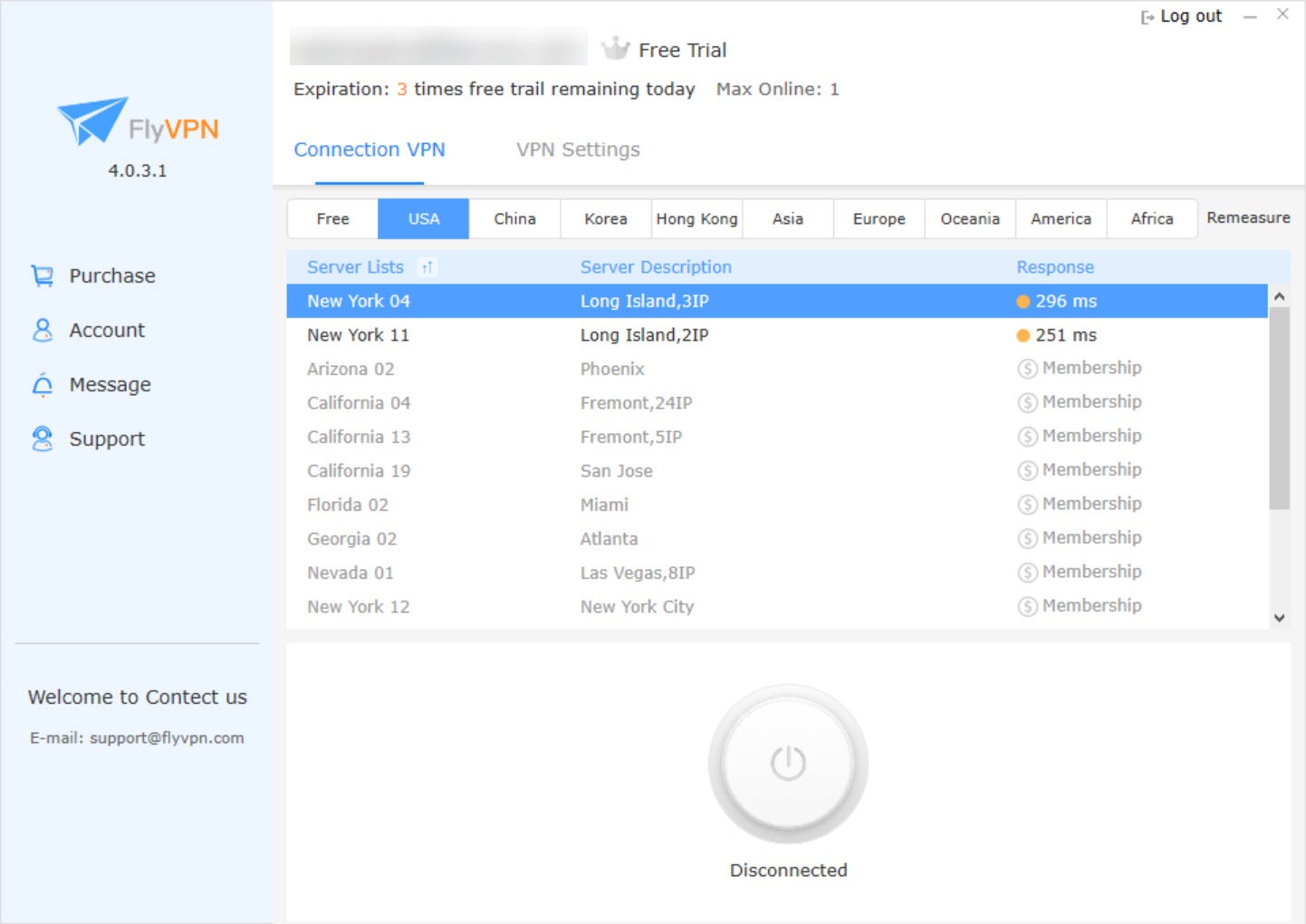
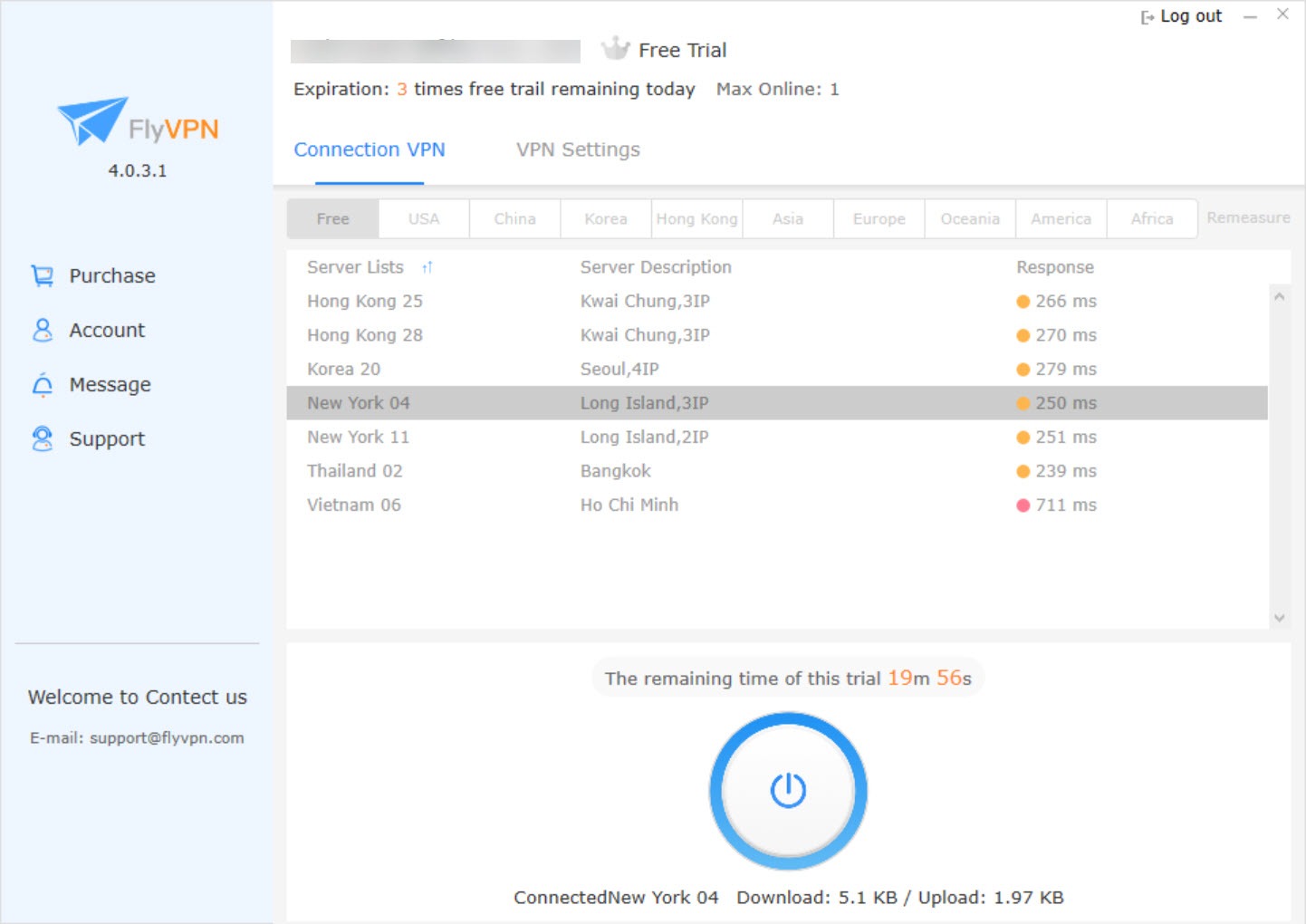
Connecting is a picture of simplicity. Pick a country from the list, watch the latency indicator next to each server, click, and you’re tunneled within a second or two. Tabs separate the full list, favorites, and recently used servers, so daily use quickly settles into two clicks.
Against a giant like NordVPN, FlyVPN loses on nearly every spec-sheet line except one, and that one line, Asian coverage depth, happens to be the line some users care about most.
A server map that leans east
The network spans more than forty countries, but the distribution tells the real story. Seoul hosts over four hundred servers, more than most services deploy on entire continents, and Los Angeles plus Portland account for another five hundred. Between those poles sit locations that mainstream services skip entirely, including multiple Vietnamese and Thai cities.
The practical effect shows up in congestion. A service with three servers in a country funnels everyone through them at peak hours, while this kind of depth spreads the load. Server counts per city are listed openly in the client, and the latency badge beside each entry saves you from connecting blind.
If a Korean server shows 40 ms from your location and another shows 190 ms, you know which one carries your game session before committing.
The proprietary tunnel trade-off
Here’s the part that divides opinions. The settings expose a protocol choice of TCP, UDP, or Socks5, and underneath them FlyVPN runs its own connection method rather than a standard like OpenVPN or WireGuard. The upside is immediacy. There’s no lengthy handshake, and connections establish almost instantly, closer to a proxy switch than a traditional VPN negotiation.
The downside is opacity. With a standard protocol, the security properties are documented and independently tested. With a proprietary tunnel, you take the encryption on trust, and there’s no clean way to compare it against other services. Leak tests by outside reviewers came back clean, IPv6 traffic gets blocked properly, and a kill switch exists under the name network lock. But that kill switch ships disabled, so flip it on in settings before you rely on the tunnel for anything sensitive, because a dropped connection otherwise exposes your real address without warning.
Gaming, the reason most people arrive here
Region-locked game launches, Korean MMO servers that demand a local presence, betas that open in one country first. This is the traffic FlyVPN was seemingly built for, and the Seoul concentration makes sense the moment you try to create or play an account on a Korean game platform. The same logic covers Japanese and Southeast Asian titles.
Manage your expectations in the other direction, though. Routing a fast-paced shooter through a server nine time zones away produces the ping you’d expect, and no VPN geography can beat physics. Reviewers testing long-haul connections measured speeds that rule out competitive play across oceans. If your goal is lowering ping to a server you can already reach, a route optimizer like ExitLag attacks that specific problem far better than any general VPN.
A similar accelerator, NoPing, plays the same specialized game. Use this tool to get into the region, not to win duels across it.
Everyday browsing and streaming, with caveats
Outside gaming, the client behaves like any consumer VPN. Streaming results are mixed and change without notice. Some major platforms open through it, others detect and block the exit addresses, so treat any specific catalog as a coin flip rather than a promise. Speeds on nearby servers hold up for video calls and ordinary browsing, and the latency indicator again earns its place by steering you away from overloaded exits.
A set of no-cost servers sits in its own tab with daily usage limits and a shorter country list. It functions as an extended test drive across real locations, which is more than most rivals allow, though the throttled speeds on those particular servers do not represent what the full network delivers.
A service like hide.me VPN handles the always-on-at-no-cost use case more gracefully if that’s the actual requirement.
Conclusion
FlyVPN earns its place with people who need to appear in Asia. Players of Korean and Japanese games, expats reaching services from home, and anyone whose target region gets token coverage from mainstream VPNs will find server depth here that the big names simply don’t offer.
Users shopping for an all-purpose privacy tool should weigh the proprietary tunnel and the disabled-by-default kill switch against the convenience, and probably look elsewhere. This is a regional specialist. Judge it on the region, and it holds up.
Pros & Cons
- Unmatched server depth in South Korea and broad Southeast Asian coverage
- Near-instant connections with per-server latency shown before you commit
- Simple client that gets you tunneled in two clicks
- Built-in kill switch and clean leak-test results from outside testing
- No-cost server tab allows genuine testing across real locations
- Proprietary tunnel cannot be independently compared with standard protocols
- The kill switch ships disabled and must be enabled manually
- Long-haul speeds are too slow for latency-sensitive competitive gaming
- Streaming access is inconsistent and varies by platform
Frequently asked questions
Korean game platforms and services often require a local connection, and demand for Korean exit points is enormous. The Seoul cluster exists to spread that load so individual servers stay responsive.
No. The feature is called network lock and ships disabled. Turn it on in settings, otherwise a dropped tunnel silently reverts traffic to your real connection.
UDP is the usual choice for speed and gaming, TCP helps on unstable or restrictive networks, and Socks5 suits app-specific proxying. Switching between them takes seconds, so testing all three costs nothing.
Only if the game server sits closer to the VPN exit than to you, which is rare. It gets you into region-locked games, but for pure ping reduction on reachable servers a dedicated route optimizer works better.
Distance adds latency no software can remove, and long routes cross congested links. Pick the nearest server that satisfies your region requirement and use the latency indicator to avoid overloaded exits.


