

FlexiHub



About FlexiHub
Some hardware refuses to travel. A licence dongle lives in an office drawer, a lab instrument is bolted to a bench, a receipt printer belongs to the shop, and yet the person who needs them is somewhere else entirely. FlexiHub exists for exactly that mismatch.
It takes a USB or serial device plugged into one computer and makes it appear on another, over any distance, as if you had just pushed it into your own port.
Think of it as the reverse of TeamViewer. A remote desktop tool sends you to the distant machine. This one brings the distant hardware to you, so your own programs, with their own settings, talk to a device that may be three time zones away.
A remote device that behaves like a local one
The setup is deliberately simple. FlexiHub runs on both computers, each signed into the same account, and every machine sees a list of the devices the others have plugged in. Click connect, and the device materialises on your side, visible to the system and to applications exactly as if it were physically present.
The application identifies what kind of device it is on its own, so the sharing side does not have to prepare anything. And the connection is not limited to USB. Serial COM ports redirect the same way, which matters for the industrial and point-of-sale world where RS-232 refuses to die, and where a terminal client expects a local port to talk to.
No public IP and no router surgery
This is the part that separates FlexiHub from older port-forwarding approaches. When the two computers cannot reach each other directly, because both sit behind home routers or corporate firewalls in different subnets, the traffic goes through a redirection server, and the connection simply works without touching a single router setting.
When a direct path exists, the app uses a point-to-point channel instead, and teams that dislike third-party relays can route everything through a private server of their own in a location they choose. Either way the stream travels encrypted over TLS, so the dongle’s conversation is not readable in transit.
Compare that with the usual alternative of building a virtual network with something like Hamachi first and sharing devices across it. Possible, but it is two systems to maintain instead of one.
Honest about what travels well and what does not
Dongles, card readers, printers, scanners, sensors, controllers and phones in debugging mode are the sweet spot, because they exchange modest amounts of data and tolerate delay. A hardware licence key queried over the internet responds fine, and that single use case justifies the whole product for plenty of outfits whose software is chained to a physical key.
Webcams and audio interfaces are a different animal. They stream constantly and hate latency, so over a LAN they are usable and over the open internet they stutter, whatever any marketing page promises.
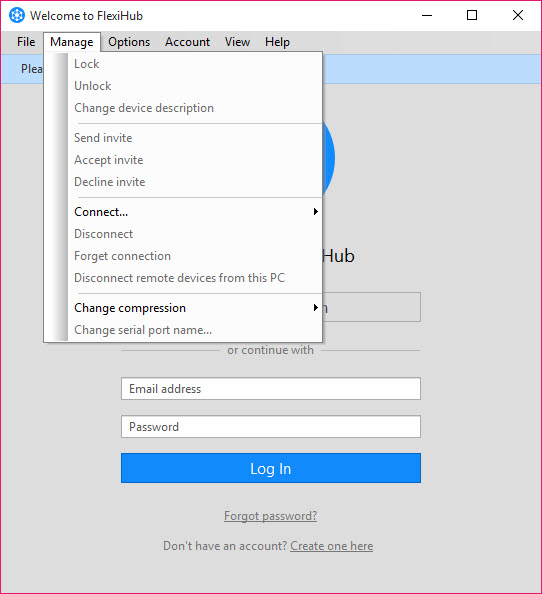
FlexiHub offers traffic compression with a choice between best speed and best packet size, which helps precisely these hungry devices, but it bends physics rather than beating it. Keep expectations modest for anything that streams.
Into virtual machines and remote desktops
Virtual machines are famously awkward about USB, and guests in VirtualBox, VMware or Hyper-V often cannot see what the host can. Run the client inside the guest, and the virtual machine connects to any shared device like one more remote computer, including devices attached to entirely different physical hosts.
The same logic extends to RDP sessions, where a device plugged into your physical machine can be forwarded into the virtual desktop you work in. For anyone who got moved onto a hosted desktop while their hardware stayed under the desk, this one trick is the reason to install it.
Tokens instead of a shared password
Giving a colleague access normally means giving them your password, and FlexiHub avoids that with login tokens. You generate a token, permanent or single-use, hand it over, and the other person connects under your account without ever seeing your credentials. Revoking access means deleting a token, not changing a password everywhere.
Devices can also be locked on the machine they are attached to. A locked device disappears from every remote list entirely, so the office computer can share the dongle while keeping the backup drive invisible, rather than relying on nobody clicking the wrong thing.
Connections that survive a flaky line
A dropped internet connection does not tear the session down. The keep-alive behaviour holds the device attached on the remote side and waits for the line to return, and auto-connect re-establishes chosen devices without you babysitting the window. For an unattended machine serving a dongle in a server room, that is the difference between a tool and a liability.
Capacity is not the bottleneck either, since a single sharing machine can offer up to 127 devices, which is the architectural ceiling of a USB host rather than a marketing number.
Conclusion
FlexiHub earns its place wherever hardware and the people who need it live in different buildings. Teams whose software depends on licence dongles, technicians reaching lab or point-of-sale equipment, and anyone feeding real devices into virtual machines will find it handles an awkward job with very little ceremony.
It is not a magic cable. Latency-sensitive devices expose the limits of any network, and the two-sided setup means it suits standing arrangements better than one-off favours. Within those limits, it is the cleanest answer to a problem most people only discover they have once.
Pros & Cons
- A remote USB or serial device appears and behaves as if plugged in locally
- Works across firewalls and subnets with no public IP or router configuration
- Login tokens grant and revoke access without sharing a password
- Devices can be locked so they never appear on remote machines
- Keep-alive and auto-connect make unattended sharing practical
- Reaches into virtual machines and RDP sessions that cannot see USB otherwise
- Streaming devices like webcams stutter over internet links despite compression
- Both machines must run the application and be signed in, so ad-hoc use needs setup on each end
- Routing through a relay adds latency compared to a direct cable, which chatty devices notice
Frequently asked questions
No. When computers cannot reach each other directly, the connection runs through a redirection server, crossing routers and firewalls without any configuration on them.
Yes, and it is one of the most common uses. Hand them a login token instead of your password, and lock any other devices on that machine so only the dongle is visible remotely.
On a local network, usually yes. Over the internet, expect stutter, because cameras stream constantly and suffer from latency. The compression option softens the problem without eliminating it.
Yes. Run the client inside the guest and it connects to shared devices like any other computer, which solves the USB blindness of VirtualBox, VMware and Hyper-V guests.
Yes, COM port devices redirect alongside USB, so legacy RS-232 instruments and point-of-sale hardware can be reached remotely the same way.


