

DS4Windows
About DS4Windows
DS4Windows makes a PlayStation controller look like an Xbox controller to games that only understand the latter. It reads the DualShock 4 or DualSense over USB or Bluetooth, feeds a virtual Xbox 360 pad through the ViGEmBus driver, and games see the input they expect.
That is the whole reason it exists, and on its own it would be a footnote. The rest of the program is what people stay for. Per-game profiles, the touchpad as a mouse, the gyro as an aiming aid, macros, and a lightbar that reports the battery. You can also skip emulation entirely and map every button straight to keyboard and mouse.
The category has grown around it. Steam has its own controller layer, reWASD remaps anything with a licence attached, and generic mappers cover the rest. DS4Windows remains the reference for PlayStation pads specifically, because it exposes more of what those controllers can do than anything else, and because it does it without asking for money.
How the emulation works and what it needs
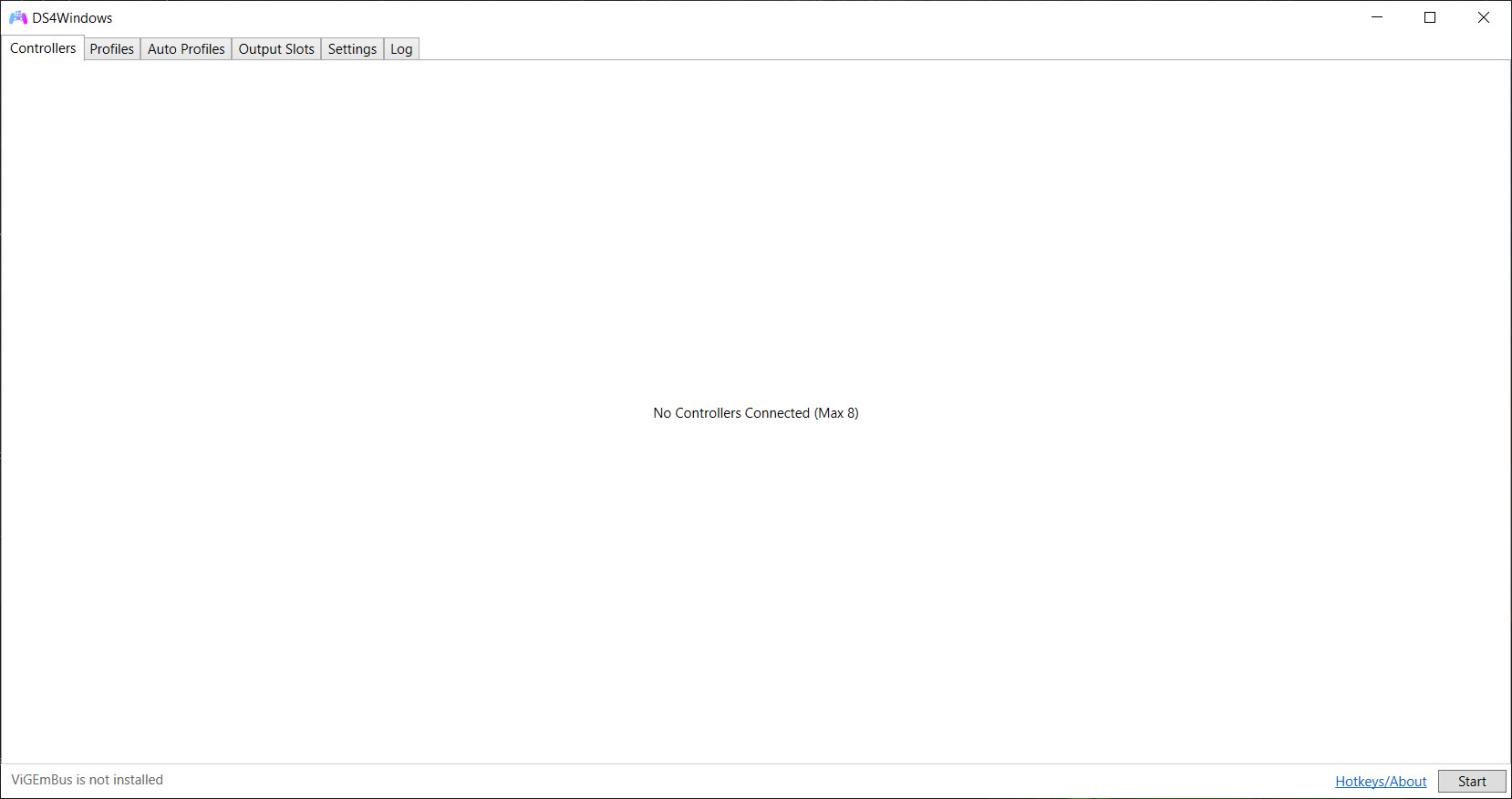
Two drivers do the work. ViGEmBus creates the virtual Xbox 360 or DualShock 4 device that games talk to. HidHide, which is optional, hides the real controller from every program except DS4Windows, so a game does not see both the physical pad and the virtual one at once. The welcome screen offers to install both and you should accept, because most first-day problems trace back to skipping one.
Without ViGEmBus the controller appears in the program and does nothing in games. Without HidHide many games see two controllers and either register every press twice or bind themselves to the wrong one.
The symptom is a character who sprints when you meant to walk, or a menu that flickers. Fix the drivers before touching any other setting.
Profiles that switch themselves
A DS4Windows profile holds every mapping and setting for one controller, and you can have as many as you like. Auto Profiles ties a profile to a program. A racing game gets one with loose stick curves, a shooter gets another with gyro aiming, and the switch happens when the game window comes to the front. A default profile catches everything else.
Mode Shift adds a second layer. Hold a button you choose and every other button takes a different mapping while it is held, which turns fourteen inputs into twenty-eight. Special Actions go further. A combination of presses can launch a program, load a profile, check the battery by flashing the lightbar, disconnect the controller over Bluetooth or run a recorded macro with timing.
A macro can type a phrase or fire a sequence of game commands, and it can loop while the trigger is held.
Sticks, triggers, response curves
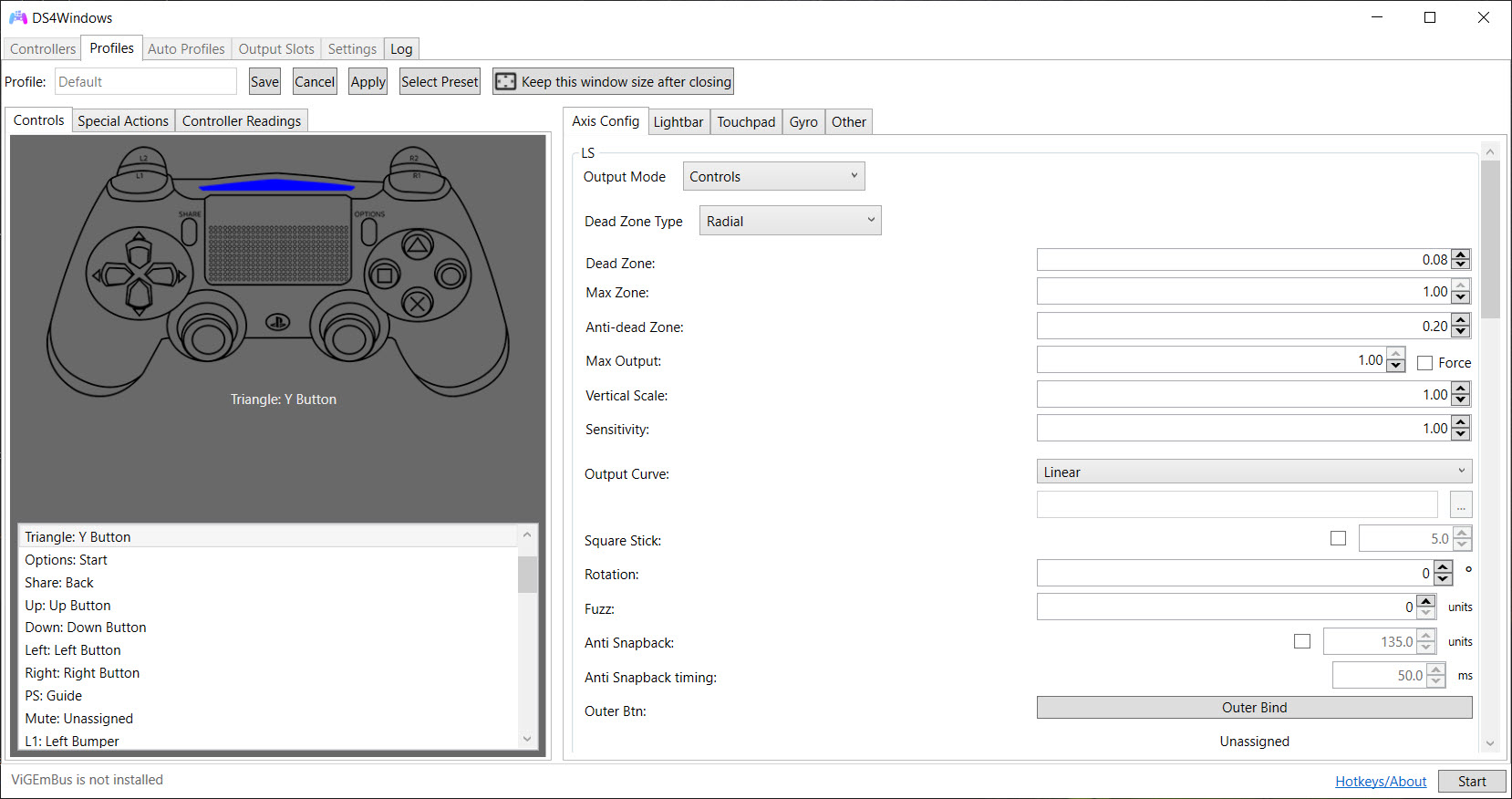
The Axis Config tab exposes what a console never shows you. Dead zones can be set as a percentage or as a shape, anti-dead zones push the first bit of movement out to where a game starts to respond, and maximum zones cap travel. Output curves range from linear through several eased shapes to a custom Bezier.
Anti-snapback stops a stick that returns to centre from overshooting, which matters in fighting games. Flick Stick, the option where a flick of the right stick turns the camera by the flick’s angle and gyro handles fine aim, is here too.
Triggers get the same treatment. A two-stage trigger can fire one mapping at a light press and another when fully pulled, or act as a hair trigger that registers at the first millimetre. On a DualSense the adaptive resistance is not passed through by the standard build, which is the one real capability of the newer controller that this tool leaves on the table.
Touchpad and gyro
In DS4Windows the touchpad can be a mouse. Slide a finger to move the pointer, tap to click, two fingers to right-click or scroll, and press the pad to toggle the mode. On a couch this replaces reaching for a real mouse in launchers and menus. The pad can also be split into left and right buttons, or mapped as a second stick, or turned off so a stray thumb does nothing.
Gyro has three roles. It can drive the mouse, which gives shooters on the desktop the same fine aim console players get from motion controls. It can drive the emulated right stick for games that only take stick input, with a sensitivity and dead zone of its own.
Or it can stay raw and be sent out over a local UDP server, which is how emulators for motion-controlled consoles receive real gyro data. A toggle button decides when gyro is active, and most people set it to the touchpad click or a trigger.
Lightbar, rumble, battery
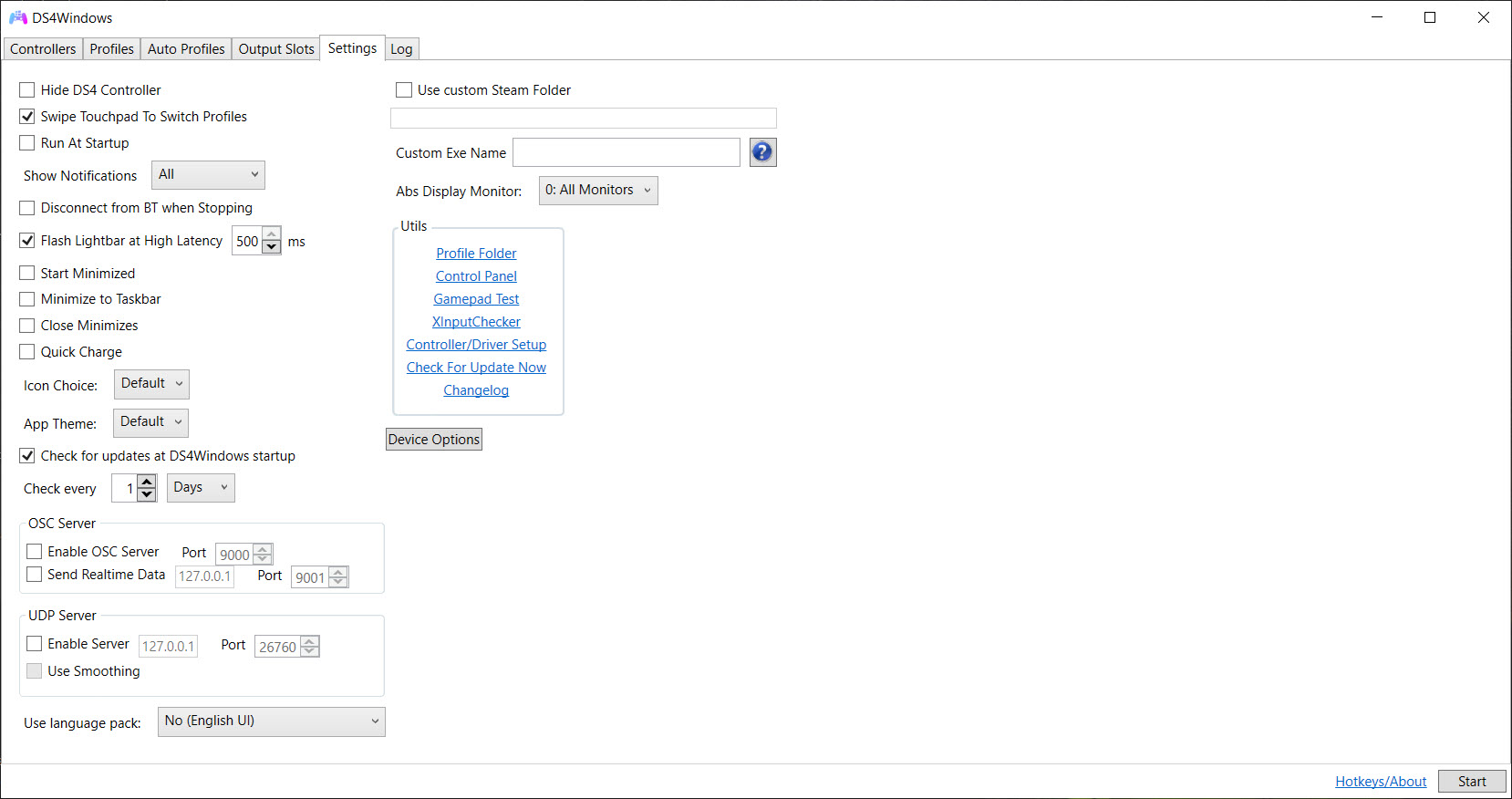
DS4Windows treats the lightbar as a display. It can show a fixed colour per profile, or a colour per controller slot so four players know who is who. It can be a battery gauge that shifts from green to red, or a rainbow cycle for people who like that. A flash at high latency warns that the Bluetooth link is struggling before you feel it. Rumble strength is a percentage per profile, and it can be turned off for controllers with worn motors.
Battery level shows in the main window and in the tray icon, and an idle timer disconnects a Bluetooth controller after a set number of minutes so it does not drain overnight on the sofa. Over USB the controller charges as it plays.
Over Bluetooth, expect around eight hours from a DualShock 4 with the lightbar dimmed.
Where it fights with Steam
Steam runs its own controller layer, and running both at once is the second most common source of confusion after the drivers. Steam sees the emulated Xbox pad, applies its own mapping on top, and the result is inputs that double up or a gyro that fights itself. Pick one. Either disable Steam Input for the game, or leave DS4Windows stopped while Steam handles the controller. The program has a setting to pause itself while a Steam game runs, which is the tidiest arrangement for a mixed library.
A related quirk is that some games look for a real DualShock 4 for their own button glyphs. With emulation active they show Xbox labels.
Switching the output to an emulated DualShock 4 in the profile’s Other tab fixes that, though that profile then loses Xbox compatibility.
Controllers beyond the DualShock 4
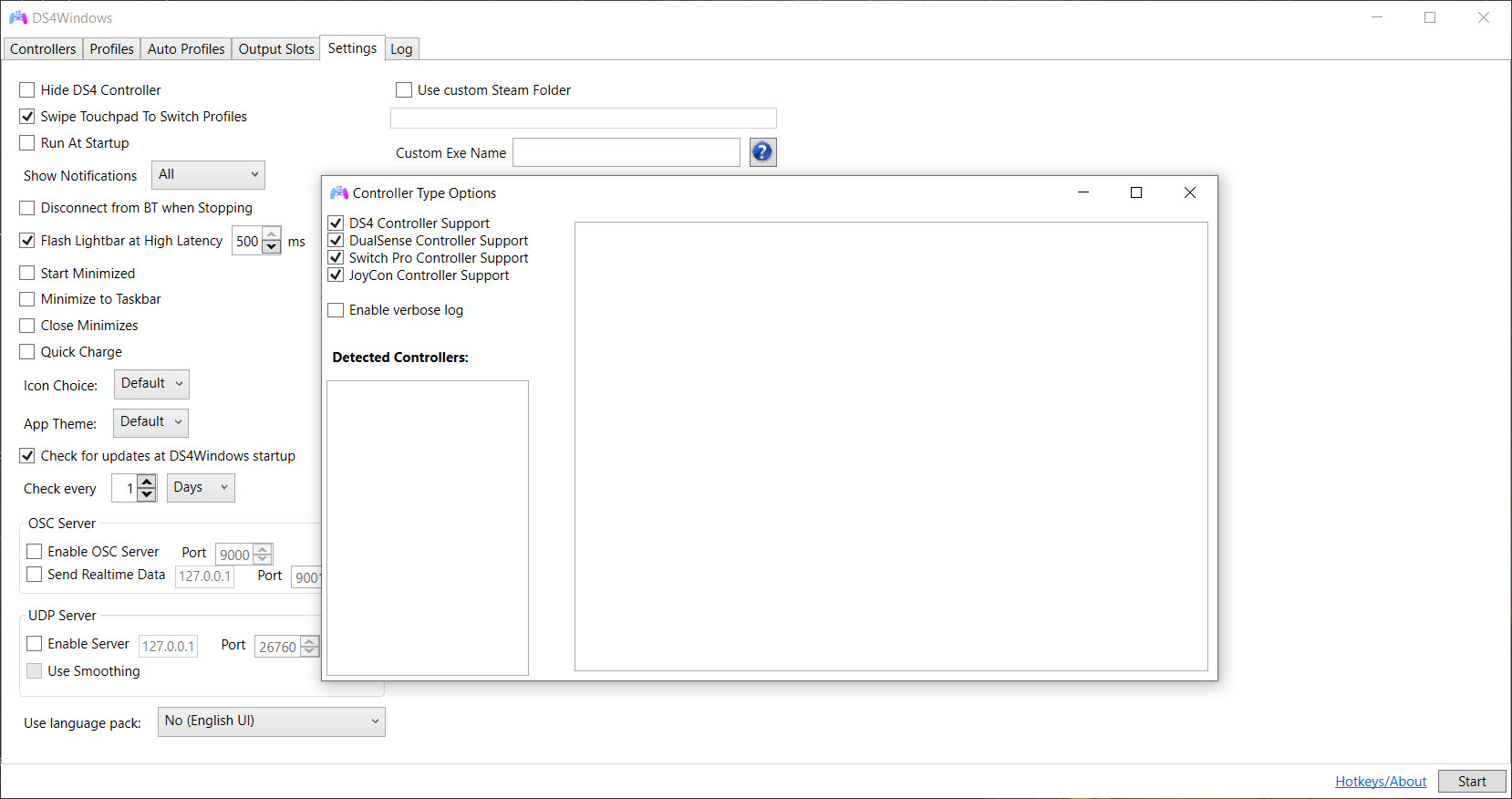
Despite the name, the input side accepts more than the DualShock 4. The DualSense works over USB and Bluetooth with gyro and touchpad, plus lightbar and rumble, though not adaptive triggers. Switch Pro controllers and Joy-Cons are recognised, with a pair of Joy-Cons treated as one pad. A few third-party PlayStation-compatible pads work if they identify themselves correctly, and many do not.
Xbox controllers are pointless here, since they already speak the language the emulation produces, and a mapper built for any gamepad serves them better when keyboard mapping is the goal.
Conclusion
DS4Windows is for anyone with a PlayStation controller and a library of games that expect an Xbox one, which is most of them. Beyond that, it is for the player who wants gyro aiming on the desktop, a couch mouse on the touchpad and a controller that behaves differently in every game without being told each time.
People who only play through Steam can lean on its controller layer and never install this. Everyone else should, and then spend the first hour on drivers rather than settings, because that is where the trouble lives.
Pros & Cons
- Turns a DualShock 4 or DualSense into an Xbox pad every game understands
- Auto Profiles switch settings per game, with Mode Shift doubling every button
- Touchpad as mouse and gyro as mouse, stick or raw UDP output
- Dead zones, anti-snapback, custom curves and two-stage triggers
- Lightbar shows battery level and warns of Bluetooth latency
- Macros and Special Actions triggered by button combinations
- Needs ViGEmBus and usually HidHide, and most early problems are missing drivers
- Conflicts with Steam Input unless one of them is disabled per game
- No adaptive trigger passthrough for the DualSense
- Dense settings that take an evening to learn
- Third-party pads are hit and miss
Frequently asked questions
The ViGEmBus driver is missing or failed to install, so no virtual Xbox controller is being created. Reinstall it from the Settings tab and restart the program.
The game can see both the real controller and the emulated one. Install HidHide and let the program hide the physical pad, or, if Steam is running the game, disable Steam Input for it.
Not in the standard build. The DualSense connects with gyro and touchpad working, plus lightbar and rumble, but trigger resistance is not passed to games.
Open the profile, go to the Touchpad tab and choose Mouse as the output. Sliding a finger moves the pointer and tapping clicks. A press on the pad toggles the mode on and off.
The Bluetooth connection is showing high latency. Move closer to the adapter, remove obstacles or switch to a cable. The flash threshold can be changed or disabled in the profile.


