

DiskGenius
About DiskGenius
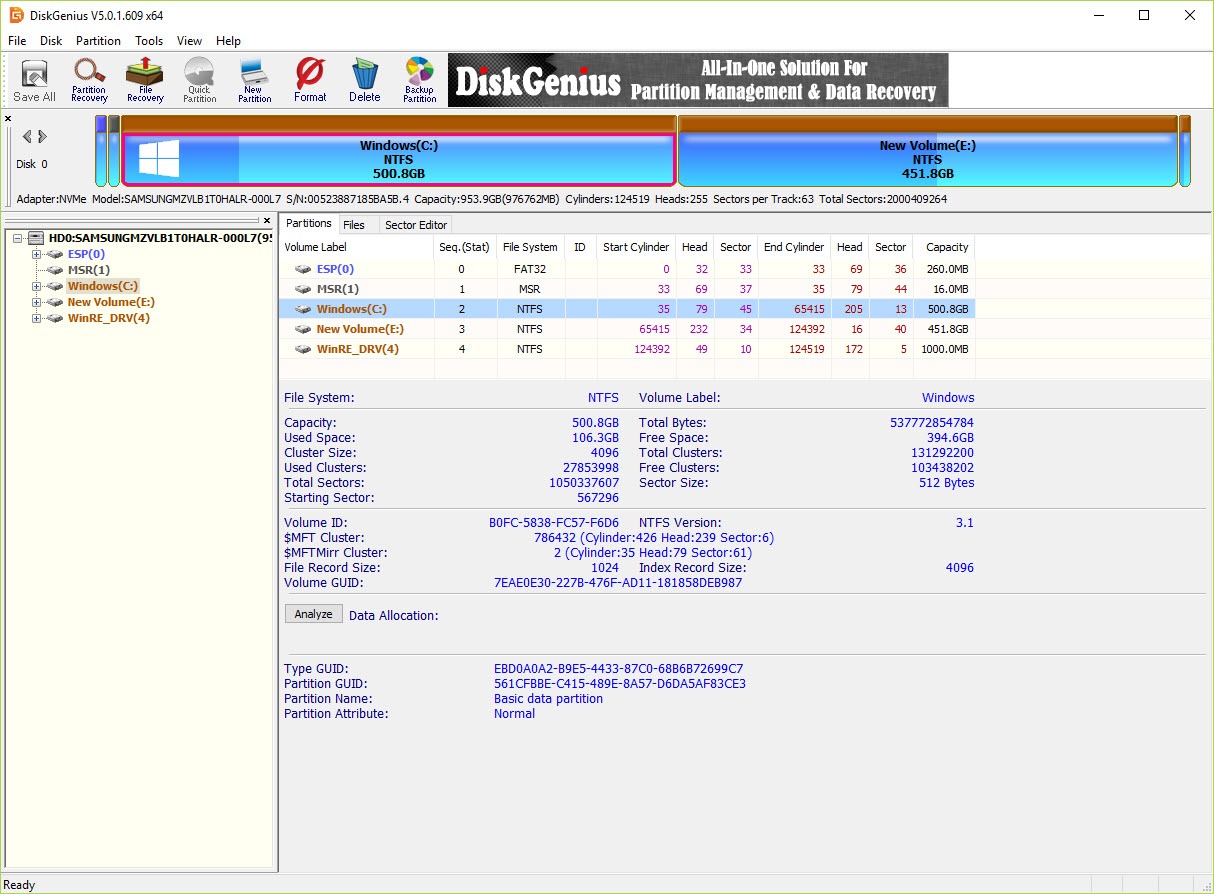
DiskGenius puts a partition editor, a file recovery engine, a disk cloner and a raw sector viewer into one window, and it hides none of them behind wizards. The drive map runs across the top, the file browser sits underneath, and almost every operation lives in a right-click menu attached to whatever partition you highlighted. That density is the personality of the whole application. It expects you to arrive knowing roughly what you want.
Most tools in this category pick a side. Some wrap every action in a five-step assistant that asks you to confirm the same thing three times. Others hand you a terminal and a manual. DiskGenius takes a third route by showing you the disk structure itself, down to individual sectors, then letting you act on it with two clicks.
You can resize a partition, dump its directory tree to an HTML file, scan the unallocated space behind it for deleted data, and clone the whole drive, without ever leaving the same screen.
Resizing and splitting partitions without starting over
Resizing is the operation most people install this for, and it works the way you would hope. Right-click a partition, choose Resize Partition, then either drag the edge of the bar or type an exact figure. What sets it apart is the third dialog, where you decide what happens to the space you just freed. It can sit unallocated, merge into a neighbouring partition, or immediately become a new partition with a file system already written. That saves the usual three-step dance of shrink, then create, then format.
Split Partition does the reverse in one shot, carving an existing volume in two and moving files into the new half rather than deleting them. Extend Partition can pull space from a different partition on the same drive, not only from adjacent unallocated space, which is the limitation that makes the command-line partitioning tool so frustrating for this job.
One honest warning. If the partition you are resizing holds the running system, the application will tell you it has to reboot into its own boot environment to finish. That is the correct behaviour, but it surprises people who expected a progress bar and got a restart instead.
Quick Partition and the MBR to GPT switch
Quick Partition is the feature technicians keep coming back to. Pick the number of partitions, adjust the sizes in a column of boxes, choose the file systems, and the drive is wiped and laid out in seconds, already aligned and already formatted. Setting up a batch of identical machines drops from twenty minutes to two.
Converting a disk between MBR and GPT happens in place, with the partitions left intact. That matters if a machine needs a boot mode change and you would rather not reinstall. DiskGenius also writes the partition table backup to a file before you touch anything, and Check Partition Table Error will find and correct the mismatches that make a drive show the wrong capacity.
What the recovery scan finds, and where it stops
DiskGenius offers two scan modes. The quick pass reads the file system records and returns recently deleted files with their original names and folder paths intact. The deep scan walks the drive sector by sector looking for file signatures, which finds far more but hands you a tree of numbered files with no names left. On a 1TB mechanical drive that second pass is an afternoon, not a coffee break.
Preview is where the application earns trust. Documents and photos render in a panel before you commit, and so do video and audio files, so you learn whether something survived intact before doing anything else. The preview window is small and refuses to open for some formats, which is a real irritation compared with MiniTool Power Data Recovery and its larger viewer.
Recovery of BitLocker-protected partitions works if you have the key or recovery password, and the scan can be pointed at a storage pool rather than a single disk. Those two features alone put it ahead of most single-purpose undelete utilities.
Partition recovery when the table is gone
Losing a partition table is worse than losing individual files, because the drive reports as unallocated and nothing will open it. Search Lost Partitions scans for boot sectors and file system headers, then rebuilds a candidate table from what it finds, showing you each discovered partition so you can confirm it looks right before saving.
The good part is that you do not have to save. After the search, you can browse the found partitions and copy files out while the table is still only a guess in memory, which is the safest possible order of operations. TestDisk covers the same ground, but through a text interface with no preview, so most people will get to a confident answer faster here.
Three ways to clone, and moving a system to a new drive
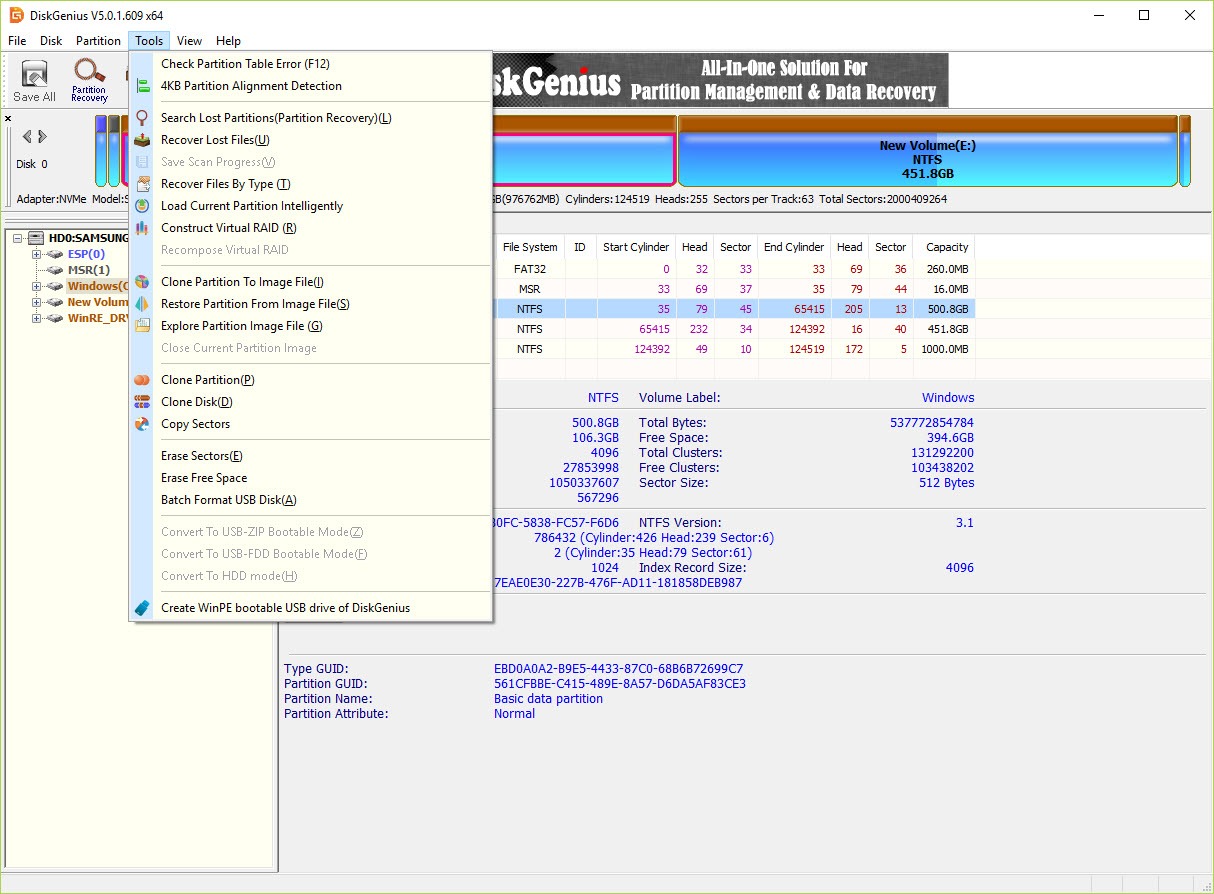
DiskGenius offers three cloning modes and the difference matters. Copy by files moves only used data, so a 2TB drive with 300GB on it clones in the time 300GB takes. Sector by sector copies everything including empty space, which is what you want when the source is failing and you need a raw duplicate. Copy by file system layout sits between the two.
System migration is its own menu entry that moves the boot drive to a new SSD and fixes the boot entries afterwards, and the application can also turn a live installation into a virtual machine disk if you would rather run the old machine in a window.
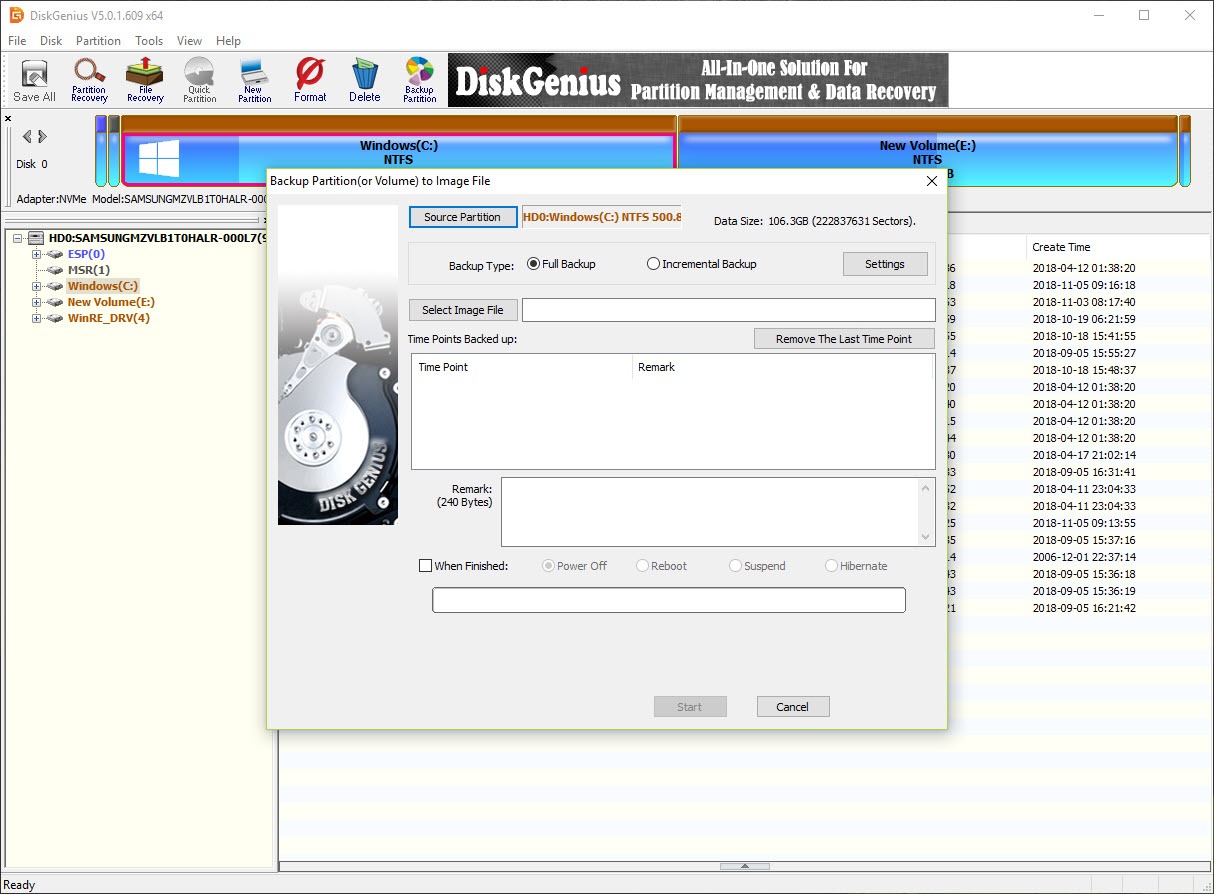
Partition and disk images can be written as files and mounted later to pull out single items, and incremental images are supported, with a cap on how many restore points the unregistered build will keep. For scheduled, unattended imaging, a dedicated backup tool such as EaseUS Todo Backup still does it better, because DiskGenius has no real scheduler.
Health checks and bad sector repair
The S.M.A.R.T. viewer shows the attributes that actually predict failure, including reallocated sector count, pending sectors, power-on hours and temperature, with a plain health verdict at the top. It is not as detailed as a dedicated drive health monitor, but having it in the same window as your partition tools saves a context switch.
Verify Or Repair Bad Sectors runs a surface scan and paints a grid of coloured blocks as it goes. Repair here means rewriting the sector to force the drive to remap it, and anything living in that sector is gone afterwards. The application warns you. People click through the warning anyway, so read it.
Sector editing, virtual disks and RAID reassembly
The hex viewer is the feature that marks this out as a technician’s tool. You can jump to a specific offset, or right-click a file and jump straight to the sectors holding it, which is an unusually direct way to inspect why a file is corrupt. Editing sectors requires a licence, so the unregistered build reads but does not write, and anyone needing a writable editor for ordinary files is better served by a standalone hex editor.
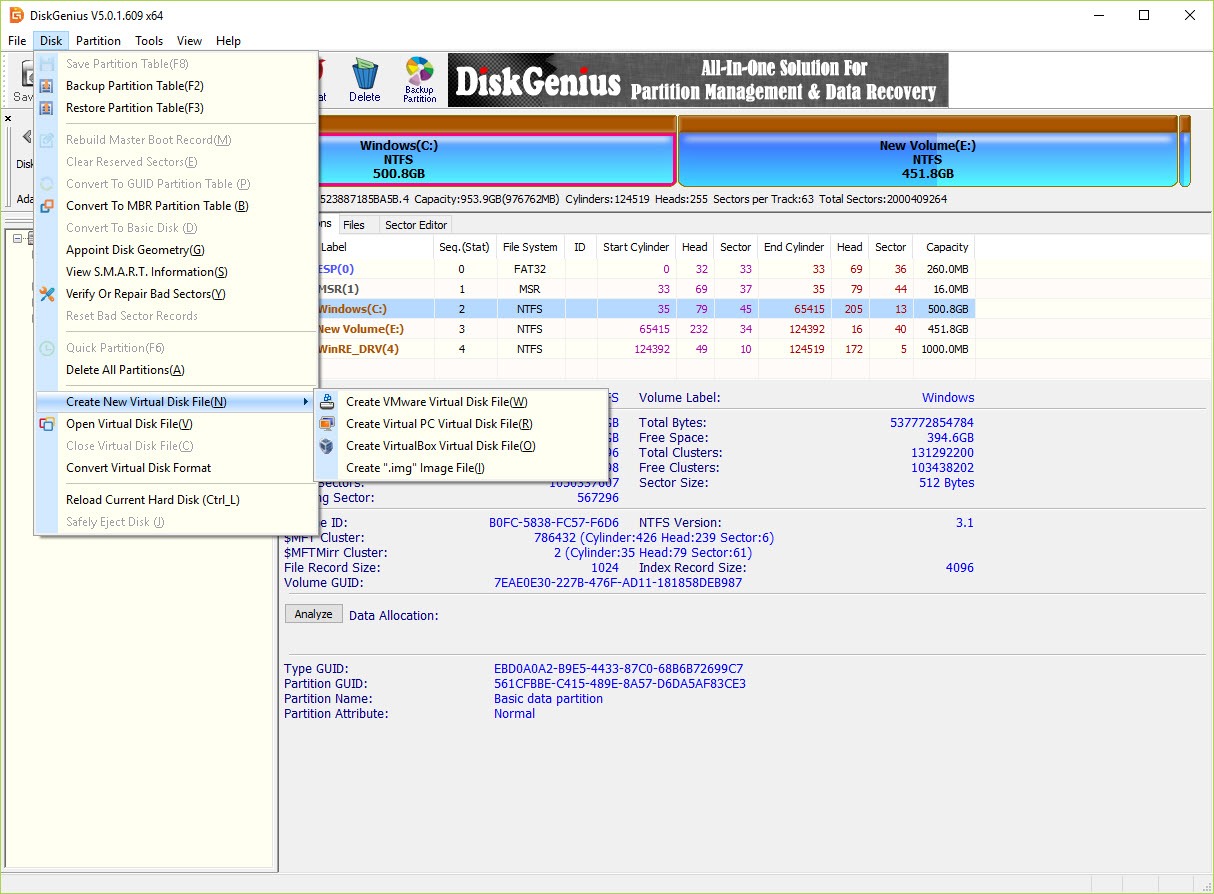
Virtual disk files in VMDK, VHD, VHDX, VDI and IMG form open as though they were physical drives, so you can browse them, resize what sits inside, or point a recovery scan at one. Build Virtual RAID reassembles a striped or mirrored array from its member disks when the controller has died, letting you read the array as a normal volume.
Add UEFI boot entry editing and batch formatting of up to four USB sticks at once, and the toolbox is stranger and deeper than the front screen suggests.
Conclusion
DiskGenius suits the person who already knows what a partition table is and wants one window instead of four programs. Technicians, anyone rebuilding drives regularly, and users facing a drive that has gone unreadable will get more out of it than someone who simply wants to shrink a partition once, because the interface rewards familiarity and punishes guessing.
The recovery limit is the thing to weigh. As a partition manager and cloner, the unregistered build is close to unrestricted, and it is stronger at those jobs than most of its rivals. As a recovery tool it works well enough to prove your files are still sitting there, then stops at the 64KB copy limit until you register it. Knowing which of those two jobs you came for will tell you what to expect.
Features & benefits
Pros & Cons
- Resize and split operations decide the fate of the freed space in the same dialog
- Quick Partition lays out and formats an entire drive in seconds
- Deep scan previews media and documents before you commit to recovery
- Lost partitions can be browsed and copied from before the rebuilt table is written
- Three clone modes, including a true sector-by-sector copy for failing drives
- Hex viewer jumps directly from a file to the sectors that hold it
- Copying recovered files stops at 64KB without a licence
- Preview panel is small and fails to render some formats
- No scheduler for automatic or repeating backups
- Dense menus and terse labels make the first hour slower than it should be
- Deep scans on large mechanical drives take hours with no time estimate
Frequently asked questions
Yes. When the partition holds the running system, the application reboots into its own boot environment, completes the resize there and returns you to the desktop.
Cloning copies a drive or partition as data, while system migration copies the boot drive and then repairs the boot entries so the new disk actually starts. Use migration for an SSD upgrade and cloning for everything else.
Yes, the conversion happens in place and existing partitions survive. Back up the partition table first anyway, since a power failure during the write leaves the disk in a bad state.
It does. Repair rewrites the sector so the drive remaps it, and whatever occupied that sector is unrecoverable afterwards. Copy the files you care about before starting.
Yes. Ext2, Ext3 and Ext4 volumes appear in the file browser and their contents can be copied to a normal drive, along with ReFS and LVM2 volumes.
Often, yes. Build Virtual RAID reassembles the array in software from its member disks, after which you can browse it and copy files as if it were an ordinary volume.


