

DeskPins
About DeskPins
DeskPins keeps a window on top of every other window. Click the tray icon, and the mouse pointer turns into a pin. Click the title bar of the window you want to keep visible, and a small red pin appears beside its buttons. From then on that window stays above everything else, however many other windows you open or bring forward, until you hover over the pin and click the cross to remove it.
A calculator stays over the spreadsheet. A video stays in the corner over the browser. A chat stays above the document while you type the reply. Programs that never offered an always-on-top option now have one, and the ones that did have a common switch.
It is as small a program as the description suggests. DeskPins sits in the tray, uses almost no memory and asks for nothing beyond that first click. Two features lift it above a bare toggle. Autopin rules, with wildcards, pin matching windows automatically the moment they open, so the notepad or the timer you always want on top never needs pinning by hand.
And hotkeys enter pin mode or toggle the active window’s pin without touching the mouse. The sections below cover pinning, the rules, the hotkeys and settings, and the newer kind of window the pins cannot mark.
Pinning and unpinning
One click on the DeskPins tray icon, or a double-click if you set it that way, turns the pointer into a pin. Click the window and it is pinned, with the pin drawn on its title bar in the colour you chose. Any number of windows can be pinned at once, and each one is independent, so a pinned calculator and a pinned video both stay up while the rest of the desktop goes about its business underneath.
Hover over the pin and a small cross appears. Click it and the window goes back to behaving normally. The tray menu removes every pin at once for when the desk is cleared. For a desk that is too small for pins to help, a desktop that scrolls past the screen edges adds room instead of layers.
The pins themselves do not survive a restart of the program, which is where the rules come in.
Autopin rules
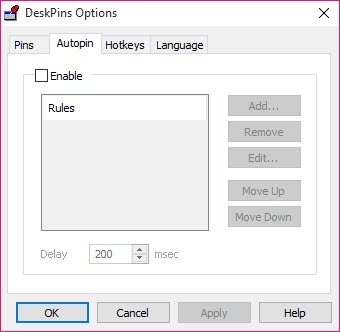
The DeskPins Autopin tab holds rules that pin windows automatically. A rule names a window by its title, its class or both, with wildcards, so “*Notepad” catches every notepad window and a class name catches a program whatever its title says. When a window matching a rule opens, the program waits a moment for it to settle and then pins it. Each rule has a checkbox, so a rule can be switched off without being deleted, and the delay before pinning is adjustable.
That is how a timer, a music player or a reference window is always on top without a thought, and how a machine set up for one job keeps its key window visible across reboots. The help built into the options explains window classes for anyone who has never met them.
For scripting more complex window behaviour than a pin, AutoHotkey can set a window’s always-on-top state as one line among many.
Hotkeys
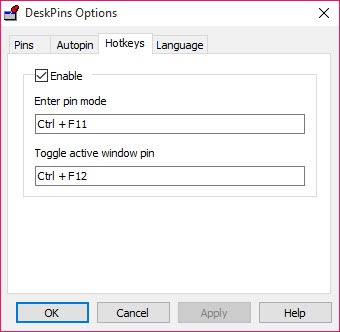
Two DeskPins hotkeys ship by default, one that enters pin mode and one that toggles the pin on the window that has focus. Both can be changed in the Hotkeys tab. The toggle is the one keyboard people use, pressing it with the chat window active to pin it and pressing it again to release it, with the mouse never leaving the document.
Colour and tracking rate
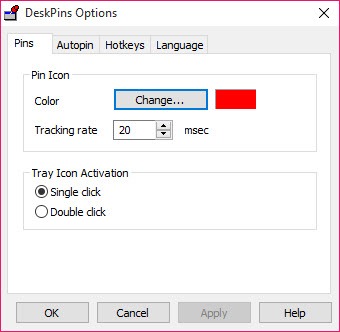
The Pins tab sets the colour of the pin, red by default, and a tracking rate that decides how often each pin checks its window’s position and state. A lower rate makes the pin follow a moving window more closely, and a higher one asks less of the system, though on any current machine the difference is invisible.
Settings keep in the program’s own folder.
The newer windows the pin cannot mark
Some current applications draw their own window frames, which DeskPins cannot mark, rather than using the system’s title bar. On those the pin does its job, and the window stays on top, but the red pin itself has nowhere to sit. A message says the pin could not be placed even though the window has moved to the top layer. A few of the newest application types resist the pinning entirely. The program is old and quiet, and that is what its age brings.
Everything else works as it always did, which is why guides still recommend it alongside the newer tools. For a shortcut-driven alternative that lives in a larger utility collection, the system’s own power user toolkit offers an always-on-top switch, and this program remains the one with rules.
For keeping windows apart in separate workspaces rather than on top of each other, Dexpot is the other approach.
Conclusion
DeskPins suits anyone who wants a calculator, a video, a timer or a chat to stay visible over the work beneath it, without hunting for an always-on-top option that most programs never had. One click pins, one click unpins, and the autopin rules make the arrangement permanent.
It cannot draw its pin on every modern window and it has aged quietly. Set a rule for the window you always want up, learn the toggle hotkey, and the program disappears into the tray until the day you miss it on another machine.
Pros & Cons
- Pins any window on top with one click, in any number
- Autopin rules with wildcards pin matching windows automatically on open
- Hotkeys for pin mode and for toggling the active window's pin
- Adjustable pin colour and tracking rate
- Tiny footprint, sitting in the tray and using almost no memory
- Open source
- Pins do not survive a restart without an autopin rule
- Pin icon cannot be drawn on windows with custom frames, though they still stay on top
- A few of the newest application types resist pinning
- Old and quietly maintained
Frequently asked questions
Click the tray icon so the pointer becomes a pin, then click the window's title bar. Hover over the pin and click the cross to unpin.
Yes. Add an autopin rule matching the window's title or class, with wildcards, and the window is pinned a moment after it appears.
The window draws its own frame, so there is no title bar for the pin to sit on. The window is still on top. A few of the newest application types resist pinning entirely.
Not by itself. Use an autopin rule for any window that should always be on top.


