

Cisco Packet Tracer
About Cisco Packet Tracer
Cisco Packet Tracer is a powerful network simulation and visualization tool designed primarily for students, educators, and networking professionals who want to design, configure, and troubleshoot virtual networks without needing physical hardware.
Developed by Cisco Systems as part of the Cisco Networking Academy program, it has become an essential learning companion for anyone studying for certifications like CCNA or simply trying to understand how networks actually work.
For learners and professionals alike, this tool delivers a remarkably realistic simulation environment that mirrors the behavior of actual Cisco equipment. It allows users to experiment freely, build complex topologies, and develop hands-on skills in a safe, cost-free virtual workspace.
Realistic network simulation environment
The core value of Cisco Packet Tracer lies in its ability to accurately simulate real Cisco devices and protocols.
Routers, switches, firewalls, wireless access points, and end devices behave much like their physical counterparts, executing genuine iOS commands and responding to configuration changes in realistic ways.
This authenticity matters enormously for students preparing for Cisco certifications, since the command-line experience translates directly to working with actual hardware.
Practicing in this environment builds the muscle memory and conceptual understanding that exams and real-world jobs demand, without requiring access to expensive lab equipment that most learners simply cannot afford.
Drag-and-drop network design
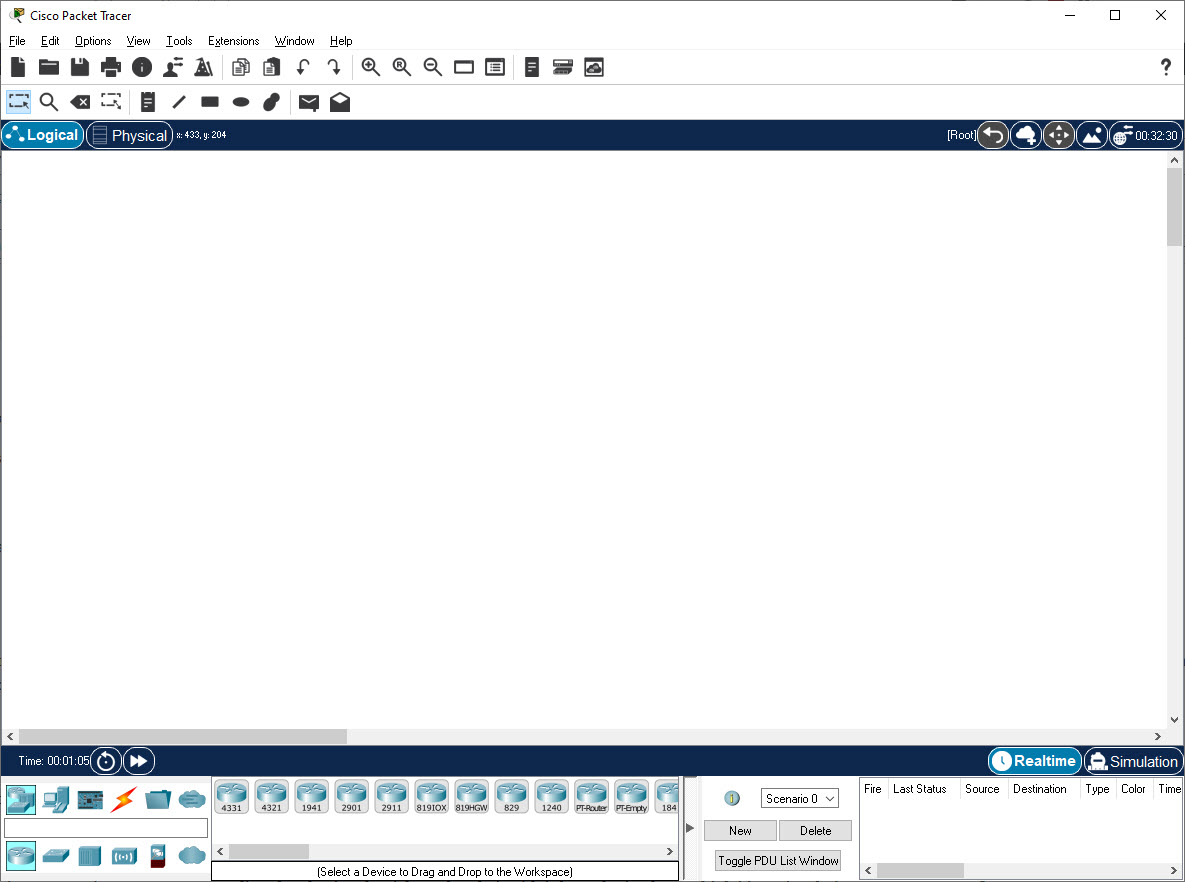
Building a network in this software starts with a clean workspace where you can drag devices from a categorized panel and drop them onto the design canvas.
Routers, switches, hubs, servers, PCs, laptops, and even IoT devices are all available, and connecting them is as simple as choosing the appropriate cable type and clicking on the relevant ports.
The visual approach makes complex topologies easier to understand at a glance, since you can see exactly how each segment connects and where traffic flows.
For beginners, this immediate visual feedback transforms abstract networking concepts into something tangible and explorable, which accelerates learning considerably compared to purely text-based study.
Two simulation modes for deep learning
This tool offers two distinct operating modes that serve different educational purposes. Realtime mode behaves like a live network where packets travel instantly between devices, ideal for testing configurations and verifying that everything works as intended.
Simulation mode, on the other hand, lets you slow down the action and watch individual packets move step by step through the topology.
Simulation mode is particularly valuable when learning protocols, since you can pause traffic, inspect packet headers at each layer of the OSI model, and see exactly how protocols like ARP, DHCP, OSPF, or TCP handshakes actually work in practice.
This visibility into the inner workings of networking is something physical equipment simply cannot provide, making this software uniquely suited to teaching fundamentals.
Comprehensive device and protocol support
The range of supported devices and protocols in Cisco Packet Tracer is impressive for an educational tool.
From basic switches and routers to more advanced security appliances, wireless controllers, and IoT components, the device library covers most scenarios encountered in study materials and certification exams.
Protocol support is equally broad, including routing protocols like RIP, OSPF, EIGRP, and BGP, along with switching technologies such as VLANs, STP, EtherChannel, and trunking.
VPN configurations, ACLs, NAT, DHCP, and various security features round out a feature set that allows learners to practice virtually any networking scenario they are likely to encounter in coursework or professional environments.
IoT and smart home simulation
A relatively recent and welcome addition is the inclusion of IoT devices and home automation simulation.
Users can build networks featuring smart bulbs, thermostats, security cameras, motion sensors, and other connected gadgets, then configure them to interact based on conditions or commands.
This IoT capability reflects the modern reality of networking, where traditional infrastructure increasingly coexists with smart devices that bring their own protocols and security considerations.
For students preparing for current networking roles, getting hands-on experience with these scenarios in a controlled environment is genuinely valuable preparation for what they will encounter in the field.
Multi-user collaboration features
For classroom settings and group study, this software supports multi-user mode where several students can connect their individual instances together over a network.
Each participant works on their own portion of a shared topology, with traffic flowing between participants’ segments as if they were all on one continuous network.
This collaborative capability opens up interesting teaching scenarios, such as having different students manage separate enterprise sites that need to communicate with each other, or simulating realistic team troubleshooting exercises.
The feature requires some setup but pays off significantly in educational settings where teamwork mirrors what students will eventually do in their careers.
Activity wizard for guided learning
Educators and self-learners benefit from the Activity Wizard, which lets instructors create structured exercises with specific objectives, initial configurations, and automatic grading.
Students working through these activities receive immediate feedback on whether their configurations meet the requirements, eliminating the guesswork that often accompanies independent learning.
This grading capability saves educators significant time while giving students confidence that they have actually mastered the concepts being taught.
For self-paced learners working through Cisco Networking Academy materials, the activities provide a structured path through topics that might otherwise feel overwhelming when approached without guidance.
Cross-curriculum integration
Beyond pure networking, this tool extends into adjacent areas like programming and physical computing through its integration with environments like Blockly and JavaScript.
IoT devices can be programmed to respond to network events, sensor inputs, or scheduled triggers, creating rich learning experiences that bridge networking and programming concepts.
This cross-disciplinary approach reflects how modern technology careers actually work, where networking knowledge often intersects with automation, scripting, and integration tasks.
Students who explore these features develop a broader, more practical skill set than networking knowledge alone would provide, preparing them for the realities of contemporary IT roles.
Detailed packet inspection and troubleshooting
When something does not work as expected, the troubleshooting capabilities of Cisco Packet Tracer become invaluable.
You can examine packets at any point in the network, see exactly what fields they contain at each protocol layer, and trace the path they take from source to destination through routers, switches, and firewalls.
This level of visibility makes the tool exceptional for learning how to diagnose network problems systematically.
Rather than guessing at why a configuration is not working, students can observe the actual behavior of packets and protocols, building genuine analytical skills that apply directly to professional troubleshooting work on real networks later in their careers.
Lightweight and accessible
Despite the depth of its capabilities, this software remains relatively lightweight in terms of system requirements.
It runs comfortably on modest hardware, which matters significantly for students using older laptops or sharing computer lab resources where heavy applications might struggle to perform.
The installation is straightforward, and the interface, while detailed, becomes familiar quickly with regular use.
For an educational tool aimed at a global audience that includes learners with varying access to high-end equipment, this thoughtful approach to performance and accessibility makes a meaningful difference in usability.
Conclusion
Cisco Packet Tracer stands out as one of the most valuable free educational tools available for anyone learning networking, offering an authentic, hands-on environment that bridges the gap between theoretical study and practical experience.
Its ability to simulate real Cisco equipment, combined with rich visualization features and structured learning activities, makes it indispensable for students pursuing certifications or building foundational networking skills.
For educators, self-learners, and professionals refreshing their knowledge, Cisco Packet Tracer provides a remarkably capable platform that turns the abstract complexity of networking into something approachable, explorable, and ultimately understandable, all without the cost or logistical challenges of maintaining a physical lab.
Pros & Cons
- Realistic simulation of Cisco devices supports certification preparation effectively
- Two simulation modes offer both quick testing and deep protocol-level learning
- Extensive device library covers routing, switching, security, wireless, and IoT scenarios
- Visual drag-and-drop interface makes complex topologies easy to design and understand
- Activity Wizard enables guided exercises with automatic grading for structured learning
- Multi-user mode supports collaborative classroom and group learning experiences
- IoT and smart home simulation reflects modern networking realities meaningfully
- Free access through Cisco Networking Academy makes it widely available to learners
- Some advanced features and protocols found in real Cisco IOS are not fully implemented
- Performance can degrade noticeably when working with very large or complex topologies
- Account registration with Cisco Networking Academy is required for downloading the software
- Interface, while functional, can feel busy and overwhelming for absolute beginners
- Certain real-world scenarios cannot be fully simulated due to inherent simulation limits
Frequently asked questions
Yes, this tool is one of the most widely used resources for CCNA preparation, since it accurately simulates the Cisco IOS commands and protocols that appear on the exam, allowing students to build practical skills that translate directly to the test environment.
Yes, this tool supports complex topologies including multiple sites, routing protocols, VLANs, security policies, and wireless networks. While extremely large enterprise environments may run into performance limits, most realistic study scenarios work smoothly.
This software simulates a substantial subset of Cisco IOS commands accurately, covering most features needed for educational purposes and certification study. Some highly specialized or recent commands may not be fully implemented, but the core experience closely matches real equipment.
Yes, multi-user mode allows several instances of this tool running on different computers to connect their topologies together. This enables collaborative exercises where each participant manages a portion of a shared network environment.
Simulation mode slows down packet flow and lets you inspect each packet as it traverses the network. You can see exactly what happens at each protocol layer, which is invaluable for understanding how protocols like OSPF, ARP, or TCP actually function in practice.
Yes, IoT devices can be programmed using Blockly visual programming or JavaScript, allowing them to respond to sensor data, network events, or scheduled triggers. This creates rich learning scenarios that combine networking with basic automation concepts.
Yes, this tool has modest system requirements and runs reasonably well on older hardware. Performance may slow when working with very large topologies, but typical study scenarios work fine on most modern computers without issue.
Yes, network topologies are saved as files that can be easily shared with classmates, instructors, or study partners. This makes collaborative learning straightforward and allows educators to distribute starting configurations or completed examples to students.
Yes, this tool includes wireless access points, wireless controllers, and various wireless client devices that simulate Wi-Fi networking scenarios. You can configure SSIDs, security settings, and observe wireless connections behaving similarly to real wireless deployments.


