

CDBurnerXP
About CDBurnerXP
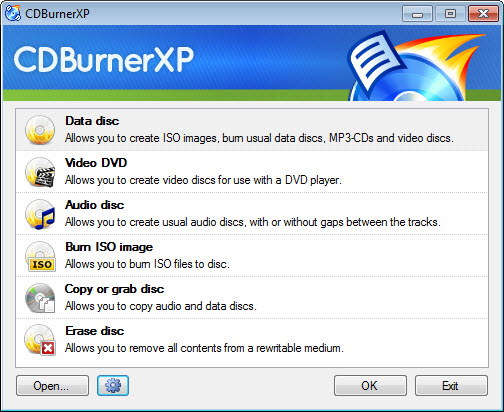
CDBurnerXP is a disc burning program that covers the whole list. Data discs on CD, DVD, Blu-ray and the double-layer variants. Audio CDs from a folder of MP3 or FLAC files. ISO images built or burned, discs copied, rewritables erased and bootable discs made from a boot image.
Each job is a tile on a start screen, and each tile leads to a compilation window where you drag files in and press Burn. It is what most people mean by “a burning program”, and it has been the one they reach for when the built-in disc writing is too thin.
Its two neighbours are ImgBurn, which is the deeper tool for images and troublesome drives, and BurnAware, which covers the same ground with a newer face. CDBurnerXP sits between them, friendlier than the first and no longer being updated, which is the one fact about it that matters more than any feature.
Data discs, sessions, spanning
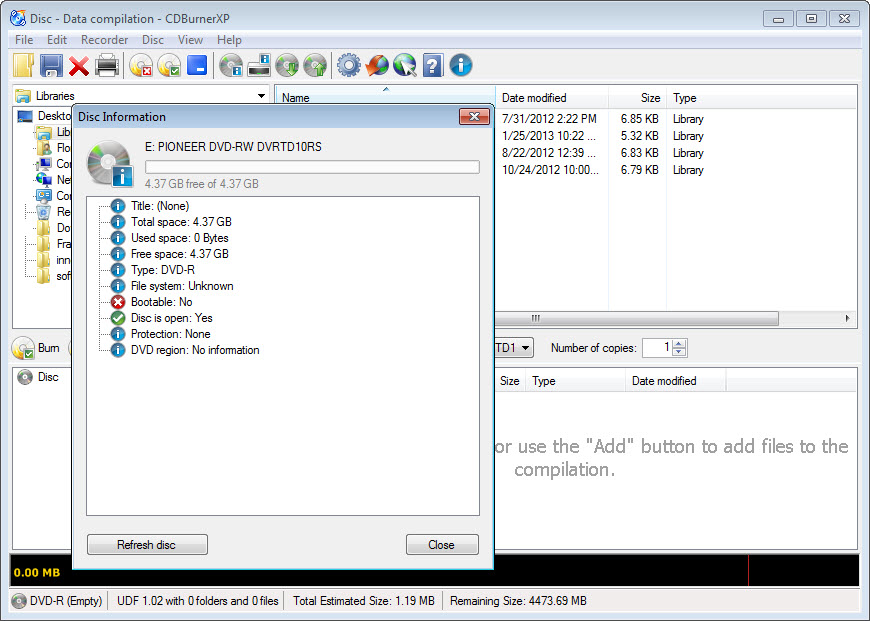
The data compilation window is a two-pane file browser. Drag folders in, watch the capacity bar along the bottom fill towards the disc size you picked, and rename or rearrange without touching the originals. The filesystem can be ISO 9660 with Joliet names, or UDF for large files, and an existing disc’s previous session can be imported so files are added or replaced rather than the disc started over.
Disc spanning is the feature people miss until they need it. Drop 30 GB onto a compilation for single-layer DVDs and CDBurnerXP splits it across as many discs as it takes, prompting for each blank and keeping whole files on one disc where it can.
A verify pass after each burn reads the disc back against the source, and it should be left on, because a disc that verifies is the only disc that can be trusted for an archive.
Audio CDs from almost any file
The CDBurnerXP audio compilation accepts MP3, WAV, OGG, FLAC, WMA, APE, MPC and WV files and decodes them to CD audio as it burns. Tracks can have the standard two-second gap or run gapless for live albums, CD-Text carries artist and title to players that show it, and a mixed-mode option puts a data session on the same disc. Playback of a track from within the window checks the order before committing.
An MP3 disc mode writes the compressed files as data for car stereos that read them, and the reverse job, saving an audio CD to files on disk, is present but plain. It rips to WAV or MP3 without touching an online database for track names.
For a collection that needs tagging as it comes off the disc, a ripper that looks up titles and encodes to several formats is the right pairing.
ISO images, disc copies, bootable discs
Burn ISO Image in CDBurnerXP takes a file and writes it, with speed selection and a finalise option, and the same screen converts BIN and NRG images to ISO first. Copy Disc reads a source disc to an image or straight to a second drive. Create ISO turns a data compilation into an image without a blank in the drive, which is how you test a compilation in a virtual drive before spending a disc.
Bootable discs are built by pointing the data compilation at a boot image file, the small floppy-style image or a no-emulation image that BIOS boot expects. That works for the rescue and installer discs of its era.
It does not build the structures a firmware set to UEFI-only looks for, so a modern installer disc is better burned from a ready-made ISO than assembled here.
Cover printing and the command line
The cover printer, reached from the File menu, lays out a jewel case insert or a DVD cover. The disc title and track list are filled from the compilation, a background image is optional, and a downloaded cover can be printed as it is. On the handful of drives that support it, the same dialog etches a label directly onto a LightScribe disc, in one or more passes for darker results. That feature lives only in the 32-bit build.
A separate CDBurnerXP command-line program, cdbxpcmd, exposes almost everything. List drives, burn a data folder, burn an audio list, burn an ISO, erase, eject, wait for a disc. A nightly backup script that writes yesterday’s files to a rewritable and verifies them is a dozen lines.
The main window opens a saved compilation from the command line as well, so a standing set of folders can be burned with a double-click.
What being unmaintained means in practice
Nothing here has broken, and that is the point of a program that talks to a mature hardware standard. Drives still appear, discs still burn, the verify still verifies. But no drive introduced since the last release has been tested against it, a few newer Blu-ray writers report odd capacities, and the bootable disc builder will never learn UEFI. If a job fails on a specific drive, a burner that is still receiving updates is the next thing to try rather than a setting to fiddle with.
One more practical note. The standard installer has offered sponsored software during setup, with the boxes pre-ticked. Read each screen, or use the portable build, which has none of that and runs from a folder.
Conclusion
CDBurnerXP is for anyone who still burns discs for car stereos, archives, rescue kits and relatives, and wants every kind of disc job under one roof without a manual. The spanning and verify options make it a sound archive tool, and the audio compilation is more capable than most.
People with a brand-new drive, or who need a UEFI-bootable disc assembled from files, should start with a maintained burner. Everyone else will find that a program which stopped changing has simply stopped breaking.
Features & benefits
Pros & Cons
- Data, audio, ISO, copy, erase, bootable jobs from one start screen
- Disc spanning across as many blanks as the data needs
- Audio CDs from eight compressed and lossless formats, with CD-Text and gapless
- Verify after burn on every disc type
- Full command-line control for scripted backups
- No longer updated, so newer drives are untested
- Bootable disc builder is BIOS-only
- Audio CD ripping is basic with no track name lookup
- Standard installer offers sponsored software
Frequently asked questions
Yes. Data compilations and ISO images can be written to BD-R and BD-RE, including double-layer, on drives it recognises. Verify the first disc on a new drive, since recent writers were not tested against it.
The bootable option writes a BIOS-style boot record. A machine set to UEFI-only ignores it. Burn a ready-made bootable ISO instead, or enable legacy boot in the firmware.
Insert the disc, start a data compilation and choose to import the previous session. Add or replace files and burn again. The disc must not have been finalised.
Yes. Copy Disc reads the source to an ISO on the hard drive first, then prompts for a blank in the same drive and writes the image.


