

Carroll
About Carroll
Carroll gives each person who signs into a shared computer their own screen resolution. The system treats resolution as a setting for the whole machine. When one person likes everything large and another wants every pixel, whoever signs in second inherits the first one’s choice and has to change it by hand.
This small program fixes that. Each account picks a resolution once, and from then on signing in switches the screen to that choice automatically, with nothing to click. Sign out and the next account gets theirs.
It is a single-purpose tool and it stays one. Carroll runs for every user at sign-in, shows its window only until a choice has been made, and after that works silently in the background. It suits a family computer with a grandparent who needs large text, a classroom machine shared by students with different sight, and the systems administrator who wants a resolution applied by account from a login script.
The sections below cover the first run, what happens afterwards, where it fits beside the system’s own scaling, and the cases it does not cover.
Choosing a resolution the first time
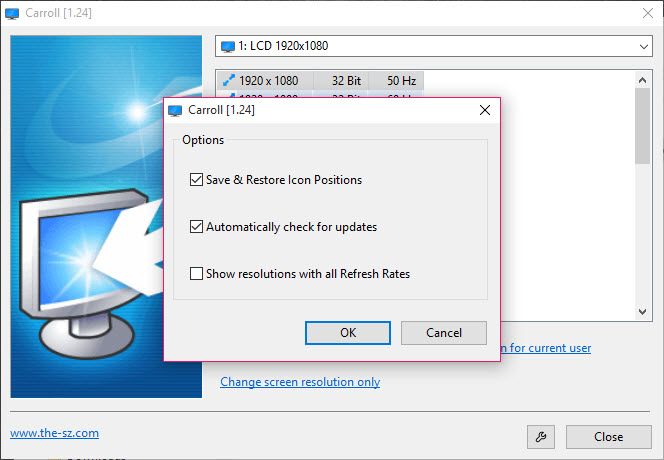
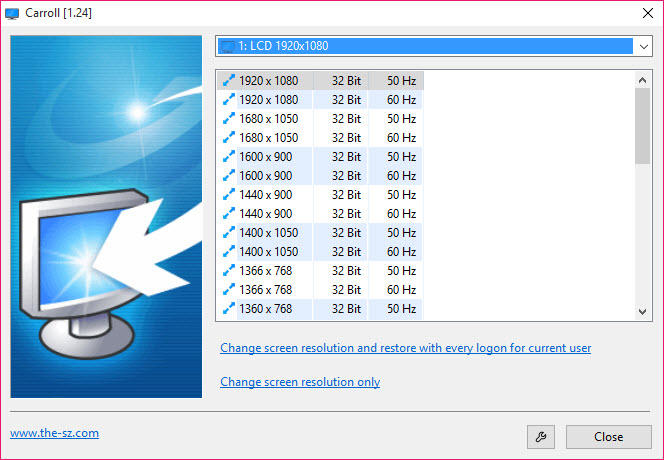
At the first sign-in after installation, Carroll opens a window listing every resolution the graphics card and monitor support, each with its colour depth and refresh rate. Scroll to the one you want and choose between two buttons. One changes the resolution now and restores it at every future sign-in for this account. The other changes it once and remembers nothing.
The first button is the point of the program. Press it, and the choice is saved for the account that is signed in. Another account signing in later sees the same list and makes its own choice.
The window never appears again for an account that has chosen, unless the program is opened on purpose to pick something else.
What happens at every sign-in afterwards
Carroll starts automatically for every user. For an account that has saved a choice, it changes the resolution within a moment of the desktop appearing and then stays out of sight. For an account that has not, it shows the list. Switching between accounts without signing out, through the fast user switching that keeps both sessions alive, applies each account’s resolution as it comes to the front.
Because the system has one resolution setting, the program is changing it each time rather than keeping two in parallel. That has a visible consequence. The screen flickers for a second as the mode changes, and any program left running by the previous account is now drawn at the new resolution.
On a machine where everyone wants the same setting, the program adds nothing.
Resolution versus scaling
Modern displays have one native resolution at which they look sharpest, and the system’s own scaling setting makes text and buttons larger without leaving it. For the person who needs everything bigger on a current monitor, scaling is usually the better answer, since lowering the resolution on a flat panel makes the whole picture softer. The system saves scaling per account already, so for that need the program may not be required at all.
Resolution still matters in the cases scaling cannot touch. Older programs that ignore scaling, games and remote sessions that expect a fixed size, or a machine that also drives a television. And the accessibility need where a lower resolution is simply what the person sees best.
There the program does what nothing built in does. For a monitor’s brightness and contrast set from the keyboard rather than its buttons, Twinkle Tray is the companion for the other side of the display.
Scripts and several screens
Administrators can drive Carroll from a login script, so a resolution is applied by group membership rather than by each person choosing, which is how a lab of identical machines is set up once. Options for exactly this were added at the request of administrators, which the reviews note with some gratitude.
Several monitors are where expectations need care. The program is built around the primary display’s mode, and on a setup with two or three screens the behaviour depends on the graphics driver as much as the program. Test on one machine before rolling it out. For arranging windows and wallpaper across several screens, Dual Monitor Tools handles the multi-display side that this program leaves alone.
Where it stops
Carroll changes resolution and nothing else. Colour depth and refresh rate are chosen along with it, but scaling, orientation and multi-monitor layouts are outside it. The mode change at every sign-in flickers, and on a shared machine where one account picks an unusual resolution the others will see that flicker too. The interface is a plain list with two buttons, which is all the job needs.
For a game that wants a fixed window on any resolution, Borderless Gaming addresses the other common resolution complaint.
Conclusion
Carroll suits shared computers where people with different needs sign into different accounts, from a family machine with a grandparent to a classroom or a lab, and the administrators who set resolution by group. It does one thing automatically and reliably.
It is resolution only, it flickers at sign-in, and on a modern monitor the system’s scaling often does the job better. Try scaling first, use this program where scaling falls short, and test it on one machine before a whole room.
Pros & Cons
- Saves a screen resolution per account and applies it at every sign-in
- Runs automatically for every user and stays out of sight once a choice is made
- Lists every supported resolution with colour depth and refresh rate
- One-time change option for a temporary switch
- Works from login scripts for administrators
- Tiny and still maintained
- Resolution only, with no scaling or orientation
- Screen flickers at each sign-in as the mode changes
- Multi-monitor behaviour depends on the graphics driver
- Unnecessary on a machine where scaling, saved per account already, meets the need
Frequently asked questions
No. Each account saves its own choice, and the program applies that account's resolution when it signs in.
The system has one resolution setting, so the program switches it to your saved choice as the desktop appears, and the mode change shows briefly.
Scaling, where it works, since it keeps the monitor at its sharpest resolution and is already saved per account. The program is for the cases scaling cannot handle.
Yes. Administrators drive it from a login script, so the resolution is applied by group membership rather than chosen by each person.


