

Betternet
About Betternet
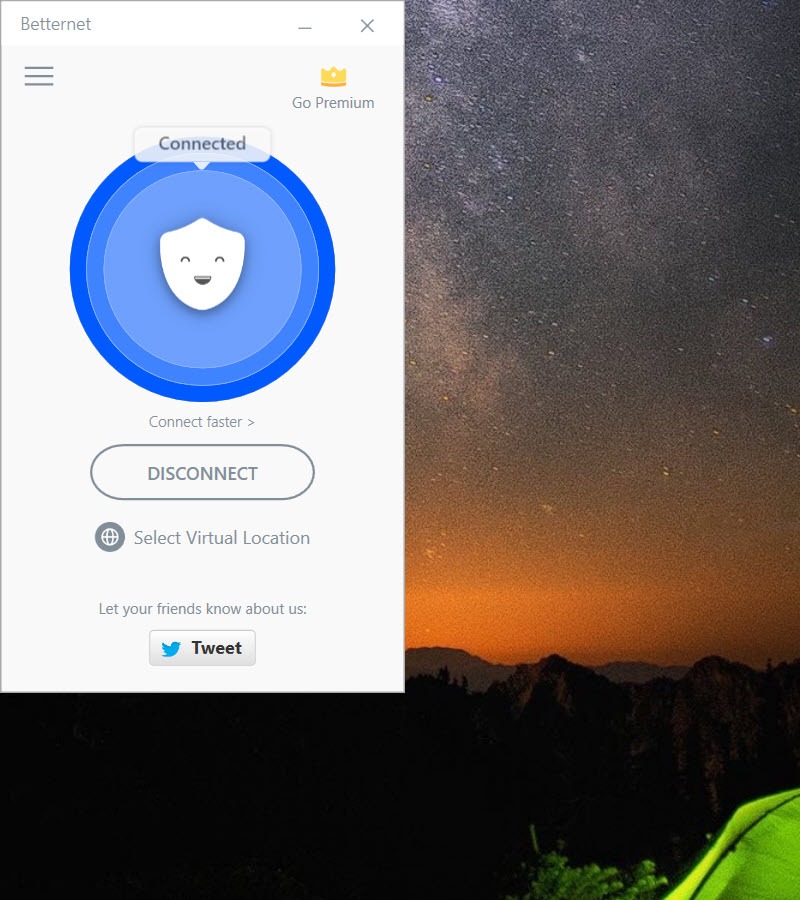
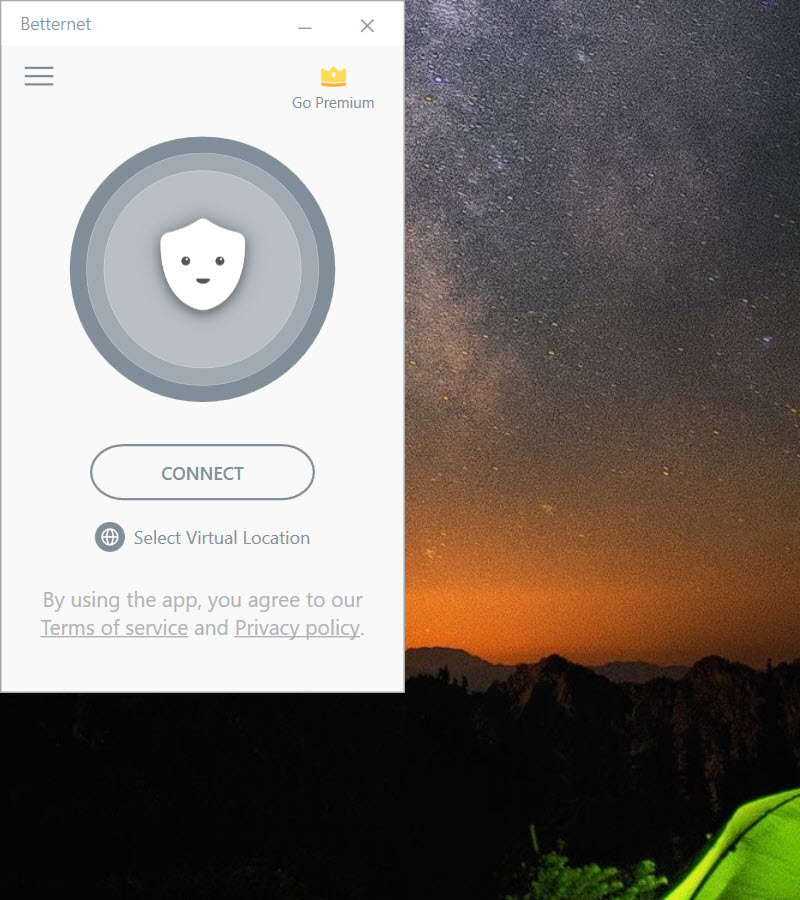
Most tunnelling services present a list of settings, a protocol chooser and a map. Betternet presents a button. Press it, wait a moment, and your traffic is routed through somebody else’s server with a different apparent location attached.
That simplicity is deliberate and it is the entire product. There is no protocol to select, no server list to study and almost nothing to configure, which suits somebody who wants a connection changed rather than an arrangement designed.
The question worth asking before pressing that button is not how well it works. It is how a service that costs you nothing pays for the bandwidth you are about to use.
Somebody is paying for the servers
Routing traffic is expensive. Servers cost money, bandwidth costs money at scale, and a service carrying millions of people’s traffic has a substantial bill arriving every month.
When the person using the service is not paying it, the money comes from somewhere else. Here that somewhere is advertising, shown in the application and around the experience, alongside a paid tier for people who would rather not see it.
That is worth understanding rather than glossing over, because it defines the relationship. A subscription service answers to subscribers, and an advertising-funded service answers to advertisers, and those are different sets of incentives applied to a product that handles all your traffic.
The alternative arrangement is a service funded only by the people using it, and one built around charging for the service and knowing nothing else about you is the clearest example of what that looks like.
One button, and nothing behind it
The interface is a single control and a location indicator, which is the whole point rather than an omission. Somebody who wants a connection routed elsewhere presses it and stops thinking.
That design has a consequence when something fails. With no protocol setting, no server detail and no diagnostic information, a connection that will not establish gives you nothing to work with beyond trying again later.
Betternet covers all traffic from the machine rather than only a browser, so downloads and background applications go through it too, which is more than a browser extension offers.
What the unpaid tier actually gives you
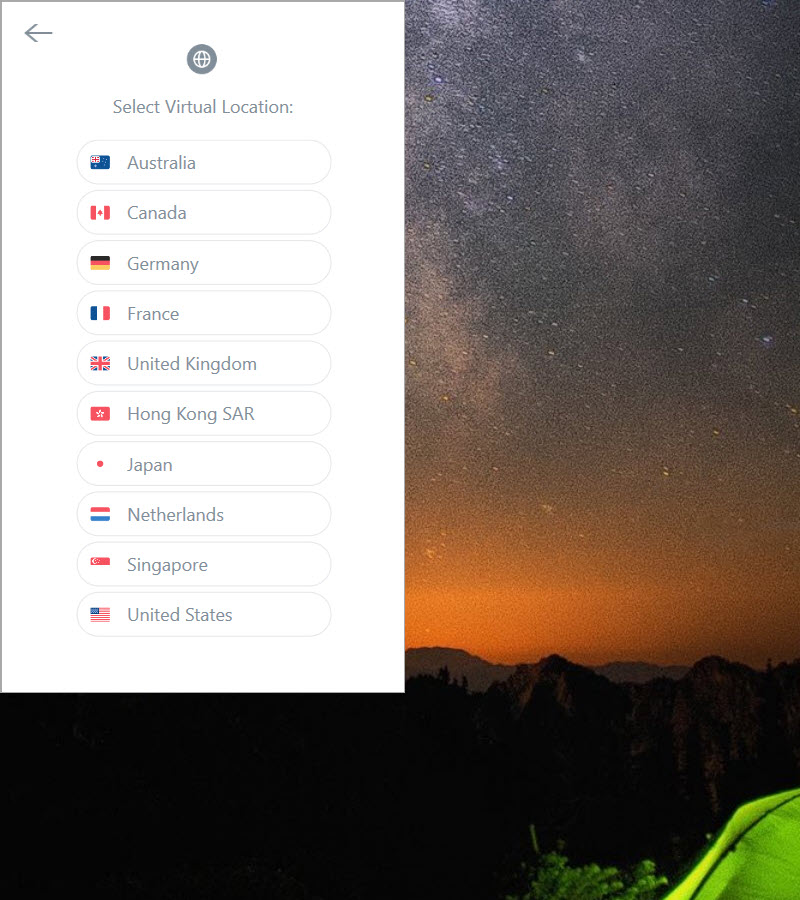
Betternet gives you a data allowance rather than unlimited use, a small set of locations rather than a full list, and no control over how the connection is made.
For occasional use that is workable. Checking something on a hotel network, reaching a page while travelling, or covering a short session on a public connection all fit inside what it offers.
For daily use it does not stretch. The allowance runs out, the location choice is too narrow to be useful for reaching anything specific, and the absence of protocol selection means no recourse when a network blocks the connection.
Among unpaid tiers, Windscribe is considerably more generous with both allowance and locations, which makes it the more sensible starting point for anybody who only needs one occasionally.
What is missing compared with its peers
Several things other services treat as standard are absent or limited in Betternet, and they are the things that matter when a connection misbehaves.
A kill switch, blocking traffic entirely when the tunnel drops rather than letting it silently revert, is the most important of them. Split tunnelling, excluding chosen applications, is the next. Protocol selection, which is what gets a connection through a restrictive network, is the third.
The logging claim is the other gap. Every service in this category says it keeps no logs, and the ones worth believing have had an independent firm examine the infrastructure and confirm it. ProtonVPN publishes such audits, and an unaudited claim is a statement rather than a finding.
Hotspot Shield occupies very similar territory with a comparable unpaid tier, and anybody choosing between the two is choosing between two versions of the same arrangement.
Where an unpaid service fits
Betternet has a real use and it is narrower than the marketing suggests.
On a public wireless network, where the alternative is the network operator seeing everything in plain view, routing through almost anything is an improvement. The operator loses visibility, and for reading news on a café connection that is the whole requirement.
Where it does not fit is anything you would mind a third party seeing. Betternet moves your traffic from your connection provider to a service funded by advertising, and whether that is an improvement depends entirely on which of the two you would rather have watching. For casual browsing the answer is often fine. For anything sensitive it deserves more thought than a single button suggests.
And the standard point applies as it does to every service here. A tunnel changes who observes your traffic rather than removing observation, and nothing in this category delivers anonymity whatever the description says.
Conclusion
Betternet is the simplest possible version of this category, and simplicity is a real virtue for somebody who wants a connection routed elsewhere without learning anything. On a café network for casual browsing it does the job and asks nothing of you.
Weigh the arrangement before relying on it further. An unpaid tunnel is funded by advertising rather than by you, it lacks the kill switch and protocol controls that matter when things go wrong, and the logging claim has no independent examination behind it. For occasional convenience that is an acceptable trade. For anything where the answer actually matters, a service funded by its users is a different proposition and worth the difference.
Pros & Cons
- One button, with nothing to configure and nothing to understand first
- Covers all traffic from the machine rather than only a browser
- An unpaid tier sufficient for occasional use on a public network
- Simple enough for somebody with no interest in how any of it works
- A paid tier removes the allowance and the advertising
- Funded by advertising, which shapes the incentives behind a product handling your traffic
- No kill switch, so a dropped tunnel reverts silently to an unprotected connection
- No split tunnelling and no protocol selection when a network blocks the connection
- The logging claim has not been independently audited
- Location choice is too narrow to be useful for reaching a particular country
- The unpaid allowance runs out quickly under daily use
Frequently asked questions
Through advertising shown in the application, alongside a paid tier that removes it. Routing traffic is expensive, so an unpaid service recovers that somewhere, and knowing where is part of deciding whether to use it.
The amount of data you may pass, the locations available and any control over how the connection is made. That suits occasional use on a public network and does not stretch to daily use.
Not in the way services built around privacy provide one. That matters because a tunnel dropping without a kill switch means traffic reverting to the ordinary connection silently, with no indication that protection has gone.
For casual browsing, yes. The network operator loses visibility of what you are doing, which is the main risk on an unfamiliar connection. For anything you would mind a third party seeing, the funding arrangement deserves consideration first.
No. It changes which party can observe your traffic rather than removing observation, which is true of every service in this category regardless of how it is described.


